Life & fun · alternatives · 2026
24 alternatives to 90k Computer Vision Datasets and 7k Pre-Trained Models
Roboflow Universe is a collection of over 90,000 computer vision datasets and 7,000 pre-trained models available for developers and researchers. The platform provides ready-made resources for building and training… Below are 24 products that do a similar job, ranked by how close each is in meaning and then by launch-day votes. 90k Computer Vision Datasets and 7k Pre-Trained Models launched in 2022; newer entries below may have overtaken it.
- 1

Pre-trained computer vision models and public datasets
2021 · universe.roboflow.com · its alternatives →
- 2

Eliminating your boilerplate computer vision code
2020 · roboflow.com · its alternatives →
- 3
 100,000 Faces▲845
Free resource of 100k diverse faces generated by AI
2019 · generated.photos · its alternatives →
- 4

Annotate images with ease. Export to any format.
2021 · roboflow.com · its alternatives →
- 5

A Blender addon for generating synthetic ground truth data for Computer Vision applications - GitHub - Cartucho/vision_blender: A Blender addon for generating synthetic ground truth data for Computer Vision applications
2020 · github.com · its alternatives →
- 6

Keras code and weights files for popular deep learning models. - fchollet/deep-learning-models
2016 · github.com · its alternatives →
- 7

- 8

Open Prompts is the dataset used to build krea.ai. The data comes from the Stability AI Discord and includes around 10M images from 2M prompts. You can use it for creating semantic search engines of prompts, training LLMs, fine-tuning image-to-text models like BLIP, or extracting insights from the data—like the most common combinations of modifiers.
2022 · github.com · its alternatives →
- 9
 Zoo▲234
A free, open-source playground for AI image models
2023 · zoo.replicate.dev · its alternatives →
- 10

25k diverse & customizable free stock photos generated by AI
2019 · rosebud.ai · its alternatives →
- 11

- 12
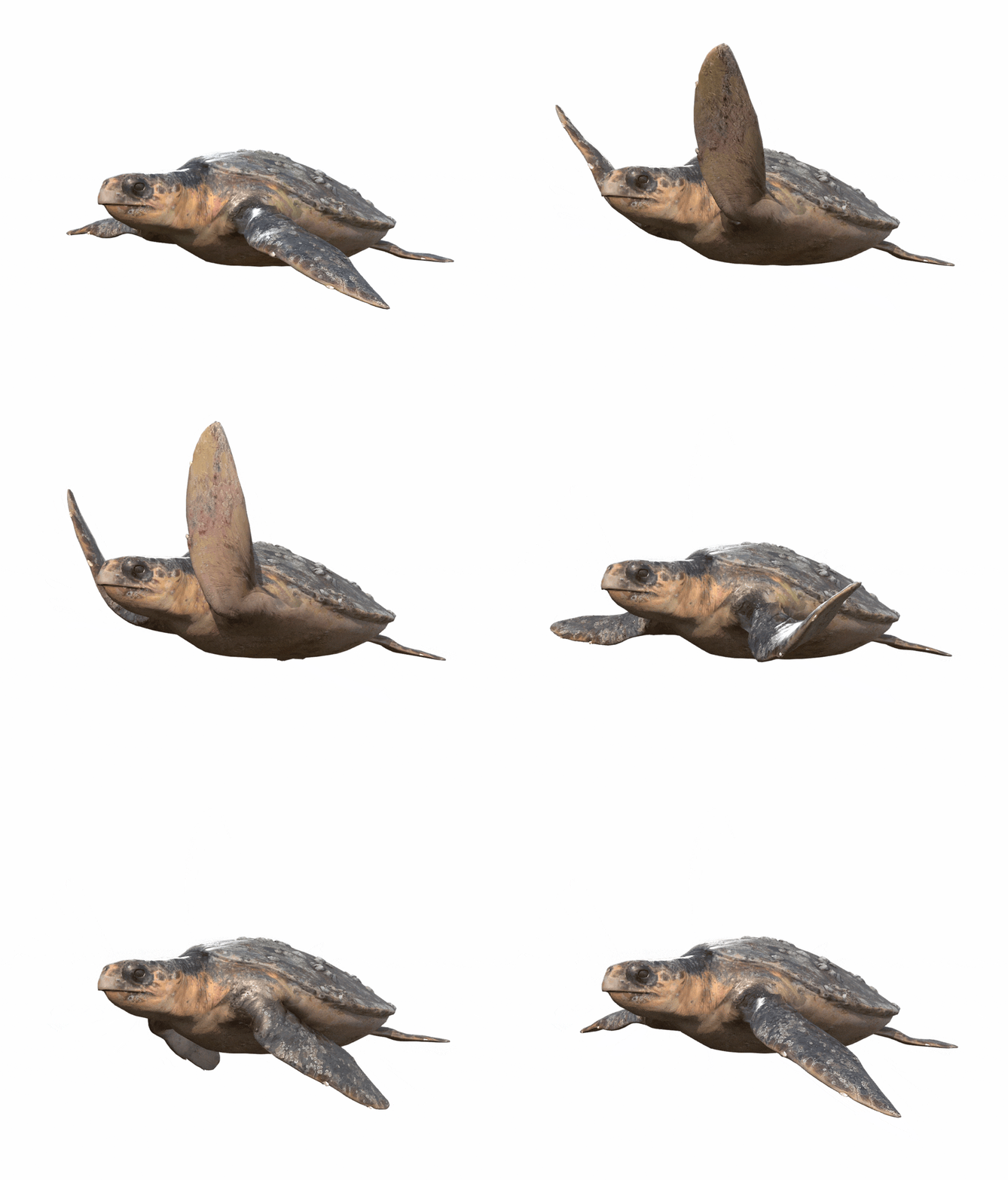 Objaverse▲106
800K+ annotated 3D objects for AIs to play with
2023 · objaverse.allenai.org · its alternatives →
- 13

- 14

The complete MLOps platform for computer vision. Build, deploy, and monitor vision AI applications at scale with Picsellia.
2020 · picsellia.com · its alternatives →
- 15

Transform 2D images into immersive 3D models with AI
2025 · its alternatives →
- 16

Deploying vision models is time consuming and tedious. Setting up dependencies. Fixing conflicts. Configuring TRT acceleration. Flashing (and re-flashing) NVIDIA Jetsons. A streamlined, developer-friendly solution for inference is needed. We, the Roboflow team, have been hard at work open sourcing Inference, an open source vision deployment solution. Our solution is designed with developers in mind, offering a HTTP-based interface. Run models on your hardware without having to write architecture-specific inference code. Here's a demo showing how to go from a model to GPU inference on a video…
2023 · github.com · its alternatives →
- 17

Reduce bias in AI systems with synthetic face datasets
2020 · generated.photos · its alternatives →
- 18

:robot: Introducing kids to coding with tiny virtual robots! - robotopia-x/robotopia
2017 · github.com · its alternatives →
- 19

Hello HN! I want to share something me and a few friends have been working on for a while now — Zeroshot, a web tool that builds image classifiers using text-image models and autolabeling. What does this mean in practice? You can put together an image classifier in about 30 seconds that’s faster and more accurate than CLIP, but that you can deploy yourself however you’d like. It’s open source, commercially licensed, and doesn’t require you to pay anyone per API call. Here's a 2 minute video that shows it off: https://www.youtube.com/watch?v=S4R1gtmM-Lo How/why does it…
2023 · usezeroshot.com · its alternatives →
- 20

Advancing the state-of-the-art in object recognition with a new way to benchmark computer vision models across domains and task targets.
2022 · rf100.org · its alternatives →
- 21

Visions is a python library for working with user defined data type systems. Out of the box, it provides type inference and automated data cleaning of sequence data with backend specific implementations for pandas, spark, python, and numpy. We often use it as a first pass cleaning step when working with tabular data and to simplify the backend logic of both pandas-profiling[1] and our tabular data compression library compressio[2]. Because data types are user defined, we can build user customizable libraries based around types without adding code complexity. In the case of compressio that…
2022 · github.com · its alternatives →
- 22

- 23

Smart Building Blocks for Young Creators
2019 · kickstarter.com · its alternatives →
- 24

Also compare
Ranked by how close each launch is in meaning, then by votes. Prices were read from each product’s own site when checked and can change. Refine with your own description →