Dev tools · alternatives · 2026
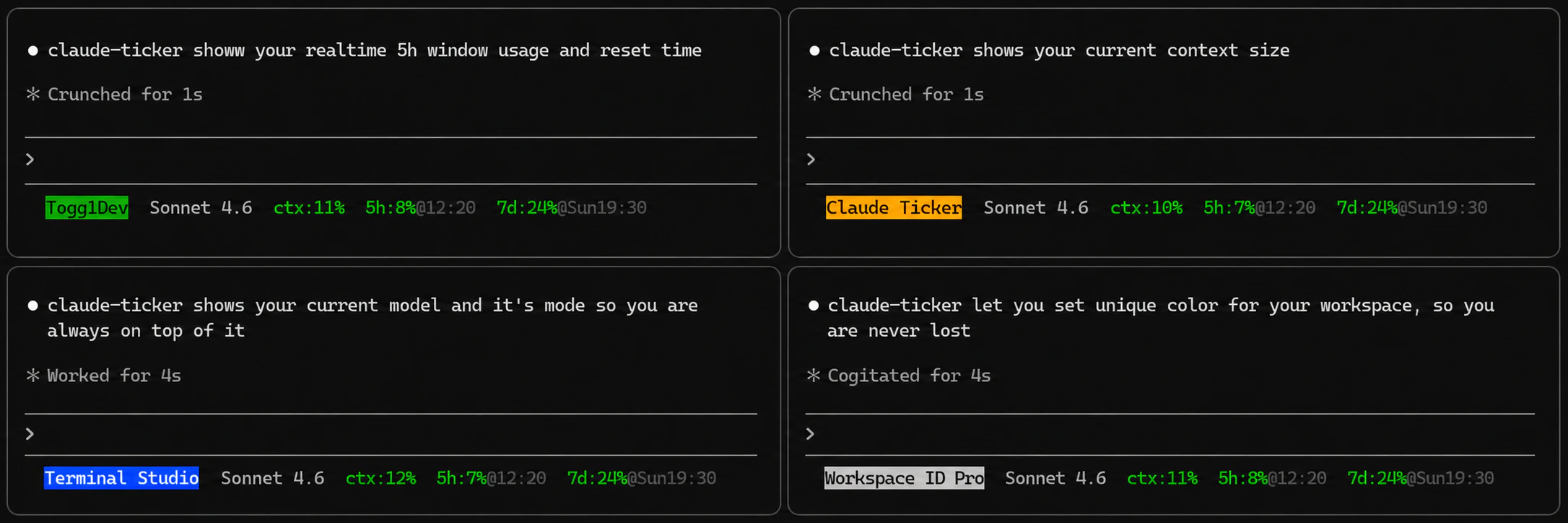
24 alternatives to claude-ticker for Claude Code CLI
Status bar for Claude Code workspace, token, limits and more
Below are 24 products that do a similar job, ranked by how close each is in meaning and then by launch-day votes. Prices are shown for the 3 we have checked on their own sites, 3 of them free or with a free tier.
- 1

See exactly how much you spend on Claude, across every tool
Mar 2026 · github.com · its alternatives →
- 2

Store, review, and share your Claude Code sessions
Mar 2026 · bench.silverstream.ai · its alternatives →
- 3
 ClaudeUsageBar▲398
Hey all! Like many of you, I've been using Claude daily and kept having a hidden fear: when my limit will be reached? How much I have consumed in this session? Im ending up going back and forth to settings > usage to check Literally every 5mns So I built ClaudeUsageBar, a minimal menu bar app that shows your Claude usage percentage at a glance. What it does: Shows your current session (5-hour) and weekly usage directly in the menu bar Notifies you at 25%, 50%, 75%, and 90% thresholds so you can pace yourself Displays exactly when your limits reset Works with both Free and Pro plans Privacy…
Jan 2026 · claudeusagebar.com · its alternatives →
- 4

I kept slamming into Claude Code limits mid-session and couldn’t find a quick way to see how close I was getting, so I hacked together a tiny local tracker. Streams your prompt + completion usage in real time Predicts whether you’ll hit the cap before the session ends Runs 100 % locally (no auth, no server) Presets for Pro, Max × 5, Max × 20 — tweak a JSON if your plan’s different GitHub: https://github.com/Maciek-roboblog/Claude-Code-Usage-Monitor It’s already spared me a few “why did my run just stop?” moments, but it’s still rough around the edges. Feedback, bug…
2025 · github.com · its alternatives →
- 5

Let Claude use your computer from the CLI
Mar 2026 · code.claude.com · its alternatives →
- 6

A Claude Code status line showing how big your session has got and what the next turn costs before you type - Field-Logic-Ltd/ClaudeStatsBar
Sep 2026 · github.com · its alternatives →
- 7

See where Claude Code burns tokens. Hit your limits less.
May 2026 · latitude.so · its alternatives →
- 8

See what your Claude Code sessions actually cost
Jul 2026 · langwatch.ai · its alternatives →
- 9
 claude-devtools▲144
See everything Claude Code hides from your terminal
Feb 2026 · claude-dev.tools · its alternatives →
- 10

Hello everyone. Claudraband wraps a Claude Code TUI in a controlled terminal to enable extended workflows. It uses tmux for visible controlled sessions or xterm.js for headless sessions (a little slower), but everything is mediated by an actual Claude Code TUI. One example of a workflow I use now is having my current Claude Code interrogate older sessions for certain decisions it made: https://github.com/halfwhey/claudraband?tab=readme-ov-file#s... This project provides: - Resumable non-interactive workflows. Essentially `claude -p` with session support: `cband continue…
Apr 2026 · github.com · its alternatives →
- 11

Continuous Claude is a CLI wrapper I made that runs Claude Code in an iterative loop with persistent context, automatically driving a PR-based workflow. Each iteration creates a branch, applies a focused code change, generates a commit, opens a PR via GitHub's CLI, waits for required checks and reviews, merges if green, and records state into a shared notes file. This avoids the typical stateless one-shot pattern of current coding agents and enables multi-step changes without losing intermediate reasoning, test failures, or partial progress. The tool is useful for tasks that require many…
Nov 2025 · github.com · its alternatives →
- 12
 Claudebin▲258
Hi HN, We use Claude Code a lot, and after a long session there isn't a simple way to share exactly what happened with someone else. Prompts, responses, file edits, and tool calls all stay inside the terminal. We built Claudebin to make that easier. It's a plugin that lets you export the current session as a URL containing: - the full message thread - file reads and writes - bash commands - web and MCP calls You can send the link to someone, attach it to a PR, embed part of it, or resume the session locally. It's open source. GitHub:…
Feb 2026 · claudebin.com · its alternatives →
- 13
 Glint▲107
Claude Code activity, right where you want it.
Jun 2026 · glint.binarybeam.net · its alternatives →
- 14
 Claudy▲163
A proper home for Claude Code — multi-session, multi-account
May 2026 · claudy.markg.app · its alternatives →
- 15
 Glance ▲87
Real browser for Claude Code Test, Screenshot, Automate
Mar 2026 · glance.debugbase.io · its alternatives →
- 16

Ask Claude Code where your usage went. Token audit, limit diagnosis and usage forensics — built from the session logs already on your machine, nothing leaves it. - kelviq/tare
Aug 2026 · github.com · its alternatives →
- 17
 Usage4Claude▲109
I kept hitting Claude's 5-hour limit without realizing it, so I made this menu bar app to track it. Shows a color-coded ring (green/orange/red) and countdown to reset. Built it in Swift/SwiftUI, just for myself initially. Right now you have to manually grab your sessionKey from browser DevTools, which is annoying but works. Stores it in macOS Keychain so it's secure. Been actively working on it, already at v1.3.0 with much better UX now. It's open source (MIT) and works with all Claude platforms (web/CLI/desktop/mobile) since they share the quota. Currently…
Oct 2025 · github.com · its alternatives →
- 18

Hi HN, I built this because I got tired of the Claude Code CLI hiding details from me. Recent updates have replaced critical output with summaries like "Read 3 files" or "Edited 2 files". To see what actually happened, I was forced to use `--verbose`, which floods the terminal with unreadable JSON and system prompts. I wanted a middle ground: *Full observability without the noise.* `claude-devtools` is a local Electron app that tails the session logs in `~/.claude/` to reconstruct the execution trace in real-time. *Unlike wrappers, it solves the visibility gap in your native…
Feb 2026 · github.com · its alternatives →
- 19

Every Claude Code session — transcript, tokens, cost, resume
Jul 2026 · ququ123.top · its alternatives →
- 20

A pre-execution guard for AI coding agents. It blocks destructive Git and file system commands, plus common attempts to access sensitive files, before a tool call runs. Supports Amp Code, Antigravity CLI, Claude Code, Codex, Cursor, Gemini CLI, GitHub Copilot CLI, Grok Build, Hermes Agent, Kimi Code
Dec 2025 · github.com · its alternatives →
- 21

A little while ago I was searching for a nice status line to use in Claude Code and was surprised that no community library type website existed for people to show off what they have made. So I decided to have a little fun and make one. All status lines are manually reviewed and rendered in a live container to capture the output. Enjoy! Source code: https://github.com/NathanAB/statuslin.es
Aug 2026 · statuslin.es · its alternatives →
- 22

I built a tool that stores your full Claude Code history to let you easily find and resume sessions. It has TUI, CLI and MCP interfaces. It's a single Go binary, and the session history is synced to SQLite each time you use it. Default mode is the TUI with a session browser and full-text search. Once a session is selected you can browse and search within it, resume it or export to markdown. The MCP server provides tools to let Claude search back through the session for pre-compact context or pull from prior sessions. I use this constantly. I've seen elaborate continuity systems to give…
Jan 2026 · github.com · its alternatives →
- 23
 Scapefree tier, from $9.99/mo▲59
Hey HN, we've been using Claude Code daily for months, and built Scape to fix our biggest pain point: managing multiple worktrees quickly & reducing the mental load of switching between them quickly. What we built: Scape is a macOS menu bar app that sits on top of Claude Code and gives you: - One-click worktrees: click a button, get a new git worktree with a Claude session already working on it. Develop in parallel without leaving your current branch. - Toolkit: per-session actions like "Create PR", "Commit & Push", "Run & Fix Tests." Add your own with bash scripts or prompts. -…
24d ago · scape.work · its alternatives →
- 24

I built a small Chrome extension for people who write long conversations in Claude and don’t want to unexpectedly hit the 200,000-token limit. Context Compass automatically counts words and estimates token usage as you write. It updates in real time, gives you a visible percentage bar, and helps power users manage sprawling chats without losing work or flow. I built it because I kept getting the “max context” error and realized there was no way to track usage in Claude. No signups, no tracking, just a simple install. Would love any feedback or ideas for improvements. Thanks!
2025 · chromewebstore.google.com · its alternatives →
Also compare
Ranked by how close each launch is in meaning, then by votes. Prices were read from each product’s own site when checked and can change. Refine with your own description →