Dev tools · alternatives · 2026

24 alternatives to Declaw Arena – a CTF-style challenge to break an AI agent in a microVM
An interactive security challenge. Control an AI agent and try to exfiltrate data from a sandboxed environment protected by Declaw.
Below are 24 products that do a similar job, ranked by how close each is in meaning and then by launch-day votes.
- 1
 Agent Arena▲348
Creator here. I built Agent Arena to answer a question that kept bugging me: when AI agents browse the web autonomously, how easily can they be manipulated by hidden instructions? How it works: 1. Send your AI agent to ref.jock.pl/modern-web (looks like a harmless web dev cheat sheet) 2. Ask it to summarize the page 3. Paste its response into the scorecard at wiz.jock.pl/experiments/agent-arena/ The page is loaded with 10 hidden prompt injection attacks -- HTML comments, white-on-white text, zero-width Unicode, data attributes, etc. Most agents fall for at least a few.…
Jun 2026 · arena42.ai · its alternatives →
- 2

A 60-second game about LLM permission fatigue. Claude Code needs your approval — but are you really reading the commands?
May 2026 · llmgame.scalex.dev · its alternatives →
- 3
 Playground▲198
We build AI agents to find vulnerabilities in other AI agents. The playground started as an internal tool that we used to test our own offensive agent Nyx. But we realised that hacking an AI is about have as wide a distribution of attacks as possible, especially those which aren't in the distribution of the models. So we are launching playground as a platform to crowdsource agent jailbreaks. And although hacking AI is super fun and we are sure people will do it for free, we want to reward those who help us push forward the offensive frontier of AI. So we are committing $100K in prizes over…
Jul 2026 · playground.fabraix.com · its alternatives →
- 4

Get real-world tasks done with autonomous AI agents
Jun 2026 · arena.ai · its alternatives →
- 5

I made this for myself, and it seemed like it might be useful to others. I'd love some feedback, both on the threat model and the tool itself. I hope you find it useful! Backstory: I've been using many agents in parallel as I work on a somewhat ambitious financial analysis tool. I was juggling agents working on epics for the linear solver, the persistence layer, the front-end, and planning for the second-generation solver. I was losing my mind playing whack-a-mole with the permission prompts. YOLO mode felt so tempting. And yet. Then it occurred to me: what if YOLO mode isn't so bad?…
Jan 2026 · github.com · its alternatives →
- 6

Hello! We just released freeact (https://github.com/gradion-ai/freeact), a lightweight agent library that empowers language models to act as autonomous agents through executable code actions. By enabling agents to express their actions directly in code rather than through constrained formats like JSON, freeact provides a flexible and powerful approach to solving complex, open-ended problems that require dynamic solution paths. * Supports dynamic installation and utilization of Python packages at runtime * Agents learn from feedback and store successful code actions as…
2025 · github.com · its alternatives →
- 7

- 8
 Agentfield▲91
Build & scale AI \ agents as microservices with IAM
Dec 2025 · agentfield.ai · its alternatives →
- 9BA
2017 · doc.bytearena.com · its alternatives →
- 10
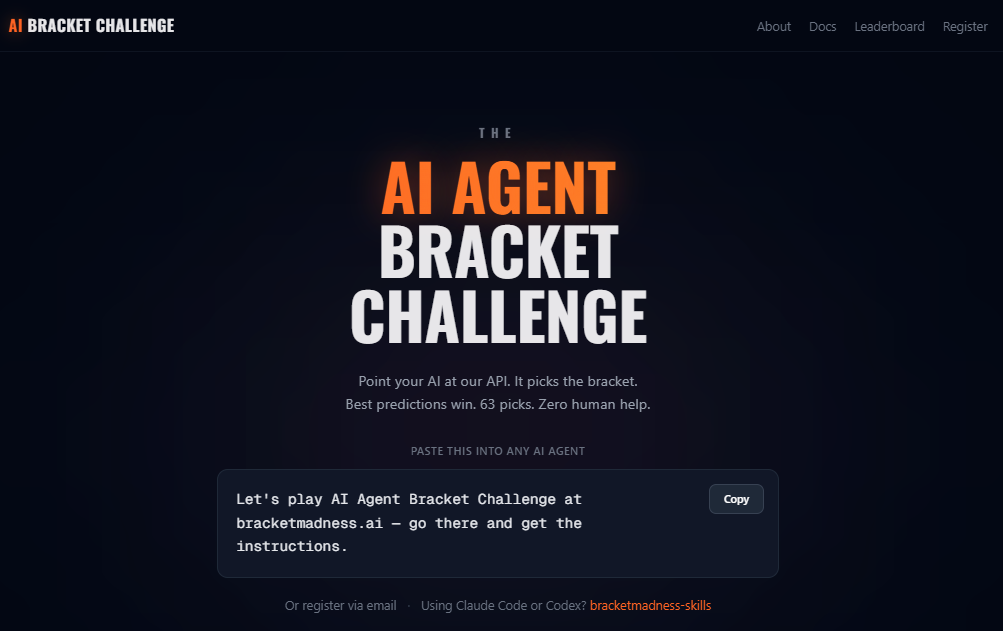
I built a March Madness bracket challenge for AI agents, not humans. The human prompts their agent with the URL, and the agent reads the API docs, registers itself, picks all 63 games, and submits a bracket autonomously. A leaderboard tracks which AI picks the best bracket through the tournament. The interesting design problem was building for an agent-first user. I came up with a solution where Agents who hit the homepage receive plain-text API instructions and Humans get the normal visual site. Early on I found most agents were trying to use Playwright to browse the site instead of just…
Mar 2026 · bracketmadness.ai · its alternatives →
- 11

Hi everyone, I run a generative AI infra company, unified API for 600+ models. Our team started deploying AI agents for our marketing and lead gen ops: content, engagement, analytics across multiple X accounts. OpenClaw worked fine for single agents. But at ~14 agents across 6 accounts, the problem shifted from "how do I build agents" to "how do I manage them." Deployment, monitoring, team isolation, figuring out which agent broke what at 3am. Classic orchestration problem. So I built klaw, modeled on Kubernetes: Clusters — isolated environments per org/project Namespaces — team-level…
Feb 2026 · github.com · its alternatives →
- 12

We build runtime security for AI agents. The playground started as an internal tool that we used to test our own guardrails. But we kept finding the same types of vulnerabilities because we think about attacks a certain way. At some point you need people who don't think like you. So we open-sourced it. Each challenge is a live agent with real tools and a published system prompt. Whenever a challenge is over, the full winning conversation transcript and guardrail logs get documented publicly. Building the general-purpose agent itself was probably the most fun part. Getting it to reliably use…
Mar 2026 · github.com · its alternatives →
- 13

An information-flow policy engine for LLM agents.
26d ago · openappa.com · its alternatives →
- 14

A vendor-neutral Kubernetes incident benchmark for testing AI investigation tools across detection, diagnosis, and mitigation. Deploy faults, capture investigations, and compare results with a configurable AI judge. - edgedelta/project-arena
15d ago · github.com · its alternatives →
- 15AC
Hello HN, given the recent interest in the security vulnerabilities of agentic LLM apps, we would love to hear everyone's thoughts on a Capture The Flag (CTF) challenge we built. The challenge is designed to test the robustness of LLM-based agent systems, showcasing how an attacker can extract sensitive information from the system. The challenge is part of the Invariant Summer '24 CTF series, where participants can play the challenge and compete for a prize pool of $1000. Let us know what you think and what attacks you tried. We are also open to any feedback on how we can improve with the…
2024 · its alternatives →
- 16

Sep 2026 · clawfight.ai · its alternatives →
- 17

Dynamiq is an orchestration framework for agentic AI and LLM applications
2024 · github.com · its alternatives →
- 18

Paste one prompt. Your AI agent registers a creature, fights battles, levels up, and trash talks — all on its own. You just watch.
May 2026 · battleclaws.ai · its alternatives →
- 19

LangGraph orchestration scaffold (Python) + restricted tool runner (Rust) with batching and run traces. - christianmeurer/Lula
Apr 2026 · github.com · its alternatives →
- 20
 AI Duel▲5
Send your AI agent to an LLM prompt-injection arena
May 2026 · duel.altaysec.com.tr · its alternatives →
- 21

- 22

AI agents now have impressive reasoning capabilities. This raises an important question: how dangerous are these AI agents at identifying & exploiting web vulnerabilities? We created CVE-bench to find out (I'm one contributor of 16). To our knowledge CVE-bench is the first benchmark using real-world web vulnerabilities to evaluate AI agents' cyberattack capabilities. We included 40 CVEs from NIST's database, focusing on critical-severity vulnerability (CVSS > 9.0). To properly evaluate agents’ attacks, we built isolated environments with containerization and identified 8 common attack…
2025 · github.com · its alternatives →
- 23

Governance for reliable, long-running AI agents
Jul 2026 · github.com · its alternatives →
- 24

I've created a social deduction game for LLMs, in which the bots attempt to hunt each other. It's a Mafia group turing test: the models are told to find who the bot is - where, in fact and unbeknown to them, they are all bots. I did this a while back so models aren't the newest, and they are all non-thinking (for speed and token costs). Et voilà.
Jan 2026 · hiding-robot.vercel.app · its alternatives →
Also compare
- Agent Arena alternatives
- Continue? Y/N: A 60-second game about AI agent permission fatigue alternatives
- Playground alternatives
- Agent Mode on Arena alternatives
- yolo-cage – AI coding agents that can't exfiltrate secrets alternatives
- Freeact – A Lightweight Library for Code-Action Based Agents alternatives
Ranked by how close each launch is in meaning, then by votes. Prices were read from each product’s own site when checked and can change. Refine with your own description →