Dev tools · alternatives · 2026

24 alternatives to Deep learning without gradient descent, 500 layers, no skip connections
Code that reproduces experiments from a scientific paper - xolod7/polyharmonic-cascade
Below are 24 products that do a similar job, ranked by how close each is in meaning and then by launch-day votes.
- 1

Trying to do gradient descent using automatic differentiation over branchy programs? Or to combine them with neural networks for end-to-end training? Then this might be interesting to you. We develped DiscoGrad, a tool for automatic differentiation through C++ programs involving input-dependent control flow (e.g., "if (f(x) < c) { ... }", differentiating wrt. x) and randomness. Our initial motivation was to enable the use of gradient descent with simulations, which often rely heavily on such discrete branching. The latter makes plain autodiff mostly useless, since it can only account for the…
2024 · github.com · its alternatives →
- 2
 Sonnet▲134
A new library for constructing neural networks from DeepMind
2017 · deepmind.google · its alternatives →
- 3
 Netmind Power▲272
Hi HN, We just opened public access to Qwen3‑Coder‑480B‑A35B‑Instruct via a REST/SDK API. Why it might be interesting: - Fully open-source (Apache‑2.0): https://github.com/QwenLM/Qwen3-Coder - 480B params (35B active MoE), long context up to 1M tokens with YaRN - Matches Claude Sonnet/GPT‑4o on SWE-Bench Verified (81.6%) - Free tier: 100K tokens/month
2023 · netmind.ai · its alternatives →
- 4

Multi-GPU reinforcement learning using Deep Q-Network in TensorFlow for OpenAI Gym - vishar0/dist-dqn
2016 · github.com · its alternatives →
- 5
 NeuroBlock▲120
No-code AI Lab: Train models, access datasets, run inference
Feb 2026 · neuro-block.com · its alternatives →
- 6

I worked on this applied Deep Reinforcement Learning course for the better part of 2021. I made a Datacamp course [0] before, and this served as my inspiration to make an applied Deep RL series. Normally, Deep RL courses teach a lot of mathematically involved theory. You get the practical applications near the end (if at all). I have tried to turn that on its head. In the top-down approach, you learn practical skills first, then go deeper later. This is much more fun. This course (the first in a planned multi-part series) shows how to use the Deep Reinforcement Learning framework RLlib to…
2022 · courses.dibya.online · its alternatives →
- 7

AI Infra / AI Orchestration / AI Control Plane. Contribute to polyaxon/polyaxon development by creating an account on GitHub.
2017 · github.com · its alternatives →
- 8

Open-source machine learning library by Google
2018 · tensorflow.org · its alternatives →
- 9
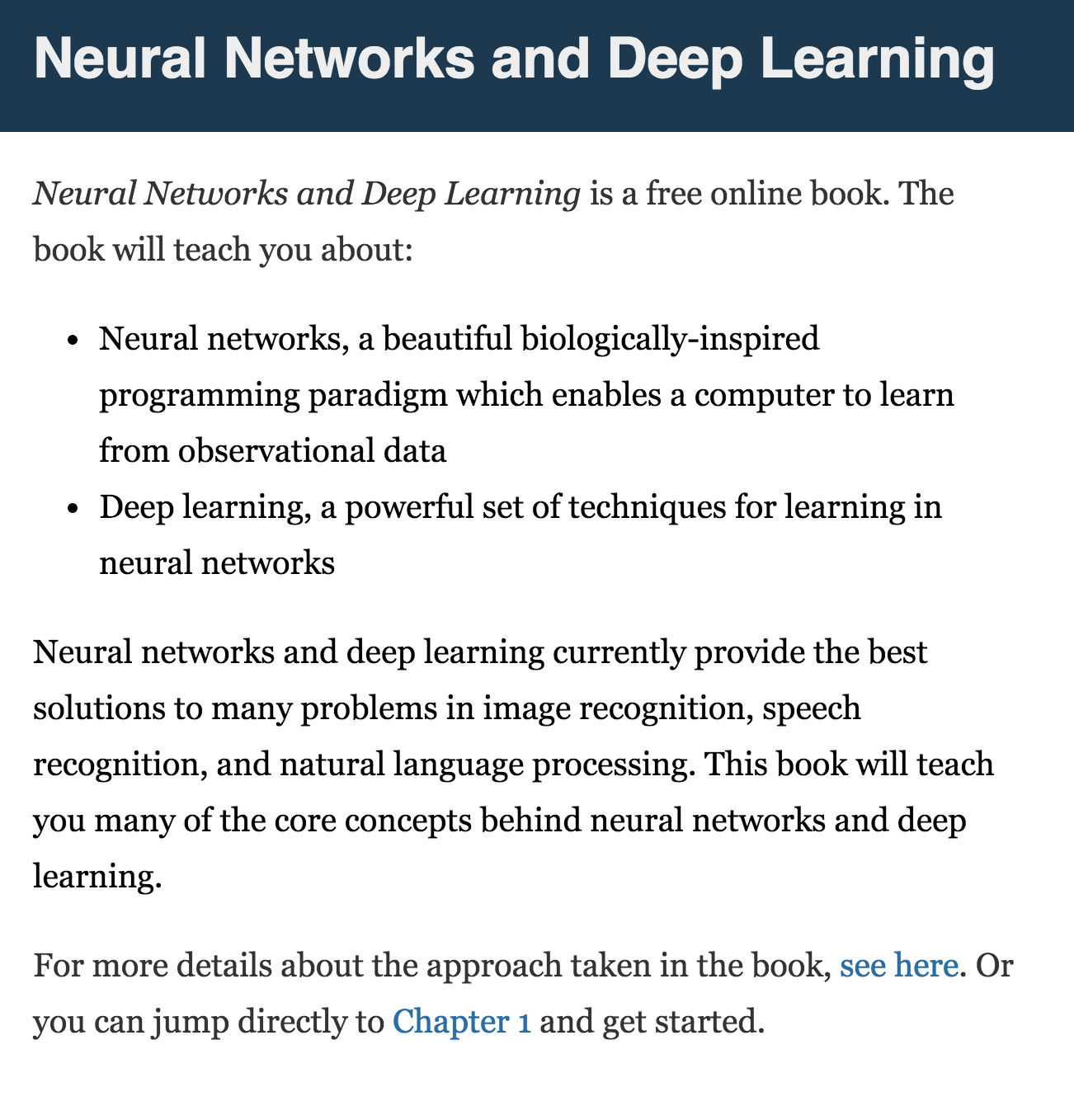
Core concepts behind neural networks and deep learning
2015 · neuralnetworksanddeeplearning.com · its alternatives →
- 10

- 11

A minimalist deep learning library written from scratch in Python - sradc/SmallPebble
2021 · github.com · its alternatives →
- 12

By Rishabh Singh, Jacob Devlin, Abdelrahman Mohamed, and Pushmeet Kohli, Microsoft Research Despite the many advances in computing over the past decades, the actual process of writing computer software has not fundamentally changed — a programmer must manually code the exact algorithmic logic of a p
2017 · microsoft.com · its alternatives →
- 13

Free, practical course on Deep Learning, without hard math
2017 · course.fast.ai · its alternatives →
- 14

Minimal, readable LLM post-training experiments on one 8GB GPU. Measures forgetting, seed variance, and RL emergence. - pochenai/nano-llm-posttraining
Aug 2026 · github.com · its alternatives →
- 15

A lightweight C library for artificial neural networks - attractivechaos/kann
2018 · github.com · its alternatives →
- 16

2024 · gitlab.com · its alternatives →
- 17

Most efforts to privately train machine-learning models either use homomorphic encryption or secure multi-party computation (MPC). Recent insights indicate…
2018 · blog.openmined.org · its alternatives →
- 18

Purely functional artificial neural network library implemented in Haskell. - jbarrow/LambdaNet
2014 · github.com · its alternatives →
- 19

An implementation of "MixHop: Higher-Order Graph Convolutional Architectures via Sparsified Neighborhood Mixing" (ICML 2019). - benedekrozemberczki/MixHop-and-N-GCN
2019 · github.com · its alternatives →
- 20

Hi guys, I’m excited to share an update on ReproModel, an open-source toolbox designed to streamline the testing and reproduction of machine learning models. I, like many of you, have really struggled with benchmarking and comparing models, from missing code, to opaque experiment parameters slowing the process. I decided to take matters into my own hands, and created a mini-toolbox in my free time to streamline the process. The goal is to reduce the time and effort spent on replicating experiments, enabling researchers to focus on innovation rather than setup. Knowing this task is not an…
2024 · github.com · its alternatives →
- 21IM
2017 · neuralnetsforhackers.teachable.com · its alternatives →
- 22LT
I’m excited to share a project I’ve been working on for over a year, which I believe will fundamentally change our approach to language models. We’ve designed a new architecture, which replaces the hidden state of an RNN with a machine learning model. This model compresses context through actual gradient descent on input tokens. We call our method “Test-Time-Training layers.” TTT layers directly replace attention, and unlock linear complexity architectures with expressive memory, allowing us to train LLMs with millions (someday billions) of tokens in context. Our instantiations, TTT-Linear…
2024 · its alternatives →
- 23IC
I spent the past week implementing a 1 Layer Neural Net and training it on MNIST within the visual scripting language provided by scratch.mit.edu. It was tedious, but ultimately not too difficult. The code runs incredibly slowly, so much so that 64 samples of MNIST takes 5+ hours to train on my machine. There were a lot of little mini challenges that were fun to overcome (implementing softmax was very tricky). If you're interested, I encourage you to try and improve on it! More details in the linked blog post.
2024 · bell-boy.github.io · its alternatives →
- 24BH
Hello HN, I recently posted a work-in-progress paper, along with code necessary for replicating all its results, at: https://github.com/glassroom/heinsen_routing Among other things, the code in this repo outperforms Hinton et al.'s recent state-of-the-art result in visual recognition[0] while requiring fewer parameters and an order-of-magnitude fewer training epochs. Most of the original research we do at work tends to be either proprietary in nature or tightly coupled to internal code, so we cannot share it with the world. In this case, however, I was able to remove all…
2019 · its alternatives →
Also compare
Ranked by how close each launch is in meaning, then by votes. Prices were read from each product’s own site when checked and can change. Refine with your own description →