Dev tools · alternatives · 2026
24 alternatives to Did you know you can multiply matrices without multiplication?
TL;DR: This idea implemented in Python https://gist.github.com/danbst/fdf604ae279f9e01c8a28f1f84f9876e Hello. Long time ago I have learned that log(xy) = log(x) + log(y) and that this was used by Napier to multiply numbers. Also I knew that matrix multiplication time is dominated by inner dot products, which use addition and multiplication. And it just stuck me today, that it is possible to multiply matrices in logarithmic space (that is, matrix values are logs of real values) without multiplication! By using same trick Napier did. (There are restrictions, as negative…
Below are 24 products that do a similar job, ranked by how close each is in meaning and then by launch-day votes. Prices are shown for the 1 we have checked on their own sites, 1 of them free or with a free tier. Did you know you can multiply matrices without multiplication? launched in 2023; newer entries below may have overtaken it.
- 1

Algebraic enhancements for GEMM & AI accelerators. Contribute to trevorpogue/algebraic-nnhw development by creating an account on GitHub.
2024 · github.com · its alternatives →
- 2

Portable matrix multiplication library in C. Contribute to webDva/matrixmul development by creating an account on GitHub.
2018 · github.com · its alternatives →
- 3IM
I've been studying interval arithmetic for the past few weeks and it's a really interesting field because while there is a ton of super interesting research published over the past decades, it has never really gotten the recognition that it deserves, IMO. One reason for this is that standard interval arithmetic has really poor handling of division by intervals containing zero. If you compute 1 / [-1, 2] in regular interval arithmetic, you get either [-∞, +∞], or you have to say that the operation is undefined. Both solutions are virtually useless. The real answer of course is [-∞, -1] U…
Apr 2026 · victorpoughon.github.io · its alternatives →
- 4AL
2025 · little-book-of.github.io · its alternatives →
- 5

Here's a project I've been working on for the last few months. It's a new (I think) algorithm, that allows to adjust smoothly - and in real time - how many calculations you'd like to do during inference of an LLM model. It seems that it's possible to do just 20-25% of weight multiplications instead of all of them, and still get good inference results. I implemented it to run on M1/M2/M3 GPU. The mmul approximation itself can be pushed to run 2x fast before the quality of output collapses. The inference speed is just a bit faster than Llama.cpp's, because the rest of implementation…
2024 · asciinema.org · its alternatives →
- 6

I launched NumPad v1 on here a few years ago, and back then it wasn't much more than a thin CodeMirror wrapper around the calculator engine I'd written. Now I've rewritten it as a PWA that supports multiple documents, persists them to IndexedDB, and has a syncing service for paying customers. Syncing is handled by Automerge[1] under the hood, which should make it relatively easy to get document sharing working too. [1] https://automerge.org/
2022 · numpad.io · its alternatives →
- 7
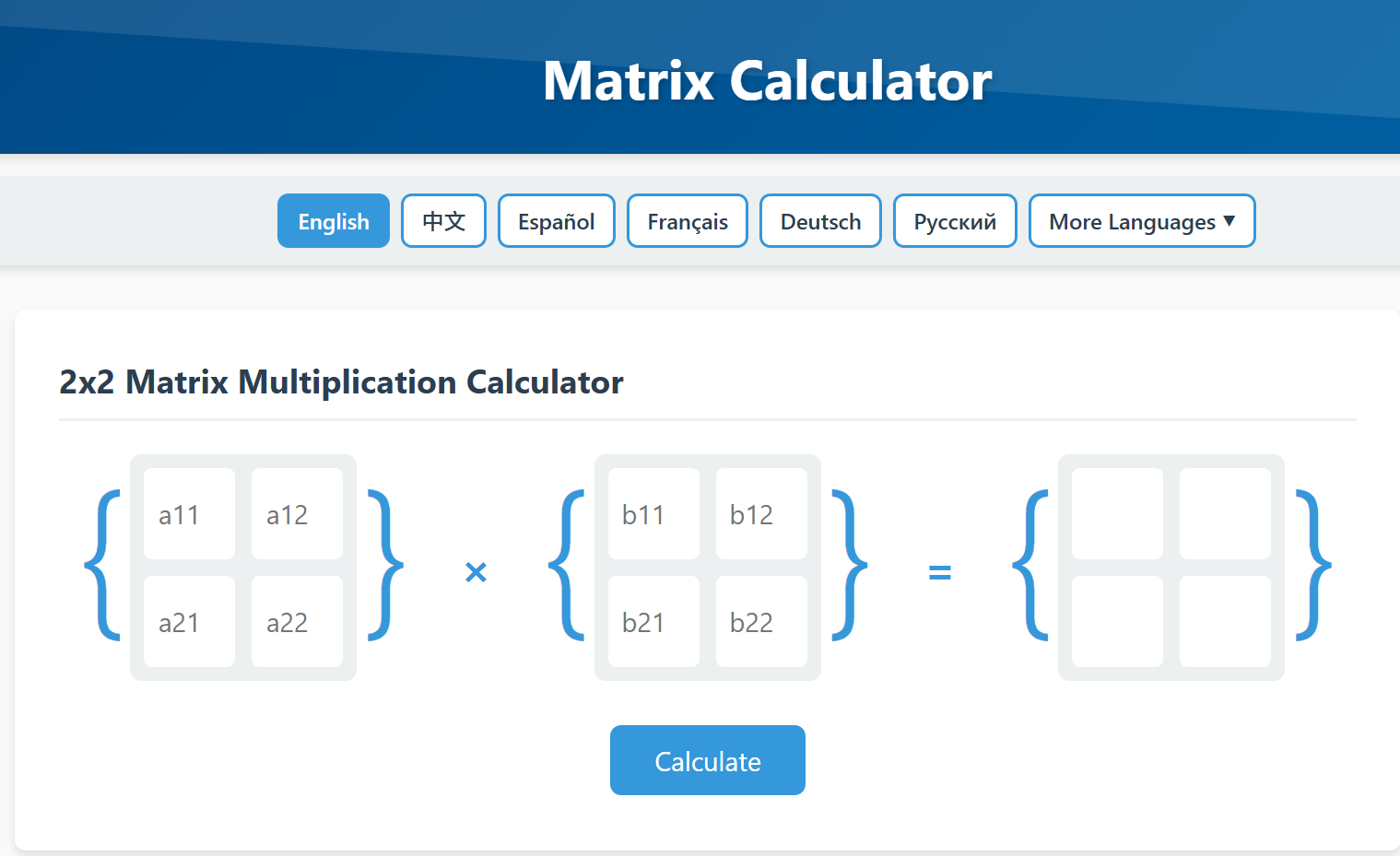
Multiplication, inverse, determinant 2x2 & 3x3
Nov 2025 · matrixcalculator.net · its alternatives →
- 8

Calculate a cross-multiplication without picking up a pen
2023 · crossyourhe.art · its alternatives →
- 9

Hey, maker here. After launching a daily word search game, I randomly thought of this math game while driving. Finally got around to making it and I think it turned out pretty cool. It’s a math search game that’s meant to help you practice your quick addition, subtraction, multiplication, and division skills. I’m hoping it’ll help people (even those like me who aren’t big on math) learn and increase their speeds. (There are also some settings you can enable to make the game harder) If you try it out, please let me know if you found it fun, if you have anything you’d like me to add, or if you…
2024 · worchle.com · its alternatives →
- 10

I built a Rust-powered Wavelet Matrix library for Python. There were surprisingly few practical Wavelet Matrix implementations available for Python, so I implemented one with a focus on performance, usability, and typed APIs. It supports fast rank/select, top-k, quantile, range queries, and even dynamic updates. Feedback welcome!
Dec 2025 · pypi.org · its alternatives →
- 11

Simple Python Calculation Engine. Contribute to bsdz/calcengine development by creating an account on GitHub.
2021 · github.com · its alternatives →
- 12CP
Evaluate a degree-n polynomial with about n/2 multiplications. Type a polynomial, pick ℚ, ℝ, ℂ, a Mersenne prime or a binary field, and get the preprocessed evaluation chain as math, C code or a circuit — everything runs in your browser.
Sep 2026 · thomasahle.com · its alternatives →
- 13

Algebraic Number Theory package. Contribute to louisabraham/algnuth development by creating an account on GitHub.
2018 · github.com · its alternatives →
- 14

Learn multiplication with goofy AI-generated stories
2023 · nautilushomeschool.com · its alternatives →
- 15

A Python library for detecting patterns and anomalies in massive datasets using the Matrix Profile - target/matrixprofile-ts
2019 · github.com · its alternatives →
- 16

Hi HN, I turned the freshly published paper “The Constructor Theory of Time” by David Deutsch and Chiara Marletto (arXiv, 13 May 2025) into an executable Python library. What you’ll find • One-to-one translation of the paper’s formalism: Substrates, Attributes, Tasks, Constructors, and task-algebra operators • Possibility / impossibility predicates and counterfactuals encoded exactly as defined • Test suite that mirrors every lemma and example (>95 % coverage, mypy-typed) • Reproductions of key results: time-keeping substrates, irreversibility proofs, quantum branching tasks, and a…
2025 · github.com · its alternatives →
- 17

- 18

Absolute minimalistic implementation of a GPT-like transformer using only numpy (<650 lines). - joennlae/tensorli
2023 · github.com · its alternatives →
- 19

To get benefits from sparsity, you usually need to have very sparse matrices, impose some structure on the sparsity pattern or have specialized hardware. None of it is the case if you want to rune pruned LLMs on consumer devices. I wanted to see how far can you push it on a GPU and ended up with this. Blog: https://www.grizzlytech.dev/blog/macko-spmv Paper: https://arxiv.org/abs/2511.13061 Code (example with torch): https://github.com/vlejd/macko_spmv
Nov 2025 · github.com · its alternatives →
- 20SA
Hey HN, I’m a physicist turned quant. Some friends and I 'built' SymDerive because we wanted a symbolic math library that was "Agent-Native" by design, but still a practical tool for humans. It boils down to two main goals: 1. Agent Reliability: I’ve found that AI agents write much more reliable code when they stick to stateless, functional pipelines (Lisp-style). It keeps them from hallucinating state changes or getting lost in long procedural scripts. I wanted a library that enforces that "Input -> Transform -> Output" flow by default. 2. Easing the transition to Python: For many…
Feb 2026 · its alternatives →
- 21

Hey HN, I'm excited to share a new side project I've been working on. The product is called Matrices. You can check it out here: https://matrices.com/. With Matrices, you can explore, visualize, and share large (100k rows) datasets–all without code. Filter data down to just what you want, visualize it with built-in charts, and share your results with one click. You can use it today (no login or waitlist or anything). Just copy and paste your data from a google sheet or CSV file. It's hard to describe the feeling of "gliding over data" you get with Matrices, so I'd rather…
2023 · matrices.com · its alternatives →
- 22IM
https://github.com/siraben/ti84-forth Hi HN! For the past year I've been getting into programming in Z80 assembly (especially for the TI-84+). More recently I've been learning about the Forth programming language and after a lot of searching online (in vain) for a Forth interpreter for the TI-84, I decided to write one myself. It's been fun demoing this to others, because it's a very unexpected use of a calculator. It's my largest project to date, and I'm interested to know what the HN community thinks, please feel free to critique my code! -- Ben
2018 · its alternatives →
- 23

Stephen Wolfram's new book on the Wolfram Language
2015 · wolfram.com · its alternatives →
- 24IT
Eigendecompositions and Singular Value Decompositions appear in a variety of settings in machine learning and data mining. The eigendecomposition looks like so: $$ \mathbf{A}=\mathbf{Q}\mathbf{\Lambda}\mathbf{Q}^{-1} $$ $ \mathbf{Q} $ contains the eigen...
2014 · blog.shriphani.com · its alternatives →
Also compare
- Matrix Multiplication with Half the Multiplications alternatives
- Portable matrix multiplication library alternatives
- I made a calculator that works over disjoint sets of intervals alternatives
- A little notebook for learning linear algebra with Python alternatives
- Speeding up LLM inference 2x times (possibly) alternatives
- I made a web-based notepad with a built in unit calculator alternatives
Ranked by how close each launch is in meaning, then by votes. Prices were read from each product’s own site when checked and can change. Refine with your own description →