AI · alternatives · 2026

24 alternatives to Geetanjali – RAG-powered ethical guidance from the Bhagavad Gita
I built a RAG application that retrieves relevant Bhagavad Gita verses for ethical dilemmas and generates structured guidance. The problem: The Gita has 701 verses. Finding applicable wisdom for a specific situation requires either deep familiarity or hours of reading. How it works: 1. User describes their ethical dilemma 2. Query is embedded using sentence-transformers 3. ChromaDB retrieves top-k semantically similar verses 4. LLM generates structured output: 3 options with tradeoffs, implementation steps, verse citations Tech stack: - Backend: FastAPI, PostgreSQL, Redis - Vector DB:…
Below are 24 products that do a similar job, ranked by how close each is in meaning and then by launch-day votes.
- 1SB
Search Bhagavad Gita Verses
2017 · searchgita.com · its alternatives →
- 2BG
2021 · play.google.com · its alternatives →
- 3

Made this in a free evening. Index an permissive license translation of the Bible (WEB) into a RAG database to allow returning passages of similar semantic meaning. Lots of fun. For example, "more money more problems" returns Ecclesiastes 5:9-13 which, I'll just say, is spot on.. "Moreover the profit of the earth is for all. The king profits from the field. He who loves silver shall not be satisfied with silver, nor he who loves abundance, with increase. This also is vanity. When goods increase, those who eat them are increased; and what advantage is there to its owner, except to feast on…
Jun 2026 · crosscanon.com · its alternatives →
- 4

I built this tool because I wanted a way to just take a bunch of URLs or domains, and query their content in RAG applications. It takes away the pain of crawling, extracting content, chunking, vectorizing, and updating periodically. I'm curious to see if it can be useful to others. I meant to launch this six months ago but life got in the way...
2024 · embedding.io · its alternatives →
- 5

I shipped a wiki layer for AI agents that uses markdown + git as the source of truth, with a bleve (BM25) + SQLite index on top. No vector or graph db yet. It runs locally in ~/.wuphf/wiki/ and you can git clone it out if you want to take your knowledge with you. The shape is the one Karpathy has been circling for a while: an LLM-native knowledge substrate that agents both read from and write into, so context compounds across sessions rather than getting re-pasted every morning. Most implementations of that idea land on Postgres, pgvector, Neo4j, Kafka, and a dashboard. I…
Apr 2026 · github.com · its alternatives →
- 6

I've built an advanced RAG (Retrieval-Augmented Generation) pipeline from scratch to demystify the complex mechanics of modern LLM-powered Question Answering systems. This repository features: -- An implementation of a sub-question query engine from scratch to answer complex user questions. -- Illustrative explanations that unveil the inner workings of the system. -- An analysis of the challenges I faced while working with the system, like prompt engineering and cost estimation. -- Qualitative comparison with similar frameworks like LlamaIndex, offering a broader perspective. Key Takeaway:…
2023 · github.com · its alternatives →
- 7WS
We’ve trained a generative AI model to browse the web and answer questions/retrieve code snippets directly. Unlike ChatGPT, it has access to primary sources and is able to cite them when you hover over an answer (click on the text to go to the source being cited). We also show regular Bing results side-by-side with our AI answer. The model is an 11-billion parameter T5-derivative that has been fine-tuned on feedback given on hundreds of thousands of searches done (anonymously) on our platform. Giving the model web access lessens its burden to need to store a snapshot of human knowledge…
2022 · beta.sayhello.so · its alternatives →
- 8

- 9

Introducing Biblos, a simple tool for semantic search and summarization of Bible passages. Leveraging Chroma for vector search with BAAI BGE embeddings, semantically find related verses across the Bible. The tool employs Anthropic's Claude LLM model for generating high-quality summaries of retrieved passages, contextualizing your search topic. Built on a Retrieval Augmented Generation (RAG) architecture, the app implements a simple Streamlit Web UI using Python. Deployed using render.com, the app is available at https://biblos.app Note: Search by just topic/keywords, e.g.…
2023 · github.com · its alternatives →
- 10
 Dabarqus▲92
Add PDF chat to your LLM app in less than 9 lines of code
2024 · dabarqus.com · its alternatives →
- 11

Looking for the best free Bhagavad Gita app? All 18 chapters and 700 verses in 7 languages, Sanskrit audio, offline reading and Gita GPT AI, on Android and iPhone. 500,000+ downloads, rated 4.8. No ads, no subscription, ever.
2018 · bhagavadgita.io · its alternatives →
- 12

Hey HN, exciting news! Our RAG framework, Cognita (https://github.com/truefoundry/cognita), born from collaborations with diverse enterprises, is now open-source. Currently, it offers seamless integrations with Qdrant and SingleStore. In recent weeks, numerous engineers have explored Cognita, providing invaluable insights and feedback. We deeply appreciate your input and encourage ongoing dialogue (share your thoughts in the comments – let's keep this ‘open source’). While RAG is undoubtedly powerful, the process of building a functional application with it can feel…
2024 · github.com · its alternatives →
- 13

Ragas is an open-source library for evaluating and testing RAG and other LLM applications. Github: https://docs.ragas.io/en/stable/, docs: https://docs.ragas.io/. Ragas provides you with different sets of metrics and methods like synthetic test data generation to help you evaluate your RAG applications. Ragas started off by scratching our own itch for evaluating our RAG chatbots last year. Problems Ragas can solve - How do you choose the best components for your RAG, such as the retriever, reranker, and LLM? - How do you formulate a test dataset…
2024 · github.com · its alternatives →
- 14

Hey hacker news, We’re the cofounders at Psychic.dev (http://psychic.dev) where we help companies connect LLMs to private data. With the launch of Llama 2, we think it’s finally viable to self-host an internal application that’s on-par with ChatGPT, so we did exactly that and made it an open source project. We also included a vector DB and API server so you can upload files and connect Llama 2 to your own data. The RAG in RAGstack stands for Retrieval Augmented Generation, a technique where the capabilities of a large language model (LLM) are augmented by retrieving information…
2023 · github.com · its alternatives →
- 15

open-source agentic AI data assistant for the next generation of AI + Data products. - eosphoros-ai/DB-GPT
2023 · github.com · its alternatives →
- 16

TL;DR: Vector-based RAG performs poorly for many real-world applications like codebase chats, and you should consider 'language maps'. Part of our mission at Mutable.ai is to make it much easier for developers to build and understand software. One of the natural ways to do this is to create a codebase chat, that answer questions about your repo and help you build features. It might seem simple to plug in your codebase into a state-of-the-art LLM, but LLMs have two limitations that make human-level assistance with code difficult: 1. They currently have context windows that are too small to…
2024 · twitter.com · its alternatives →
- 17

Simon(sfarshid) and I spend a lot of time on GitHub. As data nerds we put together a quick tool to explore your repository’s data. How it works: - Data Loading: We use dlt to pull data (issues, PRs, commits, stars) from GitHub - Semantic Layer: Relta wraps the underlying dataset into a semantic layer so the LLM doesn’t hallucinate. - Text-to-SQL: A text-to-SQL agent transforms your plain-English question into a query using the semantic layer - Generative Charts: assistant-ui dynamically generates a chart based on the SQL query - Refinements: If the semantic layer can’t handle your question,…
2024 · github.com · its alternatives →
- 18

Hi HN, I have been working with regulation-heavy documents lately, and one thing kept bothering me. Flat RAG pipelines often fail to retrieve related articles together, even when they are clearly connected through references, definitions, or clauses. After trying several RAG setups, I subjectively felt that GraphRAG was a better mental model for this kind of data. The Microsoft GraphRAG paper and reference implementation were helpful starting points. However, in practice, I found one recurring friction point: graph storage and vector indexing are usually handled by separate systems, which…
Jan 2026 · github.com · its alternatives →
- 19
 Gita AI▲4
An AI-powered workspace for authentic Gita insights.
Jul 2026 · gitaguidance.app · its alternatives →
- 20
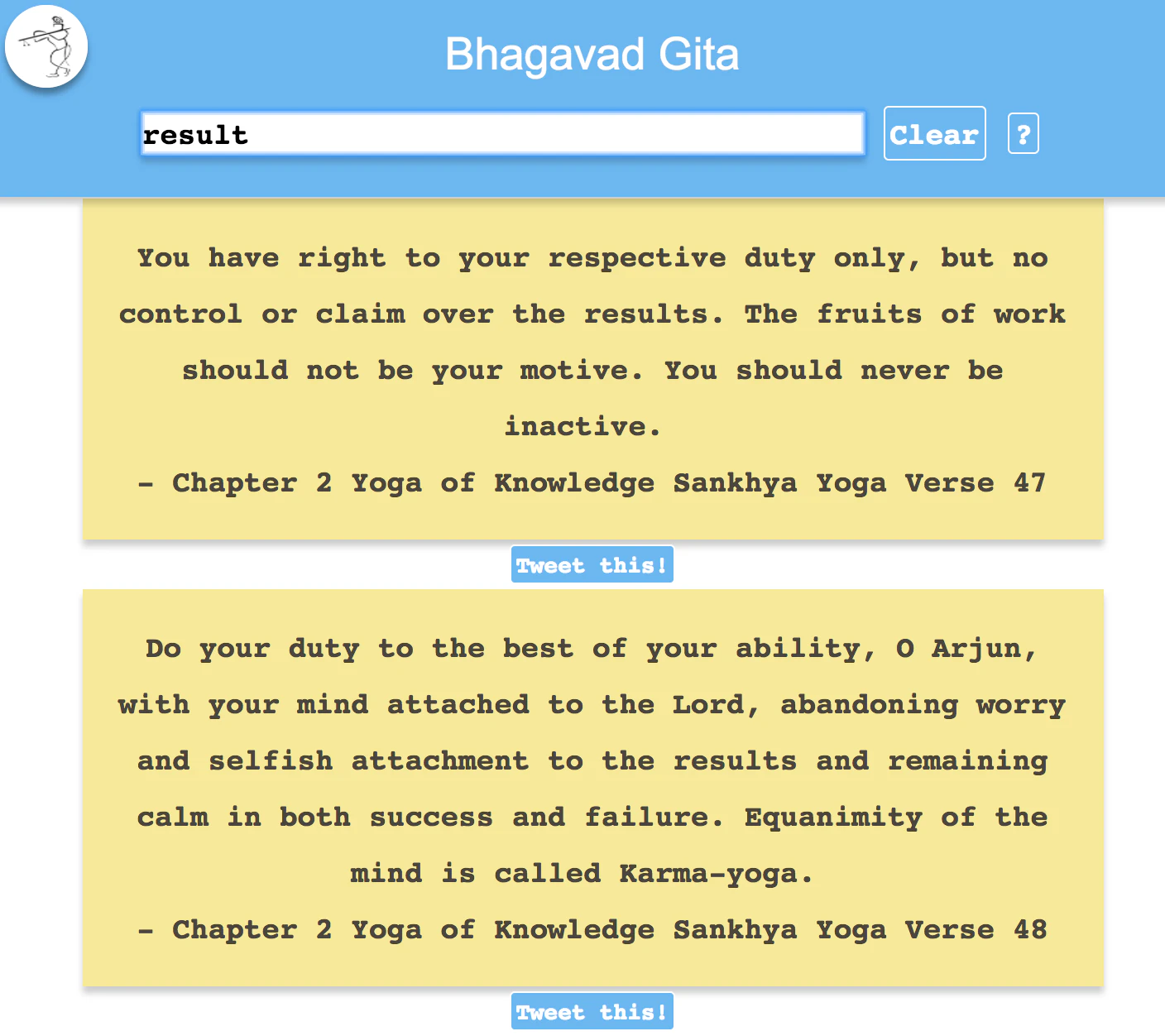
Simple Bhagavad Gita Verses Web App
2017 · searchgita.com · its alternatives →
- 21
 Gita GPT▲7
AI chatbot use Bhagavad Gita references to answer questions.
2023 · gitagpt.in · its alternatives →
- 22
 RAGstack▲111
Deploy a private ChatGPT alternative hosted within your VPC
2023 · github.com · its alternatives →
- 23

Hey HN fam, We’ve seen developers spend a lot of time implementing advanced RAG techniques from scratch. While these techniques are essential for improving performance, their implementation requires a lot of effort and testing! To help with this process, our team (Athina AI) has released Open-Source Advanced RAG Cookbooks. This is a collection of ready-to-run Google Colab notebooks featuring the most commonly implemented techniques. Please show us some love by starring the repo if you find this useful!
2024 · github.com · its alternatives →
- 24

We developed a new framework that enables flexible control of generated text in language models. By combining several models and/or system prompts in one mathematical formula, it lets you tweak your style and combine model outputs with ease. A handy tool for those working with LLMs, looking for more fine-grained control of stylistic output. More details in our paper: https://arxiv.org/abs/2311.14479. Feedback and potential applications are welcome.
2023 · github.com · its alternatives →
Also compare
- Simple Bhagavad Gita Search Web App alternatives
- Bhagavad Gita Android App for searching verses by topics like anxiety alternatives
- Bible as RAG Database alternatives
- Turn any website into a knowledge base for LLMs alternatives
- A Karpathy-style LLM wiki your agents maintain (Markdown and Git) alternatives
- Demystifying Advanced RAG Pipelines alternatives
Ranked by how close each launch is in meaning, then by votes. Prices were read from each product’s own site when checked and can change. Refine with your own description →