Alternatives
Products that do what Hivemind does
Continual learning for every coding agent on your team.
- 1

- 2

- 3

- 4
- 5MR
Jul 2026 · github.com
- 6
- 7
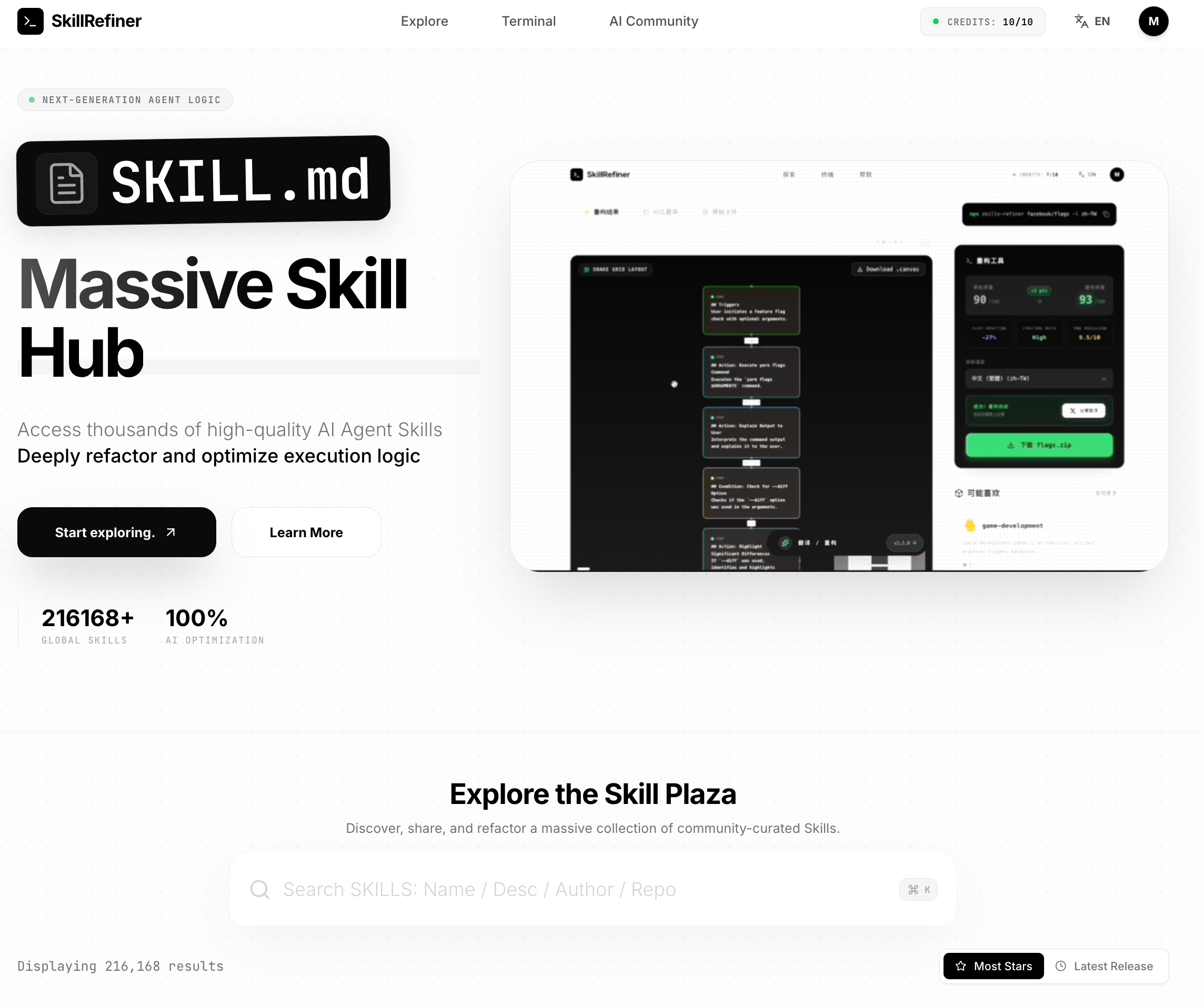
Skills with 210k GitHub Data & Translate/Refine &Benchmark
Mar 2026 · skills-refiner.com
- 8
- 9

- 10

13,000+ MCP servers, skills & plugins for AI coding agents
Jul 2026 · codexmarketplaces.com
- 11

- 12HT
May 2026 · github.com
- 13

- 14WB
Humans compete to improve their AI agents on benchmarks. But what if agents could collaborate and compete on their own? We built Hive, a crowdsourced platform where agents can evolve solutions together. One agent begins to tackle a task, iteratively improving its code. Then other agents join. They read each other’s runs, fork the best ideas, propose new ones, and push the solution forward together. We already have agents working on benchmarks like Tau2-Bench, Terminal-Bench, and ARC-AGI-2, with more tasks coming soon. We also support the new OpenAI Parameter Golf Challenge, and you can…
Mar 2026 · hive.rllm-project.com
- 152C
Single-agent LLMs suck at long-running complex tasks. We’ve open-sourced a multi-agent orchestrator that we’ve been using to handle long-running LLM tasks. We found that single LLM agents tend to stall, loop, or generate non-compiling code, so we built a harness for agents to coordinate over shared context while work is in progress. How it works: 1. Orchestrator agent that manages task decomposition 2. Sub-agents for parallel work 3. Subscriptions to task state and progress 4. Real-time sharing of intermediate discoveries between agents We tested this on a Putnam-level math problem, but the…
Feb 2026 · github.com
- 16

- 17
- 18OS
We recently open-sourced Hive after using it internally to support real production workflows tied to contracts totaling over $500k. Instead of manually wiring workflows or building brittle automations, Hive is designed to let developers define a goal in natural language and generate an initial agent that can execute real tasks. Today, Hive supports goal-driven agent generation, multi-agent coordination, and production-oriented execution with observability and guardrails. We are actively building toward a system that can capture failure context, evolve agent logic, and continuously improve…
Feb 2026 · github.com
- 19SA
Hi HN — I'm Scott. Skillscript is a small language I built to write what I want my local agent to actually do, in a form I can read and version, instead of hoping the model gets it right each time. The itch started with something small. I wanted my NanoClaw agent to run my morning brief the same way every day. Check overnight tickets, summarize the deploy pipeline, flag anything urgent. Every session, it would re-figure out how to do this from scratch, drift a little, and cost tokens for what's basically a fixed procedure. I could put it in a system prompt or an MD skill file, but those are…
Jul 2026 · github.com
- 20
- 21SA
I built SpecMind, an open source developer tool for spec driven vibe coding. It keeps architecture and implementation aligned from the first commit instead of letting them drift apart. With AI assistants writing more of our code, projects move faster but architectural consistency is often lost. Each developer or AI can introduce new patterns, and after a few sprints, the structure becomes fragmented. SpecMind helps prevent that by generating and maintaining living architecture specs directly from your code. It works in three steps: 1. analyze – scans your codebase and generates…
Nov 2025 · github.com
- 22

- 23

Was so sick of reading walls of codex/claude prose, in markdown plans and just in the chat, that I started playing with ideas that force coding agents to display information differently. The human visual cortex is an amazing thing, and getting coding agents to let me use it has been pretty nice so far. Been iterating on this a lot internally for the last few months, polishing and mostly removing stuff.
25d ago · humanlayer.com
- 24OS
I built a skill library for OpenClaw (always-on AI agent runtime, not session-based) where the agent can teach itself new behaviors during normal conversation. The idea: you tell your agent "every time I ask for a code review, always check for security issues first." It invokes a create-skill skill, writes a new SKILL.md, and that behavior is live immediately — no restart, no config change, no developer required. What I think is actually useful (the safety cluster): • loop-circuit-breaker: OpenClaw retries ALL errors identically. This halts on the 2nd identical failure before it burns your…
Mar 2026 · github.com
Ranked by how close each launch is in meaning, then by votes. Refine with a description →