AI · alternatives · 2026

24 alternatives to Kuzco
Open-source Swift package to run LLMs locally on iOS & macOS
Below are 24 products that do a similar job, ranked by how close each is in meaning and then by launch-day votes.
- 1
 Kuzco▲7
Hi HN, I’m building Kuzco, a Swift SDK for running AI models locally on Apple devices (iPhone, iPad, Mac, Vision Pro). The goal is to make “offline + private AI” feel like a normal dependency you can drop into a SwiftUI/UIKit app, without standing up servers or paying per-token API fees. What it does - Text generation with token streaming (chat style UX) - Vision AI (analyze images locally) - Image generation via Stable Diffusion - Model manager to download and manage on-device models Developer experience - create a session with a model - stream tokens as they generate - optionally get…
Jan 2026 · kuzco.co · its alternatives →
- 2

Hi HN A few folks and I have been working on this project for a couple weeks now. After previously working on the Docker project for a number of years (both on the container runtime and image registry side), the recent rise in open source language models made us think something similar needed to exist for large language models too. While not exactly the same as running linux containers, running LLMs shares quite a few of the same challenges. There are "base layers" (e.g. models like Llama 2), specific configuration to run correctly (parameters, temperature, context window sizes etc). There's…
2023 · github.com · its alternatives →
- 3
- 4

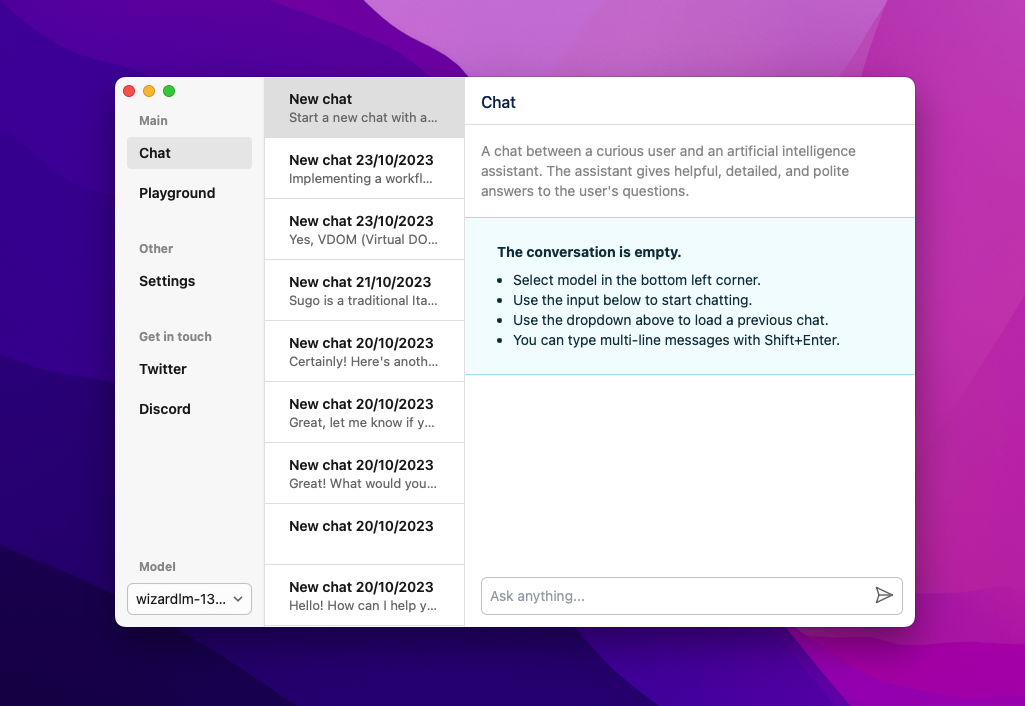
Hi Hackers, Excited to share a macOS app I've been working on: https://recurse.chat/ for chatting with local AI. While it's amazing that you can run AI models locally quite easily these days (through llama.cpp / llamafile / ollama / llm CLI etc.), I missed feature complete chat interfaces. Tools like LMStudio are super powerful, but there's a learning curve to it. I'd like to hit a middleground of simplicity and customizability for advanced users. Here's what separates RecurseChat out from similar apps: - UX designed for you to use local AI as a daily driver.…
2024 · recurse.chat · its alternatives →
- 5
 Ollama▲235
The easiest way to run large language models locally
2023 · github.com · its alternatives →
- 6MG
Hello HN, I've been working on this project for a while, and it has been in an "open" beta for some time. I finally believe it's ready for its first release. I hope you like it. Here are some potential questions that may arise: 1. How does it compare to LM Studio? It's likely that if you're already using LM Studio, you'll continue to do so. This project is designed to be more user-friendly. 2. Is it open-source? No, it is not. 3. Does it use any open-source libraries? Yes, it uses llama.cpp and a few others, as indicated in the license information included with the application. 4. Why is not…
2023 · avapls.com · its alternatives →
- 7
 LangSmith▲350
Build and deploy LLM applications with confidence
2023 · langchain.com · its alternatives →
- 8

We built SwiftAI, an open-source Swift library that lets you use Apple’s on-device LLMs when available (Apple opened access in June), and fall back to a cloud model when they aren’t available — all without duplicating code. SwiftAI gives you: - A single, model-agnostic API - An agent/tool loop - Strongly-typed structured outputs - Optional chat state Backstory: We started experimenting with Apple’s local models because they’re free (no API calls), private, and work offline. The problem: not all devices support them (older iPhones, Apple Intelligence disabled, low battery, etc.). That…
2025 · github.com · its alternatives →
- 9

- 10

This is a Python package that allows you to write function signatures to define LLM queries. This makes it easy to mix regular code with calls to LLMs, which enables you to use the LLM for its creativity and reasoning while also enforcing structure/logic as necessary. LLM output is parsed for you according to the return type annotation of the function, including complex return types such as streaming an array of structured objects. I built this to show that we can think about using LLMs more fluidly than just chains and chats, i.e. more interchangeably with regular code, and to make it…
2023 · github.com · its alternatives →
- 11
 Llama 2▲263
The next generation of Meta's open source LLM
2023 · developer.meta.com · its alternatives →
- 12

Hi HN! I'm just sharing a project I've been working on during the LLM Efficiency Challenge - you can now finetune Llama with QLoRA 5x faster than Huggingface's original implementation on your own local GPU. Some highlights: 1. Manual autograd engine - hand derived backprop steps. 2. QLoRA / LoRA 80% faster, 50% less memory. 3. All kernels written in OpenAI's Triton language. 4. 0% loss in accuracy - no approximation methods - all exact. 5. No change of hardware necessary. Supports NVIDIA GPUs since 2018+. CUDA 7.5+. 6. Flash Attention support via Xformers. 7. Supports 4bit and 16bit…
2023 · github.com · its alternatives →
- 13
 ModelHub▲317
The missing menu bar app for local LLMs on Mac.
May 2026 · studio.consciousengines.com · its alternatives →
- 14
 TensorZero▲307
Hi HN! We're Gabriel & Viraj, and we're excited to open source TensorZero. To be a little cheeky, TensorZero is an open-source platform that helps LLM applications graduate from API wrappers into defensible AI products. 1. Integrate our model gateway 2. Send metrics or feedback 3. Unlock compounding improvements in quality, cost, and latency It enables a data & learning flywheel for LLMs by unifying: • Inference: one API for all LLMs, with <1ms P99 overhead • Observability: inference & feedback → your database • Optimization: better prompts, models, inference strategies • Experimentation:…
2025 · github.com · its alternatives →
- 15

Hey HN, Henry and Roman here - we've been building a cross-platform framework for deploying LLMs, VLMs, Embedding Models and TTS models locally on smartphones. Ollama enables deploying LLMs models locally on laptops and edge severs, Cactus enables deploying on phones. Deploying directly on phones facilitates building AI apps and agents capable of phone use without breaking privacy, supports real-time inference with no latency, we have seen personalised RAG pipelines for users and more. Apple and Google actively went into local AI models recently with the launch of Apple Foundation Frameworks…
2025 · github.com · its alternatives →
- 16

- 17

- 18

Let Llama take over your desktop
2025 · github.com · its alternatives →
- 19

G'day, HN! I'm one of the maintainers of `llm`. I've been working alongside a trusty group of contributors to bring this project to life, and we're now at a point where we're ready to share it with the world. Large language models (LLMs) are taking the computing world by storm due to their emergent abilities that allow them to perform a wide variety of tasks, including translation, summarization, code generation, and even some degree of reasoning. However, the ecosystem around LLMs is still in its infancy, and it can be difficult to get started with these models. `llm` is a one-stop shop for…
2023 · github.com · its alternatives →
- 20

This lets you talk to local LLMs in Apple Notes. I saw Obsidian Ollama (https://github.com/hinterdupfinger/obsidian-ollama) and thought it was handy, but I'm too lazy to migrate away from the Apple ecosystem, so I quickly hacked this together. I tend to use Notes as a scratchpad for prompts, so it's nice to do some quick inference without leaving the app. Notes doesn't really support plugins so I'm using the macOS accessibility API for reading selections and then stream responses using the clipboard (not ideal but it works).
2024 · smallest.app · its alternatives →
- 21

Hey, I built this in a day while at Founders Inc Apple Vision Pro residency. Try it out, let me know what you think.
2024 · apps.apple.com · its alternatives →
- 22TL
2023 · tinyllms.vercel.app · its alternatives →
- 23

- 24GL
Hey everyone! I made a Mac app for exploring large language models. It’s fast, small, has a tiny memory footprint. It’s immutable by design with both immediate time travel and automatic versioning as foundational elements. The app is written in Swift and a bit of Rust for the tokenizer. I used SwiftUI for structure and animations and Cocoa for advanced behavior. All storage is SQLite and local-only. You can go through the database as needed and backup it as well. The app has support for variants, which is the `n` parameter in the OpenAI chat completion API—equivalent to the drafts feature in…
2023 · thellm.app · its alternatives →
Also compare
Ranked by how close each launch is in meaning, then by votes. Prices were read from each product’s own site when checked and can change. Refine with your own description →