AI · alternatives · 2026
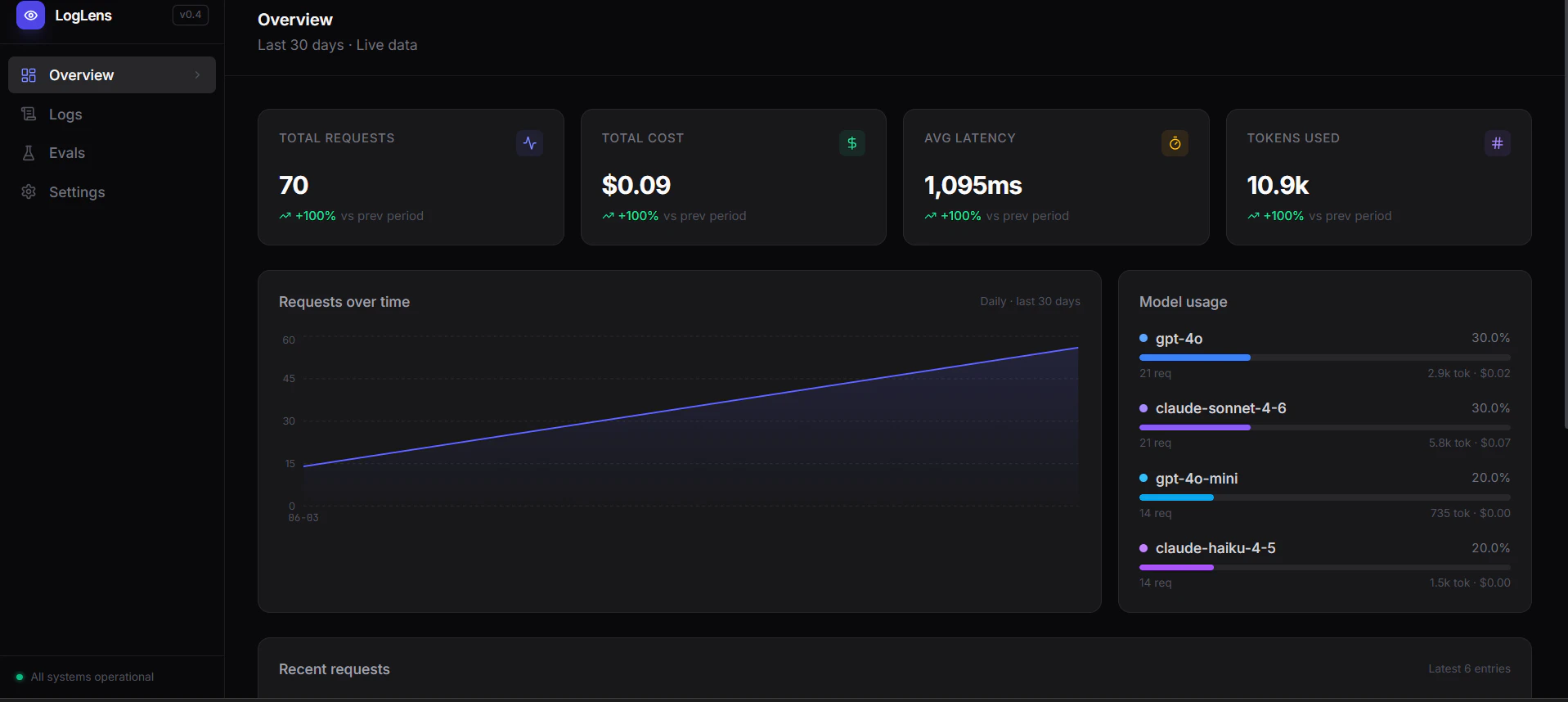
24 alternatives to Loglens
One line of code, Full AI visibility.
Below are 24 products that do a similar job, ranked by how close each is in meaning and then by launch-day votes.
- 1

OpenTelemetry-native observability for agents and LLMs
Aug 2026 · openobserve.ai · its alternatives →
- 2
 traceAI▲273
Open-source LLM tracing that speaks GenAI, not HTTP.
Apr 2026 · github.com · its alternatives →
- 3
 FlowLens▲134
Hi HN, We often run into this with coding agents like Claude Code: debugging turns into copy-pasting logs, writing long explanations, and sharing screenshots. FlowLens is an MCP server plus a Chrome extension that captures browser context (video, console, network, user actions, storage) and makes it available to MCP-compatible agents like Claude Code. You can try it here: https://magentic.ai/flowlens Any feedback—good, bad, or brutal—is welcome.
Dec 2025 · magentic.ai · its alternatives →
- 4

- 5

- 6

I spent a few hours last weekend testing whether AI can replace code by executing directly. Built a contact manager where every HTTP request goes to an LLM with three tools: database (SQLite), webResponse (HTML/JSON/JS), and updateMemory (feedback). No routes, no controllers, no business logic. The AI designs schemas on first request, generates UIs from paths alone, and evolves based on natural language feedback. It works—forms submit, data persists, APIs return JSON—but it's catastrophically slow (30-60s per request), absurdly expensive ($0.05/request), and has zero UI…
Nov 2025 · github.com · its alternatives →
- 7

- 8

Your AI visualization partner, right in your browser.
Dec 2025 · chromewebstore.google.com · its alternatives →
- 9

Your AI agent is burning 6x more tokens than it needs to just to browse the web. We built OpenBrowser MCP to fix that. Most browser MCPs give the LLM dozens of tools: click, scroll, type, extract, navigate. Each call dumps the entire page accessibility tree into the context window. One Wikipedia page? 124K+ tokens. Every. Single. Call. OpenBrowser works differently. It exposes one tool. Your agent writes Python code, and OpenBrowser executes it in a persistent runtime with full browser access. The agent controls what comes back. No bloated page dumps. No wasted tokens. Just the data your…
Apr 2026 · openbrowser.me · its alternatives →
- 10

I built this out of curiosity about what Claude Code was actually sending to the API. Turns out, watching your tokens tick up in real-time is oddly satisfying. Sherlock sits between your LLM tools and the API, showing you every request with a live dashboard, and auto-saved copies of every prompt as markdown and json.
Jan 2026 · github.com · its alternatives →
- 11
 Code Mode▲144
I’ve been testing a simple idea inspired by Apple/Cloudflare/Anthropic: LLMs are far better at writing a small program than coordinating multiple tool calls. So instead of giving the model 10+ tools, I exposed one: a TypeScript sandbox with access to the same interfaces. The model writes a script → it runs once → done. What changed - +68% reduction in token use - No multi-step drift or retries - Local models (Llama 3.1 8B / Phi-3) became much more reliable Repo: https://github.com/universal-tool-calling-protocol/code-mode Curious whether others have seen…
Nov 2025 · github.com · its alternatives →
- 12

Hi HN! We’re the team behind Fiddler, and we recently built an Agent Cache feature. It works by capturing an LLM request/response pair and, once caching is enabled, serving subsequent matching calls locally so duplicate requests never hit the provider. It’s meant to reduce three pains that show up together in agent development: token cost, feedback-loop latency, and output non-determinism. We’d love to hear your thoughts.
Aug 2026 · telerik.com · its alternatives →
- 13

Hey HN, we’re building an open specification that lets agents discover and invoke APIs with natural language, built on the OpenAPI standard. agents.json clearly defines the contract between LLMs and API as a standard that's open, observable, and replicable. Here’s a walkthrough of how it works: https://youtu.be/kby2Wdt2Dtk?si=59xGCDy48Zzwr7ND. There’s 2 parts to this: 1. An agents.json file describes how to link API calls together into outcome-based tools for LLMs. This file sits alongside an OpenAPI file. 2. The agents.json SDK loads agents.json files as tools for an LLM that…
2025 · github.com · its alternatives →
- 14

- 15

Full observability for AI agents. Zero code changes.
Apr 2026 · agentlens.techmatbd.com · its alternatives →
- 16

- 17

- 18

Hi HN, I'm Robel. I built LogClaw because I was tired of paying for Datadog and still waking up to pages that said "something is wrong" with no context. LogClaw is an open-source log intelligence platform that runs on Kubernetes. It ingests logs via OpenTelemetry and detects anomalies using signal-based composite scoring — not simple threshold alerting. The system extracts 8 failure-type signals (OOM, crashes, resource exhaustion, dependency failures, DB deadlocks, timeouts, connection errors, auth failures), combines them with statistical z-score analysis, blast radius, error velocity, and…
Mar 2026 · logclaw.ai · its alternatives →
- 19
 Spanlens▲3
Open-source LLM observability in one line of code
Jun 2026 · spanlens.io · its alternatives →
- 20

Hi Hacker News! We’re Vadim and Chris from Highlight.io [1]. We do web app monitoring and are working on using LLMs/embeddings to add new functionality to our error monitoring product. Given that there’s a lot of founders/engineers using LLMs in their products, we figured we’d share how we built the new functionality, their impact on our workflows, and how you can try it out. Our goal was to build two features: (1) tagging errors (e.g. deeming an error as “authentication error” or a “database error”); and (2) grouping similar errors together (e.g. two errors that have a different…
2023 · github.com · its alternatives →
- 21

If you've built any web-based app in the last 15 years, you probably used something like Datadog, New Relic, Sentry, etc. to monitor and trace your app, right? Why should it be different when the app you're building happens to be using LLMs? So today we're open-sourcing OpenLLMetry-JS. It's an open protocol and SDK, based on OpenTelemetry, that provides traces and metrics for LLM JS/TS applications and can be connected to any of the 15+ tools that already support OpenTelemetry. Here's the repo: https://github.com/traceloop/openllmetry-js A few months ago we launched…
2024 · github.com · its alternatives →
- 22WA
At Codeium, we've been building AI-powered extensions for a while (we first launched our VSCode extension with autocomplete a little over 2 years ago!), but we've always thought there would come a day where we would hit the limits of what could be achieved within existing IDEs, so we decided to build our own: Windsurf (yes, it's yet another VSCode fork :) We've stuffed a lot of cool features into Windsurf—a super fast autocomplete model, an inline diff generation experience that feels truly native, but we're most proud of Cascade, which is an evolution of the sidebar chat experience that…
2024 · codeium.com · its alternatives →
- 23
 Tracium.ai▲70
Hi everyone, thanks for checking out tracium. At work I needed some clarity on how much each agent costs us and how they perform on production so I started looking at existing solutions for this such as LangSmith and LangFuse. Honestly, they felt like they are overcomplicated to integrate and that there should be a simpler solution so I decided to build Tracium. Tracium keeps track of every single AI API call that you make to an LLM provider, with this you can see traces, spans, I/O, tokens in/out, latency. You can compare during A/B testing, see usage from each customer and…
Mar 2026 · tracium.ai · its alternatives →
- 24

As a longtime TypeScript/Node.js developer, I've often faced challenges with logging—choosing, using, and maintaining the right logger for various projects. While most loggers offer the usual methods like "info", "warn", and "error", they vary significantly in how they handle structured metadata or Error objects. This can lead to ad-hoc solutions, like serializing errors or writing custom pipelines, just to get logs formatted correctly. I built LogLayer to address these pain points by introducing a fluid, expressive API. With methods like "withMetadata" and "withError", LogLayer…
2025 · loglayer.dev · its alternatives →
Also compare
Ranked by how close each launch is in meaning, then by votes. Prices were read from each product’s own site when checked and can change. Refine with your own description →