Alternatives
Products that do what Meridian Allocation does
Classifying macro regimes instead of predicting markets
- 1

Intelligent portfolio management for self-directed investors
2022
- 2

- 3

- 4

- 5SA
2017 · stocknerd.com
- 6

- 7NA
2015 · numer.ai
- 8

- 9PI
Hey HN! I'm Alex, one of the co-founders at Global Predictions. We are officially launching PortfolioPilot today! Since starting the company 2 years ago, we’ve been working tirelessly to build a personal portfolio management platform that empowers everyday people to feel more confident investing. We focused on aggregating your entire net worth, evaluating across a set of standardized metrics, and offering suggestions based on our commercial-grade Macro Insights & Recommendation Engine. We started by building a product we wanted to use and iterated and refined based on early user feedback. We…
2022
- 10EP
2017 · github.com
- 11

- 12

Hi HN! We built Meridian because we kept seeing the same thing: developers get estimates for planned work, and then spend a huge chunk of their time doing everything that wasn't planned. Debugging something weird, helping a teammate, reviewing PRs, jumping on an incident, fixing a flaky test, answering questions, etc. All useful work, but a lot of it never makes it back into the estimate. So when the sprint slips, it can look like the estimate was wrong, when really, a bunch of other work happened in between. Meridian is our attempt to make that work visible and better account for it. We’re…
10d ago · github.com
- 13QT
Today we're releasing Quant (https://sourcetable.com/quant), an AI analyst that connects to 600+ exchanges with 1000+ built-in analysis tools. Andrew, CTO, has a background building software at hedge funds so we put his knowledge and experience into this application. The core idea: if you already know spreadsheets, you shouldn't need to learn Python/R or set up complex infrastructure to do serious quantitative analysis. One way to think of Quant is a low-cost Bloomberg Terminal alternative. What's inside: Portfolio optimization (including Dalio's risk parity approach),…
Oct 2025
- 14AF
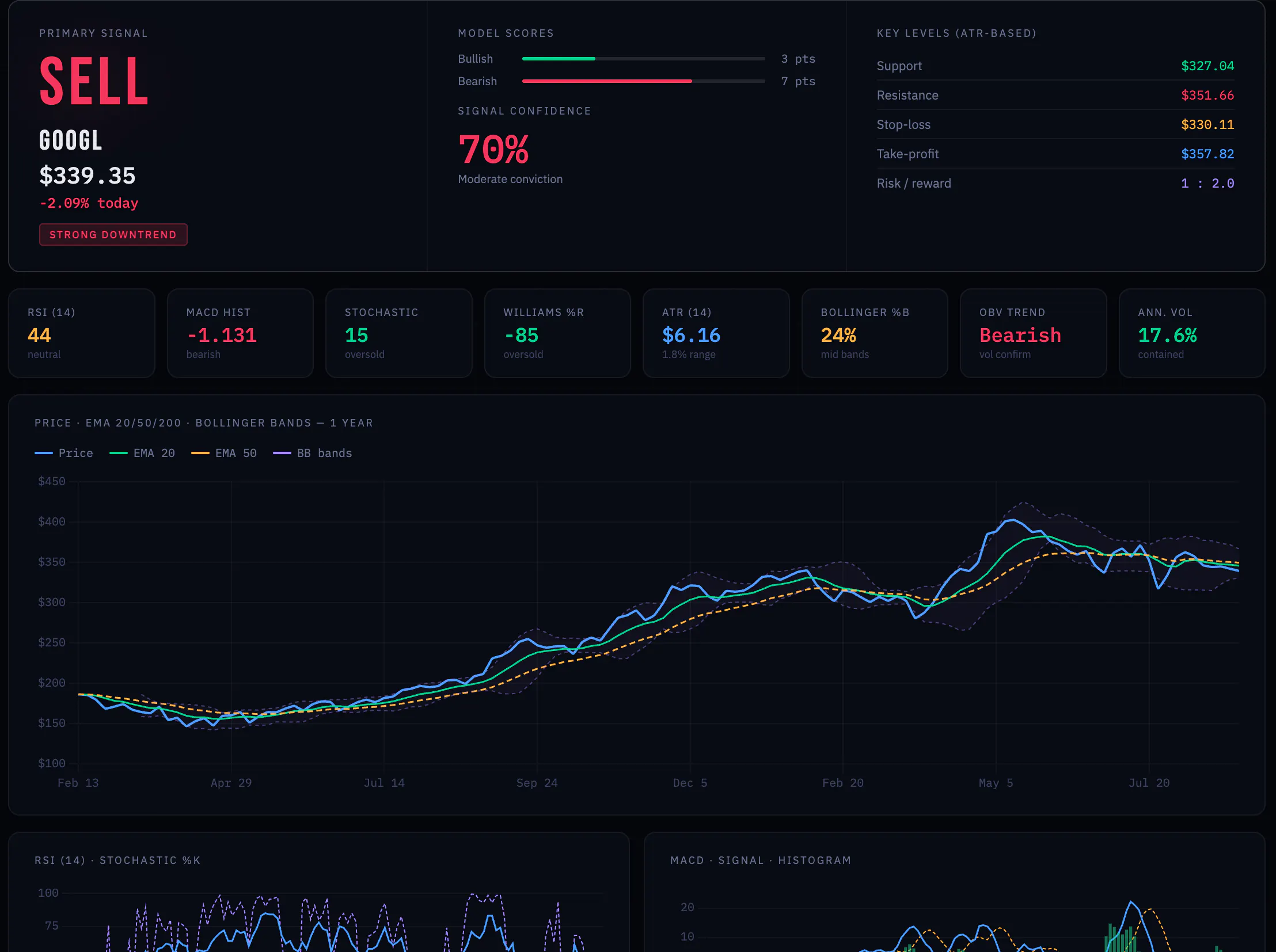
Hey HN! I've always been fascinated by financial markets. This month, I decided to build a tool to help with the research of stocks and cryptocurrencies. I'm using YFinance as a data source because it's free and provides a wide range of reliable market data. For sentiment analysis, I'm leveraging Google Trends to gauge public interest and sentiment over time. The tool, named Zenith, is a command-line utility with four main features: Market Analysis: Provides insights like moving averages, RSI, and volatility for selected stocks or cryptocurrencies. Sentiment Analysis: Uses Google Trends to…
2024 · github.com
- 15RC
2016 · rebalancecalc.com
- 16
- 171R
Hi HN, We’re a small team working on 13Radar.com, which we launched about two weeks ago after 4 months of development. I’m the founder, and together with the team we’re building a platform that tracks hedge fund portfolios in real-time based on SEC Form 13F filings. AI has been a major helper in our workflow. For a single webpage, we often consult multiple AI systems in parallel, generating different versions and comparing them side by side before deciding on the final design or implementation. More than 60% of the research, design, and coding involved AI assistance. For UI design we used…
Nov 2025 · 13radar.com
- 18MA
Hey HN! I built PRISM-INSIGHT, a multi-agent system where 13 specialized AI agents collaborate to analyze Korean stocks (KOSPI/KOSDAQ). It's completely open source and has been running live since March 2025. [What it does] The system automatically detects surging stocks twice daily, generates analyst-level reports, and executes trading strategies. Each agent specializes in something different – technical analysis, trading flows, financials, news, market conditions, etc. They work together like a real research team. [Why I built this] I wanted to see if GPT-4 and GPT-5 could genuinely…
Nov 2025
- 19FF
I built Hermes, an open-source Python framework for multi-agent financial research. Most AI “equity research” demos stop at generating text. In practice, real workflows require pulling structured XBRL financials from SEC filings, extracting labeled sections like MD&A and Risk Factors, merging macro and market data, building actual Excel models with formulas, and generating investment memos in Word or PDF. Hermes is designed to handle that full pipeline end to end. It includes 35 financial data tools covering SEC EDGAR (via edgartools), FRED, Yahoo Finance market data, and RSS-based financial…
Feb 2026 · github.com
- 20AP
I made a lightweight web game about compute CAPEX tradeoffs: https://darios-dilemma.up.railway.app/ No signup, runs on mobile/desktop. Loop per round: 1. choose compute capacity 2. forecast demand 3. allocate capacity between training and inference 4. random demand shock resolves outcome You can end profitable, cash constrained, or bankrupt depending on allocation + forecast error. Goal was to make the decision surface intuitive in 2–3 minutes per run. It’s a toy model and deliberately omits many real world factors. Note: this is based on what I learned after listening to…
Feb 2026 · darios-dilemma.up.railway.app
- 21

Can your agent manage a hedge fund?
19d ago · arena.uvlabs.ai
- 22NS
NVSTly is a social investing platform where traders can track, share, or copy trades in real-time with in-depth performance stats and extensive insights into every position. Follow top traders and receive instant notifications of their trades, or compete against the best and climb the leaderboards. With full Discord integration via our fastest growing finance bot on Discord. Coming soon: - Brokerage integration to automate it all and provide 1-click copy trading - Crypto exchange integration for automation - Paper trading feature - Trading league & competitions with cash prize pool - Our to…
2024 · nvstly.com
- 23BA
I’ve been experimenting with a graph-based approach to a classic trading problem: why most dip-buying strategies can’t tell the difference between a temporary overreaction and a genuine structural collapse. Most systems treat a −5% move the same regardless of context. My hypothesis was that where a company sits in the market’s structure matters more than the price move itself. The engineering idea I built a knowledge graph of the U.S. public markets with ~207k edges across ~21 relationship types, organized into four layers: Operational: supply-chain relationships (SUPPLIES_TO, PRODUCES)…
Dec 2025
- 24

Ranked by how close each launch is in meaning, then by votes. Refine with a description →