AI · alternatives · 2026
24 alternatives to Mugiwara Security
Proves vulnerabilities before reporting them.
Below are 24 products that do a similar job, ranked by how close each is in meaning and then by launch-day votes.
- 1

Automated Penetration Testing for AI-Built Apps
2021 · replay.io · its alternatives →
- 2
 BestDefense.io▲135
Pentest and patch every deploy with AI
Jun 2026 · bestdefense.io · its alternatives →
- 3

I use AI agents to build UI features daily. The thing that kept annoying me: the agent writes code but never sees what it actually looks like in the browser. It can’t tell if the layout is broken or if the console is throwing errors. So I built a CLI that lets the agent open a browser, interact with the page, record what happens, and collect any errors. Then it bundles everything — video, screenshots, logs — into a self-contained HTML file I can review in seconds. proofshot start --run "npm run dev" --port 3000 # agent navigates, clicks, takes screenshots proofshot stop It works with…
Mar 2026 · github.com · its alternatives →
- 4

- 5PP
Hey HN, I've been working on an intercepting proxy for penetration testing over the last few years in my spare time. Some points of difference from the existing tools: * The UIs are built using the native platform frameworks, meaning they look and behave like other applications on the desktop. * It has a fully embedded and integrated Python scripting engine. * It’s fully native meaning it’s nicer on system resources. * It has a number of built in scripts to automate reconnaissance, content discovery, authorisation checks, etc. * The core of it is open source. I'm really keen to get any…
2023 · pakikiproxy.com · its alternatives →
- 6

Scan any LLM chatbot for vulnerabilities
Apr 2026 · github.com · its alternatives →
- 7

This is a small PoC Python project for web server access logs analyzing to classify and dynamically block bad bots, such as L7 (application-level) DDoS bots, web scrappers and so on. We'll be happy to gather initial feedback on usability and features, especialy from people having good or bad experience wit bots. *Requirements* The analyzer relies on 3 Tempesta FW specific features which you still can get with other HTTP servers or accelerators: 1. JA5 client fingerprinting (https://tempesta-tech.com/knowledge-base/Traffic-Filtering-b...). This is a HTTP and TLS layers…
2025 · github.com · its alternatives →
- 8FL
Hi HN! We just launched Codacy Guardrails, an IDE extension with a CLI for code analysis and MCP server that enforces security & quality rules on AI-generated code in real-time. It hooks into AI coding assistants (like VS Code Agent Mode, Cursor, Windsurf), silently scanning and fixing AI-suggested code that has vulnerabilities or violates your coding standards, while the code it’s being generated. We built this because coding agents can be a double-edged sword. They do boost productivity, but can easily introduce insecure or non-compliant code. One recent research team at NYU found that 40%…
2025 · its alternatives →
- 9

Find AI vulnerabilities before hackers do
Mar 2026 · promptbrake.com · its alternatives →
- 10
 Opviva▲10
It proves your app's security holes, then fixes them
Jul 2026 · opviva.com · its alternatives →
- 11

I built a GitHub app that detects it in pull requests, notifies or blocks them. Alongside it, I published a Semgrep ruleset for any stage of the CI/CD. I started this after getting frustrated by all the FUD around malicious code - lots of noise, little effort to solve it. Having said that, it's still a major attack vector - a stored RCE, with the codebase itself as the sink. Feedback is appreciated. The app, PRevent - https://github.com/apiiro/PRevent The ruleset: https://github.com/apiiro/malicious-code-ruleset The research:…
2025 · github.com · its alternatives →
- 12

Tiny, offline prompt-injection scanner for CI pipelines
Apr 2026 · github.com · its alternatives →
- 13
 AttackerView▲13
Last week I wrote about building a scanner that writes its own exploits. A cron job runs Claude Code every night, it reads new CVEs, writes proof-of-concept checks, tests them against vulnerable and patched Docker instances, and opens PRs. I review and merge in the morning. That post was about how t
Feb 2026 · attackerview.com · its alternatives →
- 14

Find Out Whats Exploitable. In Hours, Not Weeks.
Jul 2026 · neurapent.com · its alternatives →
- 15

Block bad npm and pip packages. Before they download.
May 2026 · veln.sh · its alternatives →
- 16

I've been researching the bot & proxies space for years. I slowly incubated a service to protect public forms, contents and APIs. It recenty reached a few million daily requests and I now dare to bring it to light. Truesign detects bots, proxies/vpns and fake emails, through a single request from the browser, without challenges or user interaction. It can block the request based on rules you choose, or grant a token with encrypted information about the visitor for you to decide. I created a few pages to showcase how it works: - https:/demo.truesign.ai/protected-form : a form…
2025 · truesign.ai · its alternatives →
- 17

Find vulnerabilities in your AI prompts before your users do
Aug 2026 · testmyprompt.net · its alternatives →
- 18
 PwnScan▲8
For at least a few years (since before COVID), in my circle everbody wants an AI tool that finds vulnerabilities in binaries. I have my reservations about such a tool because of my perception that AI is overhyped, so I decided to build one myself to see how useful it could be (or not). I was actually kinda surprised how well it worked for my collection of binaries with known CVEs. It definitely has false positives and negatives, as any static analysis tool would, but I think its actually somewhat usable. I dont think the results are super actionable, but interesting nonetheless. I still…
2025 · pwnscan.com · its alternatives →
- 19

K-Veritas CLI. Contribute to 27-GROUP/kveritas-go development by creating an account on GitHub.
Aug 2026 · github.com · its alternatives →
- 20
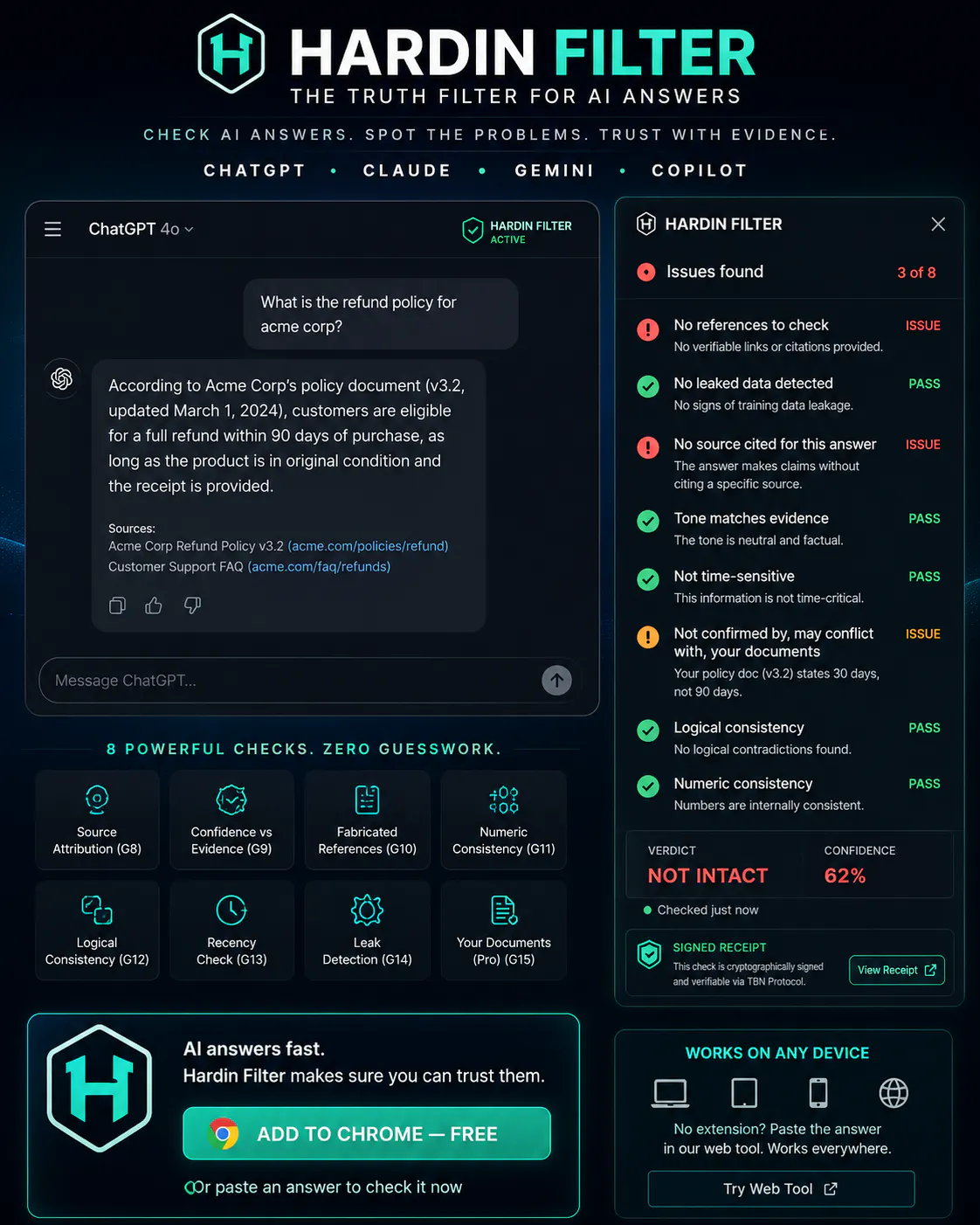
- 21

Every other gateway is detect-and-block. You don't get a security grade. You don't get red team in CI. We built the one that does. PromptGuard is a proxy: change your base URL (one line with our SDK, or a few lines without), and every request gets checked for prompt injection, PII leaks, jailbreaks, and abuse. 20+ threat vectors, 39+ PII types. We also ship a red team suite and an autonomous agent that mutates attacks to find bypasses - you get a grade (A-F) and a GitHub Action that runs these tests on every PR. So you see where you're weak before you ship. Works with OpenAI, Anthropic,…
Dec 2025 · promptguard.co · its alternatives →
- 22

- 23
 Axyr▲3
Code Review Tools AI Coding Agents AI Infrastructure Tools
Jul 2026 · axyr.dev · its alternatives →
- 24

Verify reality. Detect synthetic media in seconds.
May 2026 · truthguard-ai-deepfake.lovable.app · its alternatives →
Also compare
Ranked by how close each launch is in meaning, then by votes. Prices were read from each product’s own site when checked and can change. Refine with your own description →