AI · alternatives · 2026
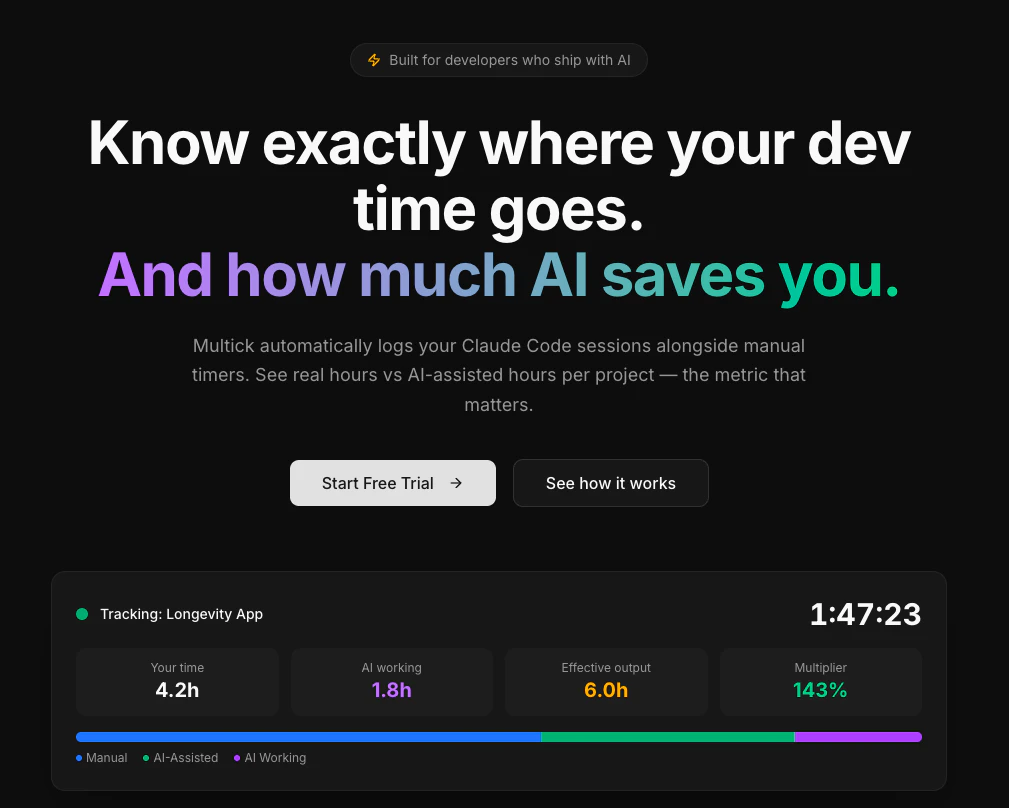
24 alternatives to Multick
Track your AI-assisted dev time.See your real productivity
Below are 24 products that do a similar job, ranked by how close each is in meaning and then by launch-day votes.
- 1

I kept slamming into Claude Code limits mid-session and couldn’t find a quick way to see how close I was getting, so I hacked together a tiny local tracker. Streams your prompt + completion usage in real time Predicts whether you’ll hit the cap before the session ends Runs 100 % locally (no auth, no server) Presets for Pro, Max × 5, Max × 20 — tweak a JSON if your plan’s different GitHub: https://github.com/Maciek-roboblog/Claude-Code-Usage-Monitor It’s already spared me a few “why did my run just stop?” moments, but it’s still rough around the edges. Feedback, bug…
2025 · github.com · its alternatives →
- 2

Run parallel coding agents from one desktop workspace
Apr 2026 · claude.com · its alternatives →
- 3
 The New Waydev▲299
Measure the full AI SDLC. From token to production.
Apr 2026 · waydev.co · its alternatives →
- 4

Let AI increase your productivity
2023 · timetracking.monitup.com · its alternatives →
- 5

See exactly how much you spend on Claude, across every tool
Mar 2026 · github.com · its alternatives →
- 6

Track your AI spend and connect it to business outcomes
Aug 2026 · rippling.com · its alternatives →
- 7

See what your Claude Code sessions actually cost
Jul 2026 · langwatch.ai · its alternatives →
- 8
 WOZCODE▲194
For the last year we've been building an AI mobile app builder. Last week we decided to generalize our agent harness and benchmark it against vanilla Claude Code. Turns out the tools we built for app building were significantly more efficient than the native Claude Code tools. When we ran benchmarks we beat Claude code on speed (~40% faster) , cost (25-55% cheaper) and performance (+17% on Terminal Bench 2.0). Today we're making our agent harness publicly available as a Claude Code plugin. Use code WOZCODE1 to try it for $1 at wozcode.com
May 2026 · wozcode.com · its alternatives →
- 9

I built a lightweight project management workflow to keep AI-driven development organized. The problem was that context kept disappearing between tasks. With multiple Claude agents running in parallel, I’d lose track of specs, dependencies, and history. External PM tools didn’t help because syncing them with repos always created friction. The solution was to treat GitHub Issues as the database. The "system" is ~50 bash scripts and markdown configs that: - Brainstorm with you to create a markdown PRD, spins up an epic, and decomposes it into tasks and syncs them with GitHub issues - Track…
2025 · github.com · its alternatives →
- 10

This project (Agents Observe) started as an exploration into building automation harnesses around claude code. I needed a way to see exactly what teams of agents were doing in realtime and to filter and search their output. A few interesting learnings from building and using this: - Claude code hooks are blocking - performance degrades rapidly if you have a lot of plugins that use hooks - Hooks provide a lot more useful info than OTEL data - Claude's jsonl files provide the full picture - Lifecycle management of MCP processes started by plugins is a bit kludgy at best The biggest takeaway is…
Apr 2026 · github.com · its alternatives →
- 11
 Usage4Claude▲109
I kept hitting Claude's 5-hour limit without realizing it, so I made this menu bar app to track it. Shows a color-coded ring (green/orange/red) and countdown to reset. Built it in Swift/SwiftUI, just for myself initially. Right now you have to manually grab your sessionKey from browser DevTools, which is annoying but works. Stores it in macOS Keychain so it's secure. Been actively working on it, already at v1.3.0 with much better UX now. It's open source (MIT) and works with all Claude platforms (web/CLI/desktop/mobile) since they share the quota. Currently…
Oct 2025 · github.com · its alternatives →
- 12

We built rudel.ai after realizing we had no visibility into our own Claude Code sessions. We were using it daily but had no idea which sessions were efficient, why some got abandoned, or whether we were actually improving over time. So we built an analytics layer for it. After connecting our own sessions, we ended up with a dataset of 1,573 real Claude Code sessions, 15M+ tokens, 270K+ interactions. Some things we found that surprised us: - Skills were only being used in 4% of our sessions - 26% of sessions are abandoned, most within the first 60 seconds - Session success rate varies…
Mar 2026 · github.com · its alternatives →
- 13

Spotify Wrapped for Claude, Codex & a Public leaderboard.
Jun 2026 · whoburnedmore.com · its alternatives →
- 14

An AI built to train you, not the other way around
Mar 2026 · make10000hours.com · its alternatives →
- 15
 KingCoding▲91
Run Claude, Codex & Cursor in parallel from one dashboard
Mar 2026 · kingcode.shingoirie.com · its alternatives →
- 16
 Clockk 2.0▲74
AI-powered time tracking for agencies and freelancers
2021 · clockk.com · its alternatives →
- 17
 Skilled▲76
Dashboard to find agent skills you no longer need
May 2026 · github.com · its alternatives →
- 18
 TimeToCoda▲65
AI Time Tracker, Weekly Journal and Productivity Dashboard
2023 · coda.io · its alternatives →
- 19

- 20

Note: this is an update to [this](https://news.ycombinator.com/item?id=44568529) "Show HN" post. timep is a state-of-the-art [debug-]trap-based bash profiler that is efficient and extremely accurate. Unlike other profilers, timep records: 1. per-command wall-clock time 2. per-command CPU time, and 3. the hierarchy of parent function calls /subshells for each command the wall-clock + CPU time combination allows you to determine if a particular command is CPU-bound or IO-bound, and the hierarchical logging gives you a map of how the code actually executed. The standout…
2025 · github.com · its alternatives →
- 21
 toktrack▲68
Did you know Claude Code deletes your session data after 30 days? I found out the hard way when I tried to check my spending history. My session files hit 3GB (2000+ files) and existing tools took 40+ seconds. Rewrote it in Rust with simd-json + rayon. - First run: ~1s (vs 40s+) - Daily use: ~0.04s (1000x faster, cached) - TUI dashboard with daily/weekly/monthly breakdown - Supports Claude Code, Codex CLI, Gemini CLI - Persistent cache — history survives even after CLI deletes files GitHub: https://github.com/mag123c/toktrack Feedback welcome!
Feb 2026 · github.com · its alternatives →
- 22
 Didon▲10
As an indie engineer, I wanted some real feedback on my productivity, like having an actual external boss. I tried using time trackers (even a physical timer), but they weren't good at tracking everything. So I built Didon, an AI time tracker that watches the screen periodically and generates work logs, then summarizes them into your workday report.
Jun 2026 · didon.app · its alternatives →
- 23
 Aimeterly▲15
See how your organization uses Claude Code — usage, estimated cost, productivity, and audit logs by user. No infrastructure to run; live in 5 minutes.
Aug 2026 · aimeterly.com · its alternatives →
- 24HW
A bunch of companies that I spoke to had their own claude & codex OTel dashboards that showed spend + seats per month. However, none of the dashboards actually analyzed how the engineers worked with the tools and if there were any areas for improvement! That's why I created https://www.promptster.ai. Managers get aggregate level view of code quality and how that ties with team workflows (nothing on a per-engineer level). While engineers get personalized coaching on how they can save tokens while keeping output high. We also have a tool built for individuals to test their local…
Jul 2026 · its alternatives →
Also compare
Ranked by how close each launch is in meaning, then by votes. Prices were read from each product’s own site when checked and can change. Refine with your own description →