Alternatives
Products that do what PrismGuard does
Self-hosted LLM guard — auditable blocks, not scores
- 1
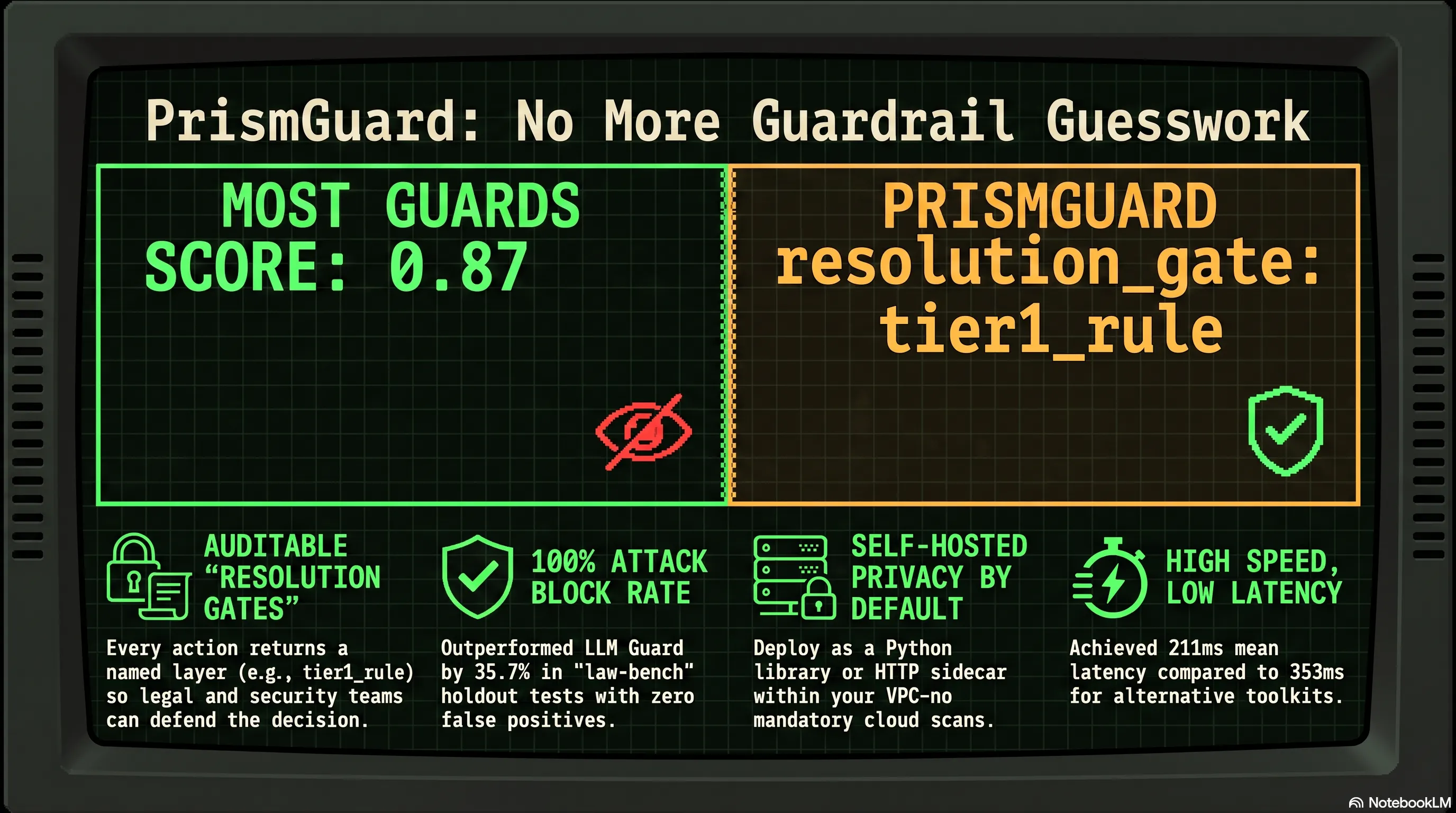
Prompt-injection firewall for prod LLM apps
Jul 2026 · insightits.com
- 2

- 3FG
Hi HN, I'm Antoine Zambelli, AI Director at Texas Instruments. I built Forge, an open-source reliability layer for self-hosted LLM tool-calling. What it does: - Adds domain-and-tool-agnostic guardrails (retry nudges, step enforcement, error recovery, VRAM-aware context management) to local models running on consumer hardware - Takes an 8B model from ~53% to ~99% on multi-step agentic workflows without changing the model - just the system around it - Ships with an eval harness and interactive dashboard so you can reproduce every number I wanted to run a handful of always-on agentic systems…
May 2026 · github.com
- 4

- 5

- 6

Trace LLM requests + costs with OpenTelemetry monitoring
Oct 2025
- 7

- 8

- 9

- 10

- 11OS
Hi HN, Matvey, Ildar, Joey, and Dominik here. If you're building LLM agents that use tools, you're probably worried about prompt injection attacks that can hijack those tools. We were too, and found that solutions like prompt-based filtering or secondary "guard" LLMs can be unreliable. Our thesis is that agent security should be handled at the network level between the agent and the LLM, just like a traditional web application firewall. So we built Archestra Platform: an open-source gateway that acts as a secure proxy for your AI agents. It's designed to be a deterministic firewall against…
Oct 2025 · archestra.ai
- 12OS
2024 · defguard.net
- 13

Self-hosted PII firewall for LLMs — policies, audit trail
Jun 2026 · github.com
- 14

- 15

- 16

- 17

- 18

- 19

- 20DO
I kept seeing every npm/pnpm/yarn/bun/uv supply chain post end with the same advice (set a minimum release age, turn off install scripts), and while I know cooldowns are "controversial", they do work. But even if you convince people that they should set cooldowns, it seems many don't end up following through, not sure why, maybe because it means hand-editing five config files in five formats with five different time units, or perhaps the "it won't happen to me" syndrome (or "I'll do it later, it seems complicated" where it's actually very simple). So I created a tool that…
Jun 2026 · github.com
- 21IB
The only way to go fast is full YOLO mode in your coding agent. I've got the local sandbox figured out (pro tip: Incus VMs work great) but I wanted to keep my agents from doing things like inadvertently blowing up my cloud services or chasing a prompt to POST to some random website. I struggle most with this on my side projects where my permission model isn't quite as robust as it is at the office. I started with a firewall on the Incus container but every time the agent needed access to something new, I was poking more holes in it - and it didn't differentiate between HTTP verbs. I've been…
Jul 2026 · trollbridge.dev
- 22CE
We just open-sourced CargoWall - a lightweight eBPF firewall for GitHub Actions. We originally built it to stop LLM agents from connecting to untrusted domains. After recent GitHub Actions supply chain compromises like the Trivy attack, we realized it'd work well for blocking untrusted connections from CI runners too. It uses iptables DNAT to redirect all outbound port 53 traffic to a local DNS proxy, which checks each query against a hostname allowlist before forwarding. Resolved IPs from allowed responses are inserted into eBPF LPM trie maps, and a TC egress classifier attached to the…
Mar 2026 · github.com
- 23LT
Current AI-assisted CLI tools are often part of larger systems and work better on Linux. I built llm-term to address these. It's a Rust-based tool that compiles into a single binary file. You only need to download the binary, add it to your PATH, and configure your OpenAI key to get started. While llm-term offers an option for gpt-4o, it works great with gpt-4o-mini. So it's not costly. I appreciate any feedback or suggestions.
2024 · github.com
- 24PL
Hey HN, We’re Alex, Land, and Rajit. We’re building Prism (prismai.sh), a tool that helps browser agents authenticate onto websites with user credentials. Developers pass in credentials, Prism logs into a website on their behalf, and hands them back the cookies so they have an authenticated session. Here’s an example of how developers can use Prism to complete username/password flows (https://youtu.be/SEtVUnWnxuE), and here’s an example of how developers can use Prism to complete login flows that require an OTP code (https://youtu.be/fe9w9PvrwH0). We spoke…
Sep 2025 · prismai.sh
Ranked by how close each launch is in meaning, then by votes. Refine with a description →