Dev tools · alternatives · 2026
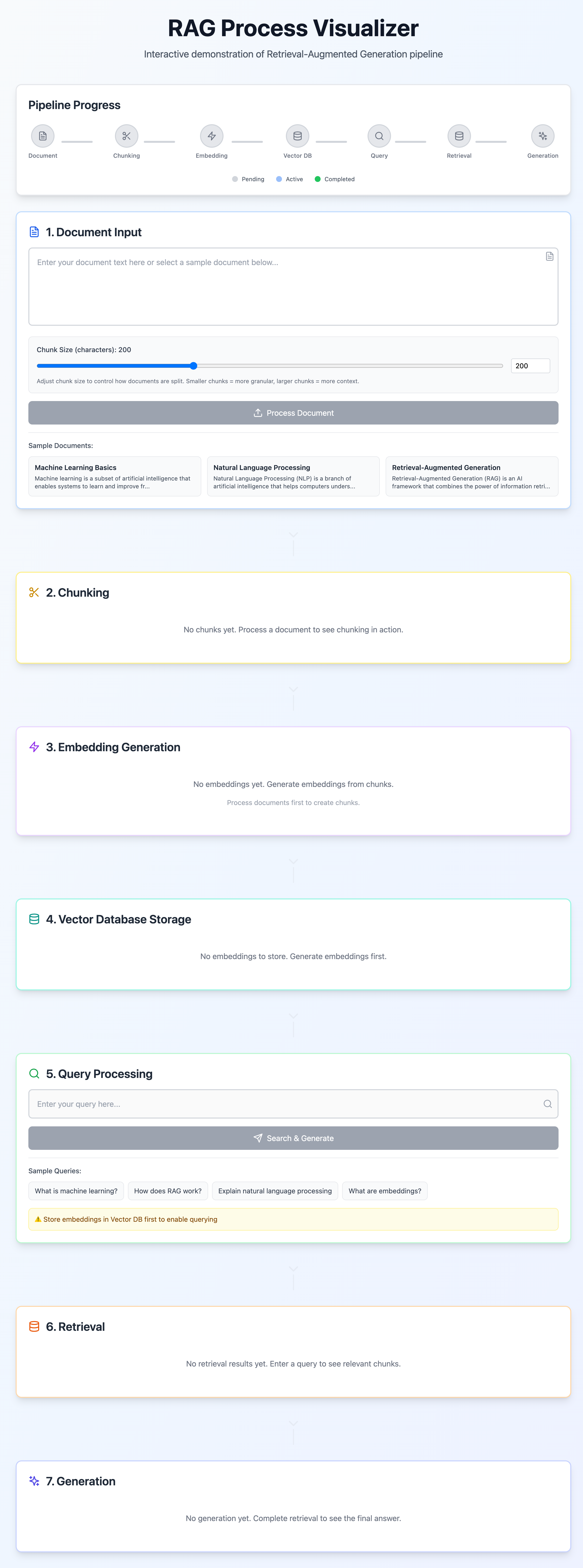
24 alternatives to RAG_Visualizer
Retrieval-Augmented Generation (RAG) pipeline visuals.
Below are 24 products that do a similar job, ranked by how close each is in meaning and then by launch-day votes.
- 1
 Vectorize▲246
Build RAG pipelines that are optimized for your data.
2024 · vectorize.io · its alternatives →
- 2

I've built an advanced RAG (Retrieval-Augmented Generation) pipeline from scratch to demystify the complex mechanics of modern LLM-powered Question Answering systems. This repository features: -- An implementation of a sub-question query engine from scratch to answer complex user questions. -- Illustrative explanations that unveil the inner workings of the system. -- An analysis of the challenges I faced while working with the system, like prompt engineering and cost estimation. -- Qualitative comparison with similar frameworks like LlamaIndex, offering a broader perspective. Key Takeaway:…
2023 · github.com · its alternatives →
- 3

Hey there HN! We’re Antonio, Luca, and Yuhang, and we’re excited to introduce Fast GraphRAG, an open-source RAG approach that leverages knowledge graphs and the 25 years old PageRank for better information retrieval and reasoning. Building a good RAG pipeline these days takes a lot of manual optimizations. Most engineers intuitively start from naive RAG: throw everything in a vector database and hope that semantic search is powerful enough. This can work for use cases where accuracy isn’t too important and hallucinations are tolerable, but it doesn’t work for more difficult queries that…
2024 · github.com · its alternatives →
- 4
 RAGstack▲111
Deploy a private ChatGPT alternative hosted within your VPC
2023 · github.com · its alternatives →
- 5
 Rag About It▲48
Dive deep into AI Retrieval Augmented Generation (RAG)
2024 · ragaboutit.com · its alternatives →
- 6

RAGLite is a Python package for building Retrieval-Augmented Generation (RAG) applications. RAG applications can be magical when they work well, but anyone who has built one knows how much the output quality depends on the quality of retrieval and augmentation. With RAGLite, we set out to unhobble RAG by mapping out all of its subproblems and implementing the best solutions to those subproblems. For example, RAGLite solves the chunking problem by partitioning documents in provably optimal level 4 semantic chunks. Another unique contribution is its optimal closed-form linear query adapter…
2024 · github.com · its alternatives →
- 7

- 8

Ragas is an open-source library for evaluating and testing RAG and other LLM applications. Github: https://docs.ragas.io/en/stable/, docs: https://docs.ragas.io/. Ragas provides you with different sets of metrics and methods like synthetic test data generation to help you evaluate your RAG applications. Ragas started off by scratching our own itch for evaluating our RAG chatbots last year. Problems Ragas can solve - How do you choose the best components for your RAG, such as the retriever, reranker, and LLM? - How do you formulate a test dataset…
2024 · github.com · its alternatives →
- 9

- 10QP
Hey HN! We've just launched Quilt, a robust RAG (Retrieval-Augmented Generation) UI that revolutionizes how you interact with your documents. Key features: - Multi-user setup with private/public document collections - Advanced hybrid RAG pipeline combining full-text & vector search - Smart citations with in-browser PDF preview and highlights - Fully customizable settings and prompts through the UI Making an account is free, no need to even use a strong password: this is only to ensure your documents are separate from the rest. We're keen to hear your thoughts and feedback. What features…
2024 · quilt.fly.dev · its alternatives →
- 11

I built this tool because I wanted a way to just take a bunch of URLs or domains, and query their content in RAG applications. It takes away the pain of crawling, extracting content, chunking, vectorizing, and updating periodically. I'm curious to see if it can be useful to others. I meant to launch this six months ago but life got in the way...
2024 · embedding.io · its alternatives →
- 12

Not all improvements come from adding complexity — sometimes it's about removing it. PageIndex takes a different approach to RAG. Instead of relying on vector databases or artificial chunking, it builds a hierarchical tree structure from documents and uses reasoning-based tree search to locate the most relevant sections. This mirrors how humans approach reading: navigating through sections and context rather than matching embeddings. As a result, the retrieval feels transparent, structured, and explainable. It moves RAG away from approximate "semantic vibes" and toward explicit reasoning…
2025 · github.com · its alternatives →
- 13

- Discovering the most effective RAG pipeline for your specific data and use case can be daunting. It requires experimenting with various RAG modules and configurations, which are both time-consuming and complex. - AutoRAG addresses this challenge by automatically evaluating different combinations of RAG modules and their parameters. You don't need to write implementation code yourself; everything is set up through a single YAML file. - Our aim is to save you the hassle of continuously adapting to new RAG modules and configurations. Instead, you can focus on developing robust data for your…
2024 · github.com · its alternatives →
- 14

PDF query tool using retrieval augmented generation
May 2026 · github.com · its alternatives →
- 15

Hey HN, we’re Adi and Arnav. A few months ago, we hit a wall trying to get LLMs to answer questions over research papers and instruction manuals. Everything worked fine, until the answer lived inside an image or diagram embedded in the PDF. Even GPT‑4o flubbed it (we recently tried O3 with the same, and surprisingly it flubbed it too). Naive RAG pipelines just pulled in some text chunks and ignored the rest. We took an invention disclosure PDF (https://drive.google.com/file/d/1ySzQgbNZkC5dPLtE3pnnVL2rW_9...) containing an IRR‑vs‑frequency graph and asked GPT “From…
2025 · github.com · its alternatives →
- 16
 Korvus▲122
Search SDK to unify RAG pipeline in a single database query
2024 · github.com · its alternatives →
- 17

Hello HN, I'm Owen from SciPhi (https://www.sciphi.ai/), a startup working on simplifying˛Retrieval-Augmented Generation (RAG). Today we’re excited to share R2R (https://github.com/SciPhi-AI/R2R), an open-source framework that makes it simpler to develop and deploy production-grade RAG systems. Just a quick reminder: RAG helps Large Language Models (LLMs) use current information and specific knowledge. For example, it allows a programming assistant to use your latest documents to answer questions. The idea is to gather all the relevant information…
2024 · github.com · its alternatives →
- 18
 Linq▲35
Build search engine for texts, images and beyond In 1 hour
2023 · getlinq.com · its alternatives →
- 19

A RAG has several moving parts: data ingestion, retrieval, re-ranking, generation etc.. Each part comes with numerous options. If we consider a toy example, where you could choose from: 5 different chunking methods, 5 different chunk sizes, 5 different embedding models, 5 different retrievers, 5 different re-rankers/ compressors 5 different prompts 5 different LLMs That’s 78,125 distinct RAG configurations! If you could try evaluating each one in just 5 mins, that’d still take 271 days of non-stop trial-and-error effort! In short, it’s kinda impossible to find your optimal RAG setup…
2024 · github.com · its alternatives →
- 20

One-Click RAG Implementation, Simple and Portable. Contribute to boquila/ocrisp development by creating an account on GitHub.
2025 · github.com · its alternatives →
- 21

Hey HN! If you’re at all interested in LLMs/LLM-apps, you’ve probably heard of RAG: Retrieval-Assisted Generation, i.e. retrieving relevant documents to give to your LLM as context to answer user queries. Today, I’m releasing RAGatouille v0.0.1, whose aim is to make it as easy as can be to improve your RAG pipelines by leveraging state-of-the-art Information Retrieval research. As of right now, there’s quite a big gap between common everyday practice and the IR literature, and a lot of the gap is because there just aren’t good ways to quickly try out and leverage SotA IR techniques.…
2024 · github.com · its alternatives →
- 22

A Python CLI to test, benchmark, and find the best RAG chunking strategy for your Markdown documents. - messkan/rag-chunk
Nov 2025 · github.com · its alternatives →
- 23

- 24

Also compare
Ranked by how close each launch is in meaning, then by votes. Prices were read from each product’s own site when checked and can change. Refine with your own description →