Dev tools · alternatives · 2026

24 alternatives to SmokedMeat, like Metasploit, but for CI/CD (open-source)
A CI/CD Red Team Framework for demonstrating Build Pipeline security risks.
SmokedMeat is an open-source CI/CD red team framework designed to demonstrate security vulnerabilities in build pipelines. Similar to Metasploit but focused on continuous integration and deployment environments, it… Below are 24 products that do a similar job, ranked by how close each is in meaning and then by launch-day votes.
- 1

- 2

The open source CI/CD platform
2025 · semaphore.io · its alternatives →
- 3

2025 · bottlefire.dev · its alternatives →
- 4
 Dastardly▲57
A lightweight web app security scanner for your CI pipelines
2022 · portswigger.net · its alternatives →
- 5

Bake, A build system for building, testing and running C & C++ projects - SanderMertens/bake
2018 · github.com · its alternatives →
- 6

- 7

Fastest CI/CD platform for world’s best engineering teams
2018 · semaphore.io · its alternatives →
- 8

I've been obsessed for the past ~year with the possibilities of talking to LLMs. I built a bunch of one-off prototypes, shared code on X, started a Meetup group in SF, and co-hosted a big hackathon. It turns out that there are a few low-level problems that everybody building conversational/real-time AI needs to solve on the way to building/shipping something that works well: low-latency media transport, echo cancellation, voice activity detection, phrase endpointing, pipelining data between models/services, handling voice interruptions, swapping out different…
2024 · github.com · its alternatives →
- 9

Your wireframe should be easy to share with any developer on your team. Design fast with iPhone and iPad collaboration. Precursor is productive prototyping.
2015 · precursorapp.com · its alternatives →
- 10DA
2018 · dotmesh.com · its alternatives →
- 11
 SafeDep Vet▲72
GitLab CI Component that lets you seamlessly protect your pipelines from vulnerable and malicious open source dependencies. The component integrates directly into your CI/CD workflow through the GitLab CI Catalog and allows you to establish policy-driven guardrails using Common Expression Language (CEL). Key features: - Set your own opinionated security policies as code using CEL - Detect and block risky OSS components before they enter your codebase - Seamless integration as a native GitLab CI Component - Available directly in the GitLab CI Catalog Try and lets us know our thoughts!
2023 · safedep.io · its alternatives →
- 12
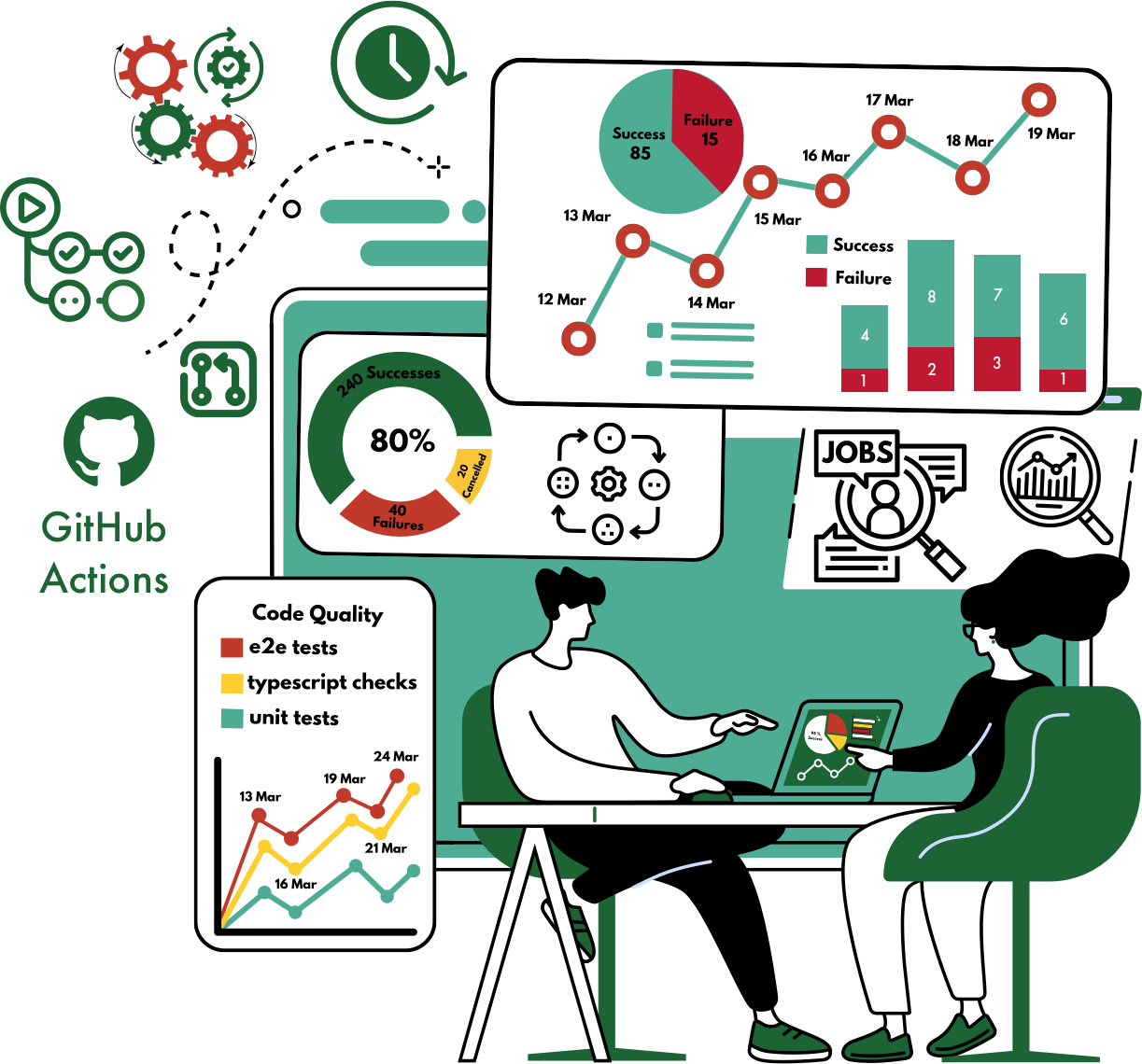
Supercharged GitHub pipelines with observability & insights
2023 · its alternatives →
- 13
 Breadcrumb▲163
Open-source LLM tracing for agent visibility
Mar 2026 · breadcrumb.sh · its alternatives →
- 14

🔥 A cross-platform build utility based on Lua. Contribute to xmake-io/xmake development by creating an account on GitHub.
2019 · github.com · its alternatives →
- 15

Autogenerate a complete mobile CI/CD pipeline in minutes
2023 · app.runway.team · its alternatives →
- 16

- 17

We’re Robin, Louis, and Thomas. Pipelex is a DSL and a Python runtime for repeatable AI workflows. Think Dockerfile/SQL for multi-step LLM pipelines: you declare steps and interfaces; any model/provider can fill them. Why this instead of yet another workflow builder? - Declarative, not glue code: you state what to do; the runtime figures out how. - Agent-first: each step carries natural-language context (purpose, inputs/outputs with meaning) so LLMs can follow, audit, and optimize. Our MCP server enables agents to run pipelines but also to build new pipelines on demand. - Open…
Oct 2025 · github.com · its alternatives →
- 18

- 19IB
I found it odd there wasn’t a simple web tool to scan Docker Hub images for vulnerabilities. So I built one. It’s powered by the popular open-source tool Trivy.
2023 · containercve.com · its alternatives →
- 20
 Mesh Blaze▲109
Easily create modular, blazing-fast and bloat-free web apps
2023 · meshblaze.com · its alternatives →
- 21

A cross-platform build utility based on Lua
2019 · xmake.io · its alternatives →
- 22

Introducing DRM-CI, a solution that lets you test graphics subsystem patches across numerous devices.
2024 · collabora.com · its alternatives →
- 23

Brisk is an open-source C++ GUI framework with a declarative approach, offering powerful data bindings, GPU-accelerated graphics, and dynamic widget management. It supports macOS, Linux, Windows, and simplifies UI creation with modern paradigms and CSS-like layouts. Initially developed for a graphics-intensive project with a complex and dynamic GUI, the framework is currently under active development.
2024 · github.com · its alternatives →
- 24
 R2Devops▲92
Automate painful tasks of software development in 1 click
2022 · getplumber.io · its alternatives →
Also compare
Ranked by how close each launch is in meaning, then by votes. Prices were read from each product’s own site when checked and can change. Refine with your own description →