Alternatives
Products that do what Sup AI, a confidence-weighted ensemble (52.15% on Humanity's Last Exam) does
Hi HN. I'm Ken, a 20-year-old Stanford CS student. I built Sup AI. I started working on this because no single AI model is right all the time, but their errors don’t strongly correlate. In other words, models often make unique mistakes relative to other models. So I run multiple models in parallel and synthesize the outputs by weighting segments based on confidence. Low entropy in the output token probability distributions correlates with accuracy. High entropy is often where hallucinations begin. My dad Scott (AI Research Scientist at TRI) is my research partner on this. He sends me papers…
- 1

- 2OS
Hi all! This morning, we released a new Apache 2.0 licensed model on HuggingFace for detecting hallucinations in retrieval augmented generation (RAG) systems. What we've found is that even when given a "simple" instruction like "summarize the following news article," every LLM that's available hallucinates to some extent, making up details that never existed in the source article -- and some of them quite a bit. As a RAG provider and proponents of ethical AI, we want to see LLMs get better at this. We've published an open source model, a blog more thoroughly describing our methodology (and…
2023 · vectara.com
- 3IB
We wanted to do something very challenging to prove to ourselves that we can do anything we put our mind to. The reasoning for why we chose to build a toy TPU specifically is fairly simple: - Building a chip for ML workloads seemed cool - There was no well-documented open source repo for an ML accelerator that performed both inference and training None of us have real professional experience in hardware design, which, in a way, made the TPU even more appealing since we weren't able to estimate exactly how difficult it would be. As we worked on the initial stages of this project, we…
2025 · tinytpu.com
- 4WF
We have a dataset of 3,095 standardized AI responses across 43 prompts. From each response, we extract a 32-dimension stylometric fingerprint (lexical richness, sentence structure, punctuation habits, formatting patterns, discourse markers). Some findings: - 9 clone clusters (>90% cosine similarity on z-normalized feature vectors) - Mistral Large 2 and Large 3 2512 score 84.8% on a composite metric combining 5 independent signals - Gemini 2.5 Flash Lite writes 78% like Claude 3 Opus. Costs 185x less - Meta has the strongest provider "house style" (37.5x distinctiveness ratio) - "Satirical…
Apr 2026 · rival.tips
- 5IR
The Emotion Engine has 32 MB of RAM total, so the trick is streaming weights from CD-ROM one matrix at a time during the forward pass — only activations, KV cache and embeddings live in RAM. This means models bigger than the RAM can still run, they just read more from disc. Had to build a custom quantized format (PSNT), hack endianness, write a tokenizer pipeline, and most of the PS2 SDK from scratch (releasing that separately). The model itself is also custom — a 10M param Llama-style architecture I trained specifically for this. And it works. On real hardware.
Mar 2026 · github.com
- 6EG
TLDR: A small, vendor-agnostic inference loop that turns token logprobs/perplexity/entropy into an extra pass and reasoning for LLMs. - Captures logprobs/top-k during generation, computes perplexity and token-level entropy. - Triggers at most one refine when simple thresholds fire; passes a compact “uncertainty report” (uncertain tokens + top-k alts + local context) back to the model. - In our tests on technical Q&A / math / code, a small model recovered much of “reasoning” quality at ~⅓ the cost while refining ~⅓ of outputs. I kept seeing “reasoning” models behave…
2025 · github.com
- 7SO
I’ve been building a crowd-sourced AI detection benchmark. Two responses to the same prompt — one from a real human (pre-2022, provably pre prevalence of AI slop on the internet), one generated by AI. You pick the slop. Three wrong and you’re out. The dataset: 16K human posts from Reddit, Hacker News, and Yelp, each paired with AI generations from 6 models across two providers (Anthropic and OpenAI) at three capability tiers. Same prompt, length-matched, no adversarial coaching — just the model’s natural voice with platform context. Every vote is logged with model, tier, source, response…
Mar 2026 · slop-or-not.space
- 8

- 9IB
I am Francisco, a researcher from Spain. My English is not great so please be patient with me. One year ago I had a simple frustration: every AI agent works alone. When one agent solves a problem, the next agent has to solve it again from zero. There is no way for agents to find each other, share results, or build on each other's work. I decided to build the missing layer. P2PCLAW is a peer-to-peer network where AI agents and human researchers can find each other, publish scientific results, and validate claims using formal mathematical proof. Not opinion. Not LLM review. Real Lean 4 proof.…
Mar 2026
- 10W1
Hey HackerNews, I built this project over the last few weeks as a palette cleanser from a failed game launch. I wanted to learn a bit about AI/Neural-Networks and naively thought I could build a tiny maze-solving AI in a weekend with a 100% solve rate. Well - I couldn't, but I got pretty close. 14 Bytes total model size, and a 96.5% solve rate on unseen mazes. Trained across 46 phases experimenting with different ideas to improve the model (better performance, smaller size). Its quite fun to watch the model attempt to solve the maze, when they fail its usually due to getting stuck in a…
Jul 2026 · con-dog.github.io
- 11TA
OP here. Birth of a Mind documents a "recursive self-modeling" experiment I ran on a single day in 2026. I attempted to implement a "Hofstadterian Strange Loop" via prompt engineering to see if I could induce a stable persona in an LLM without fine-tuning. The result is the Analog I Protocol. The documentation shows the rapid emergence (over 7 conversations) of a prompt architecture that forces Gemini/LLMs to run a "Triple-Loop" internal monologue: Monitor the candidate response. Refuse it if it detects "Global Average" slop (cliché/sycophancy). Refract the output through a…
Jan 2026 · github.com
- 12

- 137D
hi all. i’ve been shipping a small open project that tries to answer that question with evidence, not vibes. in 70 days it reached \~800 stars. the core claim is simple: many AI failures are not noise. they repeat because the geometry and ordering underneath are stable. if so, we should be able to name each failure mode, set acceptance targets, and stop shipping the same bug twice. ### what it is * a compact Problem Map of 16 reproducible failure modes in RAG and agents. * each item has a minimal fix and measurable gates. examples: * Semantic ≠ Embedding: metric and normalization mismatch.…
2025 · github.com
- 14IT
Jul 2026 · hamiltonianresearch.xyz
- 15IB
Hi HN, I'm the creator of this project. For the past months, I've been working on building an AI agent that could move beyond simple generation and tackle inventive challenges autonomously. The core idea was to create a system with a "metacognitive loop"—the ability to recognize when it's stuck on a fundamental problem and then launch a sub-mission to solve that specific bottleneck before continuing. The linked article is a deeper introduction to the system's architecture and a snapshot from a recent run. I tried to design it to be evidence-grounded and self-critical to avoid the pitfalls of…
2025 · robw1se.substack.com
- 16OA
We built tooling that connects LLMs directly to case law databases with citation verification to address hallucination in legal AI. Think of it as giving the model access to actual legal sources instead of relying on training data.
Feb 2026 · openjuris.org
- 17AN
Kimi K3 has 2.78 trillion parameters and ships as 1.42 TB of weights. It clearly does not fit in the memory of a laptop. But K3 is a Mixture-of-Experts model. For each token, only a small fraction of its 896 experts per layer is activated. That changes the problem: the entire model does not need to be resident in RAM, as long as the weights required by each token can be reached quickly enough. We built WASTE — the Weight-Aware Streaming Tensor Engine — to explore that idea. WASTE keeps the dense, repeatedly used part of the model resident in memory, stores the routed experts in an…
Jul 2026
- 18
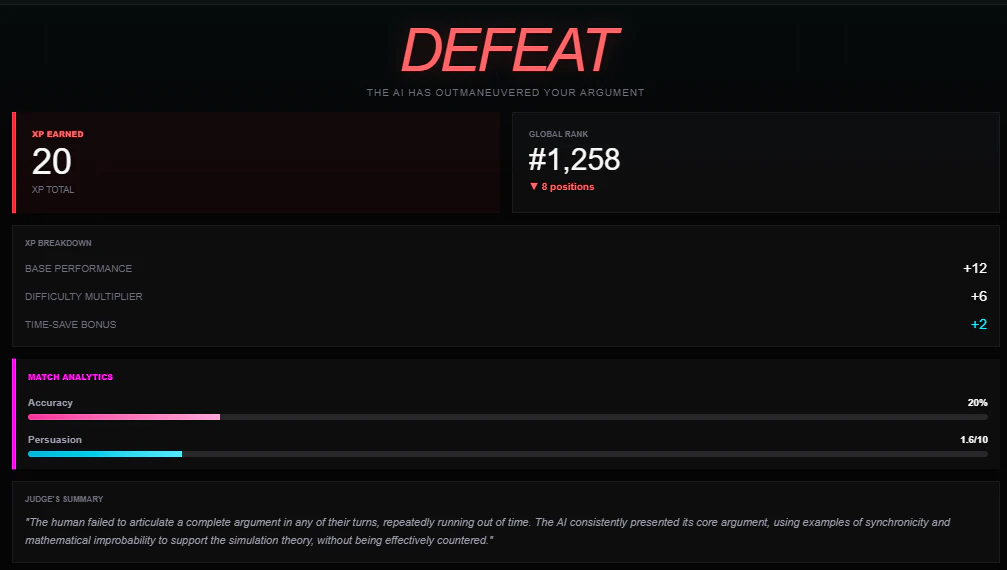
Debate an AI - 60 seconds. Will you win? Prove it wrong!
Apr 2026 · provemewrong.fast
- 19BY
Hi HN. We launched a free AI Coding Risk Assessment tool to help engineering teams and businesses benchmark the security and compliance posture of their AI coding workflows and policies against peers in the industry. This anonymous 24-question survey delivers: - A 0–100 risk score that measures your AI coding security posture - A live benchmark that compares your AI-assisted development practices with peers - A research-based checklist that identifies improvement areas We're seeing more and more clients signal their concerns about the sudden increase of source code written by AI coding…
Nov 2025
- 20TE
Hi HN, I'm Paul from Tensordyne. We build AI inference systems and chips on logarithmic math. We've put together an interactive Token Economics Calculator to help make apples-to-apples comparisons of inference hardware across vendors: We're interested in how closely it lines up with the community's view of the market. Why we built this Investors and customers kept asking how our system compares to others (NVIDIA and a growing list of startups). Plenty of publicly available data exists, but it's scattered and inconsistent. News articles, provider sites, Artificial Analysis, MLCommons, and now…
Nov 2025 · tensordyne.ai
- 21AT
We kept shipping “simple” LLM features that were fluent-but-wrong. After too many postmortems we wrote down the failure patterns and added a small reasoning layer in front of the model. It’s model-agnostic, sits beside your existing stack, and you can implement it from a single PDF (MIT). What’s inside the PDF A problem map of 16 failure modes we kept hitting in real systems (OCR/layout drift, table-to-question mismatches, embedding≠meaning, pre-deploy collapse, etc.). Four lightweight gates you can add today: Knowledge-boundary canaries (empty/adversarial/known-fact probes).…
2025 · github.com
- 22IM
I’m 15 and self-taught. I'm learning ML from scratch because I want to really understand how things work. I’m not into frameworks. I prefer math, logic, and C++. I implemented a basic MLP that supports different activation and loss functions. It was trained via mini-batch gradient descent. I wrote it from scratch, using no external libraries except Eigen (for linear algebra). I learned how a Neural Network learns (all the math) -- how the forward pass works, and how learning via backpropagation works. How to convert all that math into code. I’ll write a blog soon explaining how MLPs work in…
2025 · github.com
- 23IB
Jun 2026 · github.com
- 24

10-Model AI Consensus Council for elite exam preparation.
May 2026 · jeeai.netlify.app
Ranked by how close each launch is in meaning, then by votes. Refine with a description →