Dev tools · alternatives · 2026

24 alternatives to TenantGuard
Open source scanner for cross-tenant AI-agent security bugs
Below are 24 products that do a similar job, ranked by how close each is in meaning and then by launch-day votes.
- 1
 Permit.io▲677
The new Permit.io CLI brings developer-first workflows to access control. Define, test, deploy, and enforce fine-grained authorization using AI, CI/CD, GitOps, and OpenAPI — all from your terminal
2023 · permit.io · its alternatives →
- 2

Give AI agents access to real-time data across 200+ apps
May 2026 · apideck.com · its alternatives →
- 3

Hi HN, Gabriel, Co-Founder at Permit.io. We're releasing Permit MCP Gateway today, an authorization proxy for MCP servers. TL;DR - we built an MCP Gateway that developers love and CISOs trust. Watch more[0] Now, after your little hate on using fancy copy on HN, to the real thing: MCP is in a strange place. Developers are debating whether it's overcomplicated compared to CLIs or skills files. Meanwhile, enterprises are adopting it by default because every agentic system that acts on your behalf, Cursor, Claude, Copilot, internal agents, needs a stable infrastructure for connecting to tools.…
Mar 2026 · permit.io · its alternatives →
- 4

Hey HN! Today we're launching Agent Vault - an open source HTTP credential proxy and vault for AI agents. Repo is at https://github.com/Infisical/agent-vault, and there's an in-depth description at https://infisical.com/blog/agent-vault-the-open-source-crede.... We built Agent Vault in response to a question that been plaguing the industry: How do we give agents secure access to services without them reading any secrets? Most teams building agents have run into this exact problem: They build an agent or agentic system and come to realize at some point…
Apr 2026 · github.com · its alternatives →
- 5
 MCP Defender▲152
Hi HN, MCP Defender is an open source desktop app that automatically proxies your MCP traffic in AI apps like Cursor, Claude, Windsurf and VSCode. It then scans all requests and responses between the apps and the MCP tools they call. If it detects anything malicious, it alerts you and lets you allow or block the tool call. While the threat landscape of MCP is still being actively researched, there are dangerous things that MCP Defender can block today. For example, a developer asks Cursor to fix a Github issue with an attached crash log. However, the Github issue was created by an attacker…
2025 · mcpdefender.com · its alternatives →
- 6

- 7

Hey HN! This is Adil, Salman and Jose and and we’re behind archgw [1]. An intelligent proxy server designed as an edge and AI gateway for agents - one that natively know how to handle prompts, not just network traffic. We’ve made several sweeping changes so sharing the project again. A bit of background on why we’ve built this project. Building AI agent demos is easy, but to create something production-ready there is a lot of repeat low-level plumbing work that everyone is doing. You’re applying guardrails to make sure unsafe or off-topic requests don’t get through. You’re clarifying vague…
2025 · github.com · its alternatives →
- 8
 CtrlAI▲104
Transparent proxy that secures AI agents with guardrails
Mar 2026 · github.com · its alternatives →
- 9FL
Hi HN! We just launched Codacy Guardrails, an IDE extension with a CLI for code analysis and MCP server that enforces security & quality rules on AI-generated code in real-time. It hooks into AI coding assistants (like VS Code Agent Mode, Cursor, Windsurf), silently scanning and fixing AI-suggested code that has vulnerabilities or violates your coding standards, while the code it’s being generated. We built this because coding agents can be a double-edged sword. They do boost productivity, but can easily introduce insecure or non-compliant code. One recent research team at NYU found that 40%…
2025 · its alternatives →
- 10

Local security & compliance scanner for AI agents
Jul 2026 · safeclaude.net · its alternatives →
- 11

- 12

Your AI agent hits an infinite loop and racks up $2000 in API charges overnight. This happens weekly to AI developers. AgentGuard monitors API calls in real-time and automatically kills your process when it hits your budget limit. How it works: Add 2 lines to any AI project: const agentGuard = require('agent-guard'); await agentGuard.init({ limit: 50 }); // $50 budget // Your existing code runs unchanged const response = await openai.chat.completions.create({...}); // AgentGuard tracks costs automatically When your code hits $50 in API costs, AgentGuard stops…
2025 · github.com · its alternatives →
- 13

Your agent team, on your machine. Open-source harness for multi-user Claude agents. - yaodub/cast
Jun 2026 · github.com · its alternatives →
- 14
 Panguard.AI▲20
Open-source malware scanner and runtime guard for AI agents
Jul 2026 · panguard.ai · its alternatives →
- 15
 skillgaurd▲11
Detect Security Threats in Agent Skills
Jan 2026 · skillgaurd.up.railway.app · its alternatives →
- 16

- 17
 QuiGuard▲2
Selfhosted proxy; scrubs secrets from AI Agent tool calls.
Mar 2026 · quiguardweb.vercel.app · its alternatives →
- 18
 ContextGuard▲12
I built ContextGuard after discovering that 43% of MCP servers have critical security vulnerabilities. MCP (Model Context Protocol) is the new standard that lets Claude Clients(Desktop, Windsurf, Cursor, etc.) access external tools and data sources - think of it as a plugin system for AI assistants. The problem: When you give those clients access to your filesystem, databases, or APIs through MCP servers, you're opening up serious attack vectors. Prompt injection, data leakage, and path traversal attacks are all possible. Most developers building MCP servers don't have security expertise,…
2025 · github.com · its alternatives →
- 19

At my last company, we connected Claude Code and Cursor to almost all our internal services via MCP. It made the team incredibly fast, but we hit a wall: permissions. If you give an agent "Read Only" access, it can’t actually fix anything. If you give it "Write" access, it’s only a matter of time before a hallucination or a bad prompt results in a deleted database or a nuked production bucket. We had a few "close calls" that convinced us that simply reducing IAM permissions makes agents useless. I built Armour (https://github.com/fuushyn/armour) to solve this. It’s a…
Jan 2026 · github.com · its alternatives →
- 20

Insights, risk assessments, and plain-English summaries
2025 · contractguardai.blueorangelabs.com · its alternatives →
- 21

7 layers between your AI agents and disaster.
Feb 2026 · takeinterest.ai · its alternatives →
- 22
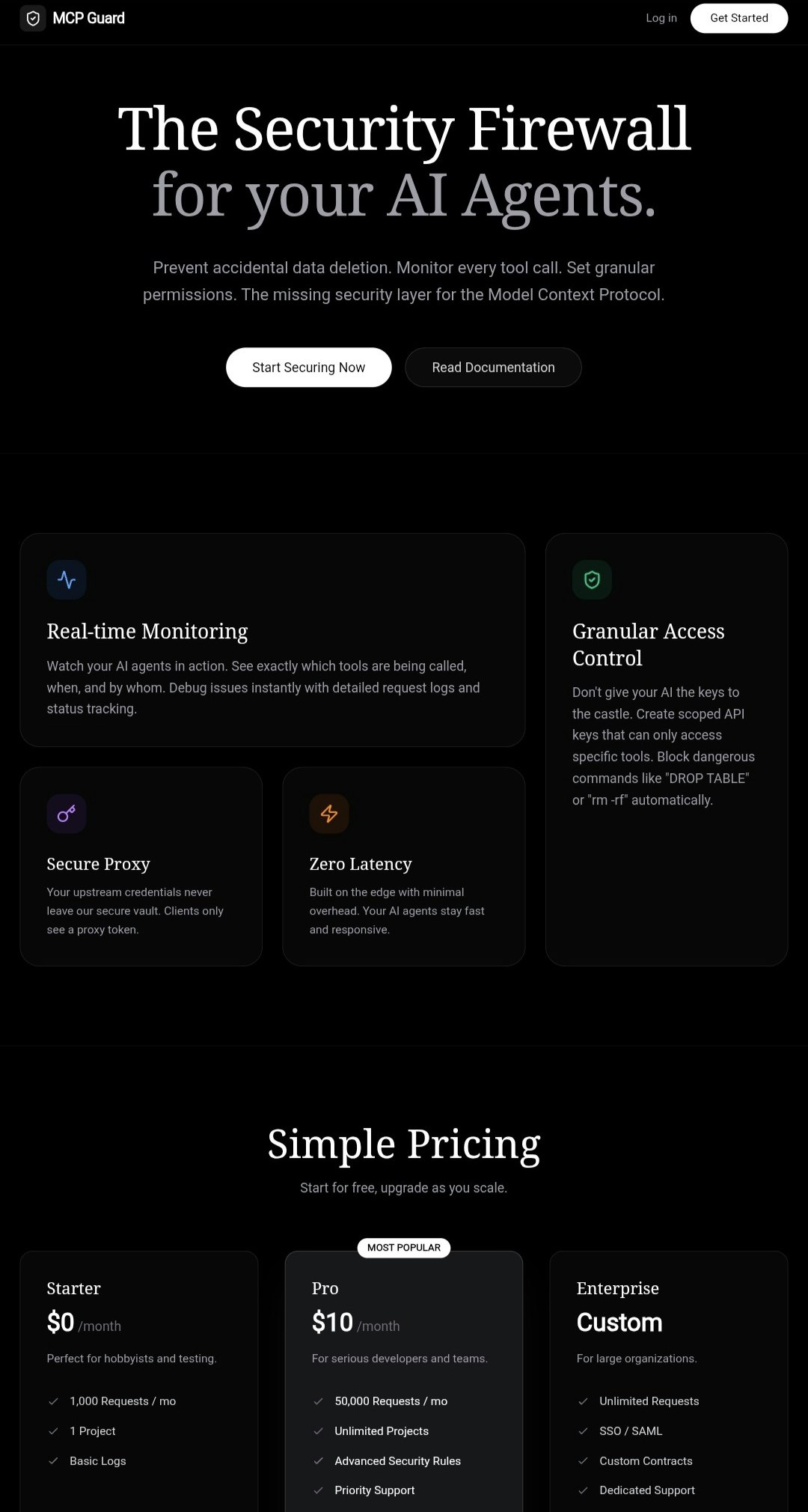
The firewall for AI agents. Block dangerous commands
Dec 2025 · mcp-shield.vercel.app · its alternatives →
- 23

- 24

AI writes code. ScopeGuard keeps it aligned.
Jun 2026 · github.com · its alternatives →
Also compare
Ranked by how close each launch is in meaning, then by votes. Prices were read from each product’s own site when checked and can change. Refine with your own description →