AI · alternatives · 2026
24 alternatives to The Impact of Noise on Recurrent Neural Networks
Series on reservoir computing, focusing on echo state networks. Covers GPU simulations, addressing variable training lengths and data processing. Analyzes Gaussian noise impact on network performance, with practical demonstrations and theoretical discussions. Relevant for those interested in neural network behavior in noisy environments.
This series examines how Gaussian noise affects recurrent neural networks, specifically echo state networks used in reservoir computing. It provides GPU-based simulations that handle variable training lengths and data… Below are 24 products that do a similar job, ranked by how close each is in meaning and then by launch-day votes. The Impact of Noise on Recurrent Neural Networks launched in 2023; newer entries below may have overtaken it.
- 1
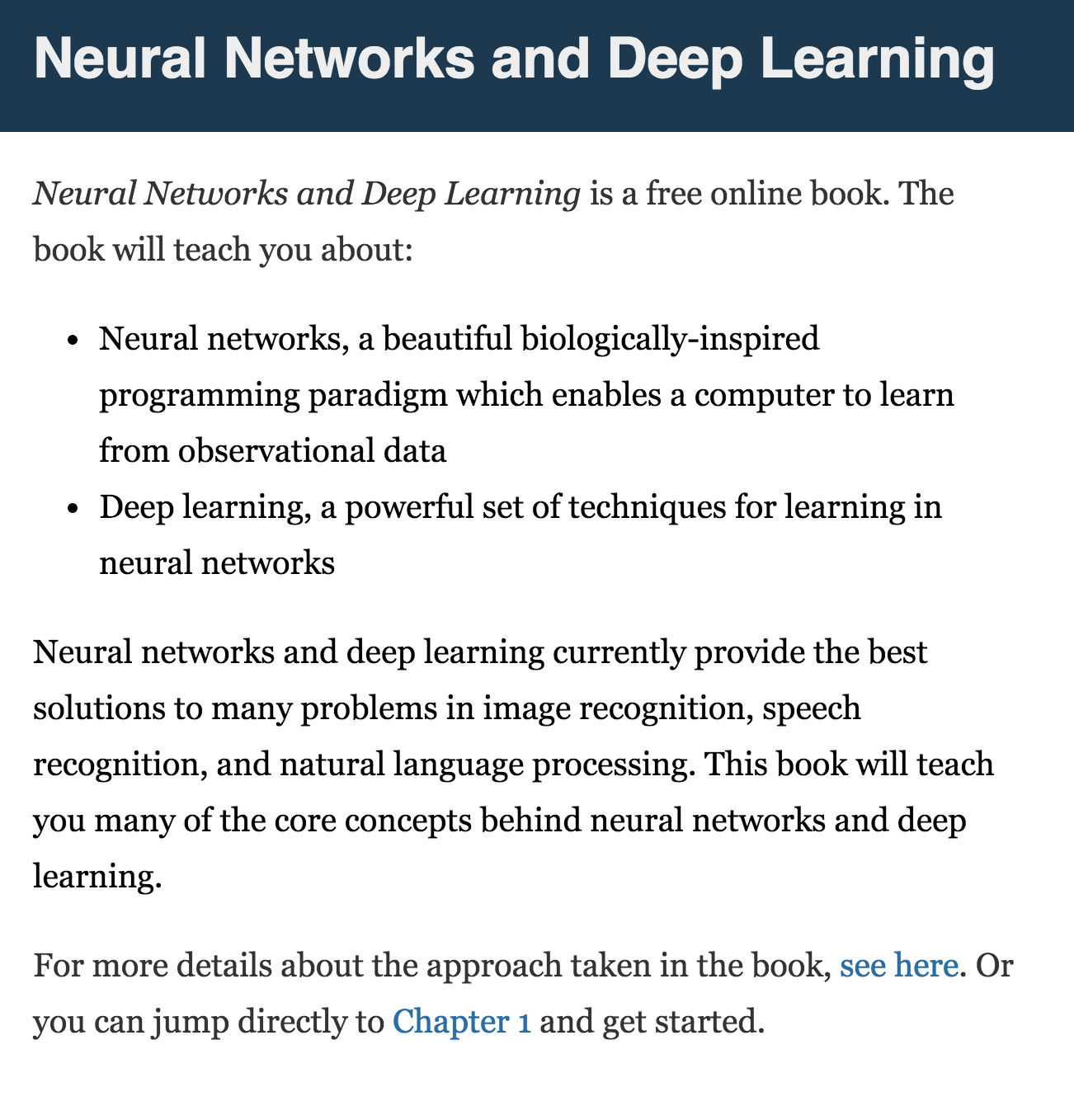
Core concepts behind neural networks and deep learning
2015 · neuralnetworksanddeeplearning.com · its alternatives →
- 2

I found that duplicating a specific block of 7 middle layers in Qwen2-72B, without modifying any weights, improved performance across all Open LLM Leaderboard benchmarks and took #1. As of 2026, the top 4 models on that leaderboard are still descendants. The weird finding: single-layer duplication does nothing. Too few layers, nothing. Too many, it gets worse. Only circuit-sized blocks of ~7 layers work. This suggests pretraining carves out discrete functional circuits in the layer stack that only work when preserved whole. The whole thing was developed on 2x RTX 4090s in my basement. I'm…
Mar 2026 · dnhkng.github.io · its alternatives →
- 3IT
2016 · danijar.github.io · its alternatives →
- 4
Featuring Ilya Sutskever, director of research for OpenAI
2016 · thetalkingmachines.com · its alternatives →
- 5
- 6

Multi-GPU reinforcement learning using Deep Q-Network in TensorFlow for OpenAI Gym - vishar0/dist-dqn
2016 · github.com · its alternatives →
- 7
 Sonnet▲134
A new library for constructing neural networks from DeepMind
2017 · deepmind.google · its alternatives →
- 8

Open-source machine learning library by Google
2018 · tensorflow.org · its alternatives →
- 9

A single / multi layer / recurrent neural network written in Golang. - made2591/go-perceptron-go
2017 · github.com · its alternatives →
- 10

Minimal, readable LLM post-training experiments on one 8GB GPU. Measures forgetting, seed variance, and RL emergence. - pochenai/nano-llm-posttraining
Aug 2026 · github.com · its alternatives →
- 11
Guest: Nando de Freitas (Oxford, Google DeepMind)
2015 · thetalkingmachines.com · its alternatives →
- 12

- 13

- 14

Most efforts to privately train machine-learning models either use homomorphic encryption or secure multi-party computation (MPC). Recent insights indicate…
2018 · blog.openmined.org · its alternatives →
- 15
 TensorFlow▲17
An Open Source Library for Machine Intelligence (by Google)
2015 · tensorflow.org · its alternatives →
- 16

- 17

Local, gradient-free neuro-symbolic memory engine combining Hyperdimensional Computing (HDC/VSA), Hebbian plasticity, and graph triples for offline AI. - roandejager/Hillock
Aug 2026 · github.com · its alternatives →
- 18

A high-performance RDMA distributed file system for fast LLM Inference and GPU Training. - GitHub - blackbird-io/blackbird: A high-performance RDMA distributed file system for fast LLM Inference and GPU Training.
2025 · github.com · its alternatives →
- 19
A general-purpose encoder-decoder framework for Tensorflow
2017 · google.github.io · its alternatives →
- 20

Reproducing the paper "Kernel-Based Approaches for Sequence Modeling: Connections to Neural Methods" - palakg11/KASM-Pytorch
2019 · github.com · its alternatives →
- 21

A lightweight C library for artificial neural networks - attractivechaos/kann
2018 · github.com · its alternatives →
- 22IC
I spent the past week implementing a 1 Layer Neural Net and training it on MNIST within the visual scripting language provided by scratch.mit.edu. It was tedious, but ultimately not too difficult. The code runs incredibly slowly, so much so that 64 samples of MNIST takes 5+ hours to train on my machine. There were a lot of little mini challenges that were fun to overcome (implementing softmax was very tricky). If you're interested, I encourage you to try and improve on it! More details in the linked blog post.
2024 · bell-boy.github.io · its alternatives →
- 23LR
I just noticed it takes literally ~5 minutes to train millions parameters on slow CPU...but before you call Yudkowsky that "it's over", an important note: the main bottleneck is the corpus size, params are just 'cleverness' but given limited info it's powerless. Anyway, here is the project: https://github.com/bggb7781-collab/lrnnsmdds/tree/main couple of notes: 1. single C file, no dependencies. Below are literally all the "dependencies", not even custom header (copy paste from the top of the single c file): #define _POSIX_C_SOURCE 200809L #include #include…
Apr 2026 · raw.githubusercontent.com · its alternatives →
- 24PA
2016 · blog.claymcleod.io · its alternatives →
Also compare
- Neural Networks and Deep Learning alternatives
- How I topped the HuggingFace open LLM leaderboard on two gaming GPUs alternatives
- Introduction to Recurrent Networks in TensorFlow alternatives
- Talking Machines: OpenAI and Gaussian Processes alternatives
- TensorFire alternatives
- Multi-GPU Reinforcement Learning in Tensorflow for OpenAI Gym alternatives
Ranked by how close each launch is in meaning, then by votes. Prices were read from each product’s own site when checked and can change. Refine with your own description →