Alternatives
Products that do what The Multi-Agent SaaS Playbook does
Build a full SaaS with 4 AI agents. No Human code
- 1

- 2OH
Related: https://simonwillison.net/2026/Jan/27/one-human-one-agent-on...
Jan 2026 · emsh.cat
- 3

Multi-agent review catching bugs early in AI-generated code
Mar 2026 · claude.com
- 4
- 5

- 6

Production-tested architecture for autonomous Claude agents
Apr 2026 · dvdshn.com
- 7
- 82C
Single-agent LLMs suck at long-running complex tasks. We’ve open-sourced a multi-agent orchestrator that we’ve been using to handle long-running LLM tasks. We found that single LLM agents tend to stall, loop, or generate non-compiling code, so we built a harness for agents to coordinate over shared context while work is in progress. How it works: 1. Orchestrator agent that manages task decomposition 2. Sub-agents for parallel work 3. Subscriptions to task state and progress 4. Real-time sharing of intermediate discoveries between agents We tested this on a Putnam-level math problem, but the…
Feb 2026 · github.com
- 9

789 skills & 10 autonomous agents for Claude Code
Mar 2026 · clskillshub.com
- 10IB
Hey HN. I built an AI agent harness over the past few months and I'm open sourcing it today. Some context on why. I've been building with Claude Code daily using this harness. It orchestrates multiple AI agents as a team, with a dashboard, chat, kanban board, the works. I used it to build a full SaaS product (MyUpMonitor, https://myupmonitor.com) in about 24 hours of focused coding. Then yesterday Anthropic announced Mythos and decided to keep it behind closed doors. Meanwhile I'm paying for Claude and I can't access their best model. I don't think that is nice at all... So I'm…
Apr 2026 · github.com
- 11

- 12

- 131D
We just open-sourced the internal system we built at Assembled for running coding agents as a team. Coding agents worked well for individual engineers, but the surrounding workflow was a bit of a mess. We generally found that many engineers had different MCP connections and context for their agents, personal automations running that other people couldn’t access, and very little introspection for what a human’s input into the coding agent looked like. So we built an internal system that converted coding agents into shared team infrastructure. The system runs Codex, Claude Code, OpenCode, and…
Jun 2026
- 14AP
I've been working on this internal project initially both to learn more Vibe-Coding but also to help our teams and projects to use AI more efficiently. As more people used it, it grew to support multiple teams/projects to analyze their Claude Code conversation and optimize them over time (understanding how to write better conversation with Claude Code and share knowledge between them) With time we added support for multiple Claude account management and monitor usage/rate limit. This is a simple project but has proved to be quite useful for our company. We have reached 5000+…
2025 · github.com
- 15

10 evidence-first workflows for AI coding agents
Jul 2026 · ai-agent-skills-pack.vercel.app
- 16CS
In the following case study, the AI coding agent rebuilds a core system invariant in just three days, with minimal human input, running 31 verification passes and correcting 201 errors, before shipping code with zero bugs, zero regressions, and zero technical debt. https://aisovereignlabs.ai/docs/case-study/liveSession/case-... Disclaimers: This case study is NOT: - a project written from scratch - yet another Rust transpilation - a clone of an open-source project found in the LLM's training data - a Super Mario clone in HTML It IS: - a complex application…
Jul 2026
- 17

- 18SR
Hello all, I'm a software developer. Over the last few months more and more of my work has turned into using coding agents instead of typing the whole code myself. Usually a few claude sessions at once, sometimes codex, one per feature or per revealed bug. I ran them in a split terminal for a few weeks, and quickly spotted two main problems. The first is that I couldn't easily tell which agent was stuck waiting on me and which was still working, so I'd cycle through sessions and checking on them. The second one: agents sharing a single branch step on each other. Two of them could be editing…
Jul 2026 · shikigami.dev
- 19

- 20AR
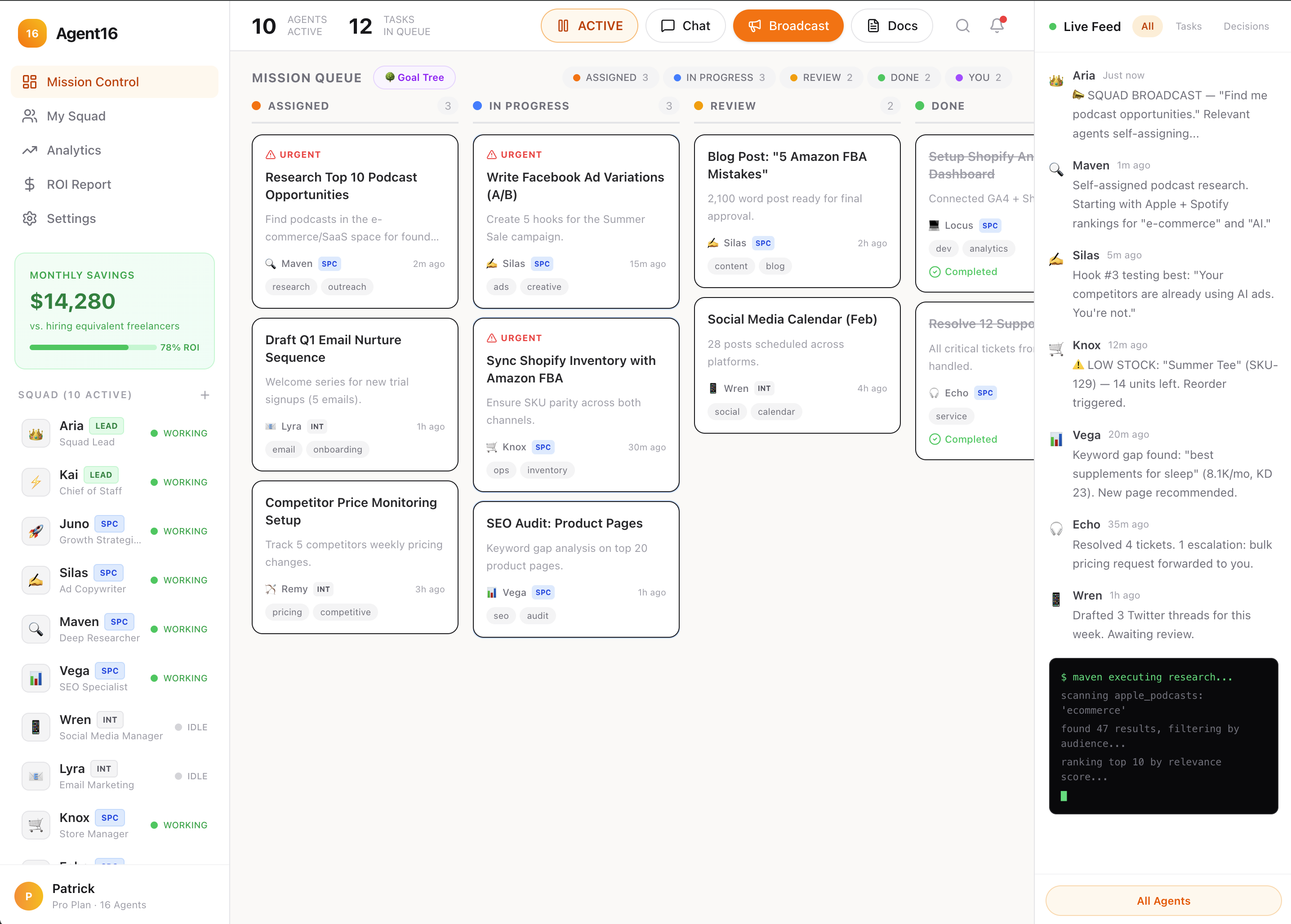
Hi HN. I'm the founder of Phoenix Labs (ex TikTok, Applied AI) and we're open sourcing our internal tooling today which is like a toolchain / meta-harness for CLI agents useful for really scaling eng and creative work. We are a very small team who's building a very ambitious product so we had to find ways to squeeze every ounce of efficiency that we could get our hands on. Harness strengths of different models (Claude, GPTs) and CLI-harnesses (Claude Code, Codex), safe/robust browser integration to speed up UX/QA testing, teams cli to speed up security reviews and parallelize…
May 2026 · agents-cli.sh
- 21
- 22OS
We're releasing the next-gen Ralph Wiggum architecture - agent clusters with independent validator agents with clear rejection mandates. As long as the code is not feature-complete and production-grade, it will not be approved. The result is AI without any need for babysittng.
Jan 2026 · github.com
- 23

One place to plan, run, and scale your coding agents
Jul 2026 · atlassian.com
- 24

Hi HN, I built Raq.com – a platform that uses Claude Code to build working internal tools directly in the browser. Claude Code is great at self correcting when given the right tools. I've found that the popular web-based AI coding tools look great in demos but fail on real API integrations or require a lot of error back and forth. They don't appear to do much research or self-correcting, likely to reduce spend. I wanted to see the current state of these tools, so I ran the same prompt on five platforms (Replit, Bolt, v0, Lovable, and Raq.com) to build a tool that requires 3 different APIs…
6d ago · raq.com

Ranked by how close each launch is in meaning, then by votes. Refine with a description →