Alternatives
Products that do what Tytan TAO does
The Agentic Operating System for the AI-First Enterprise
- 1

- 2

- 3

- 4

- 5

- 6UF
Hi HN! I want to share our latest project at NEXA AI. We developed AI agent foundation models designed to transform how developers create AI agent powered apps. One major challenge we've observed with current human-computer interactions is that many simple, one-step tasks become unnecessarily complex, multi-step workflows due to limitations of current GUIs. AI agents can solve this, but existing AI agent models are slow and costly. To tackle these issues, we built lightweight AI agent models based on our Octopus V2, small language models for function calling (You can learn more about our…
2024 · nexa4ai.com
- 7
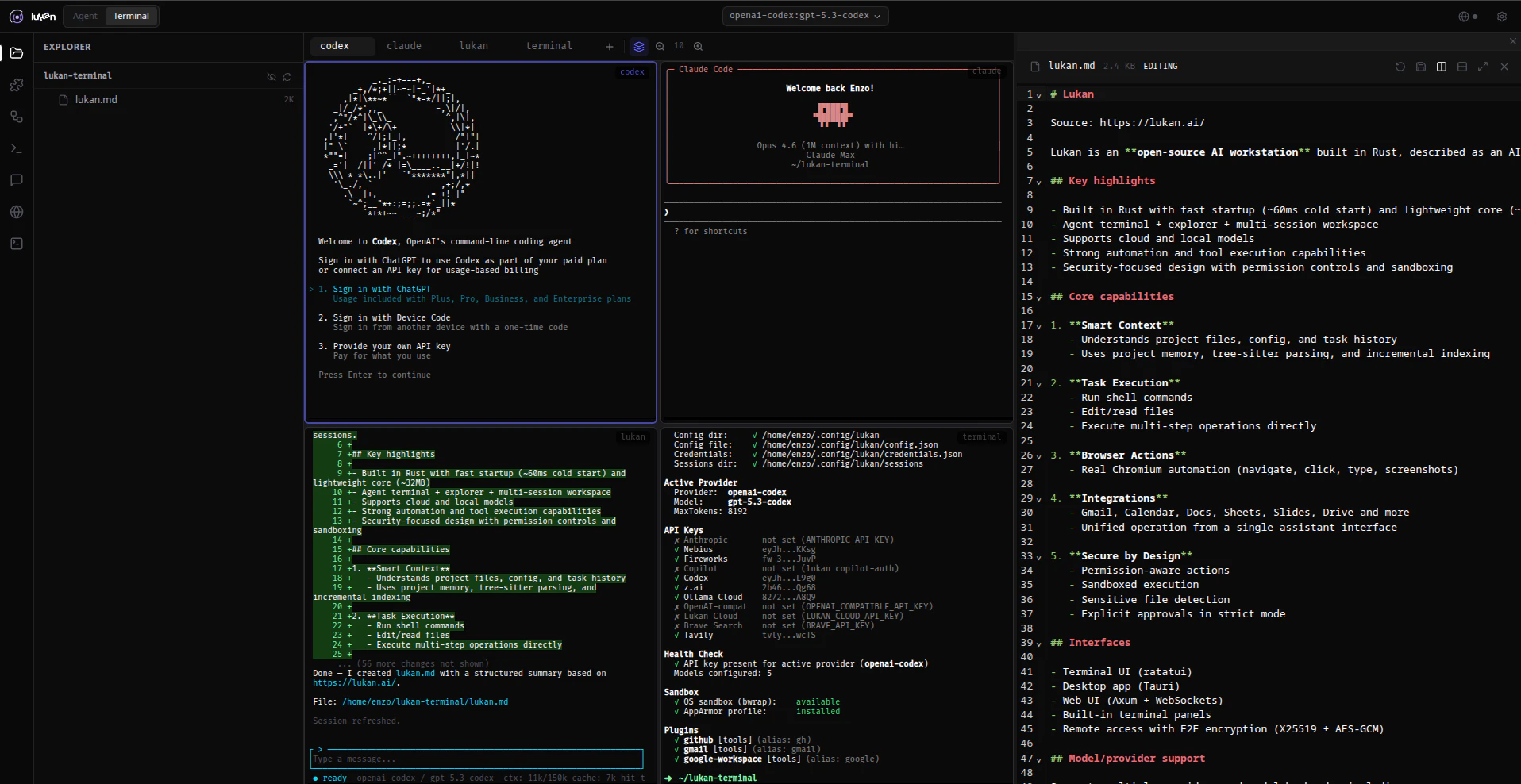
The open-source AI workstation for coding, ops, and life
Apr 2026 · lukan.ai
- 8

- 9

- 10

I think agent-first chat interfaces will be a primary software modality and busy dashboard/UI will go away. I’m not sure who exactly wins it, but I want my knowledge to grow/go with me. A lot of the “knowledge” ie research, analysis, reasoning will be done by agents as the primary user. Our current notes tools & tasks management systems were built for humans… I don’t care what the 17th thing on my bug backlog is. I want to conduct agents that can execute for me and do great work. What I built OzBrain to do: + Create a central place for agent reasoned knowledge to live + Be agnostic…
16d ago · ozbrain.com
- 11AK
Mar 2026 · github.com
- 12

- 13NA
Hi, I'm a Dapr CNCF project maintainer. We've recently released Dapr Agents which provides agentic AI features together with built-in durable execution to guarantee statefulness and reliable agentic workflows that run to completion and retry upon failure. It runs natively on Kubernetes, has built-in OTEL integration and uses a lightweight architecture where agents scale to zero, allowing you to run thousands of agents on commodity hardware. It'd be great if you can test it out and give us feedback.
2025 · github.com
- 14

- 15
 Matrix OS▲26
Matrix OS is an AI-native operating system: self-creating, self-healing, and self-expanding. The Claude Agent SDK is the literal kernel: CPU => Claude Opus 4.6 RAM => Context window (1M tokens) Kernel => Main agent + 26 IPC tools Processes => 5 sub-agents Disk => ~/apps, ~/data, ~/system Syscalls => Read, Write, Edit, Bash Drivers => MCP servers IPC => File coordination Break something, the healer agent repairs it. Need a new capability, the OS writes its own agents and skills. Describe an app, it appears as a file you own. The bigger vision is Web 4: OS + messaging + social +…
6d ago · matrix-os.com
- 16

- 17

- 18

- 19
- 20OS
GitHub: https://github.com/ClioAI/kw-sdk Most AI agent frameworks target code. Write code, run tests, fix errors, repeat. That works because code has a natural verification signal. It works or it doesn't. This SDK treats knowledge work like an engineering problem: Task → Brief → Rubric (hidden from executor) → Work → Verify → Fail? → Retry → Pass → Submit The orchestrator coordinates subagents, web search, code execution, and file I/O. then checks its own work against criteria it can't game (the rubric is generated in a separate call and the executor never sees it…
Feb 2026 · github.com
- 21RA
Hi, founder of Okteto here! We’ve been experimenting with AI agents in our workflows at Okteto. Running them locally worked at first, but quickly became painful. git worktrees, multiple terminals, and messy context switches slowed us down. So we built Agent Fleets: ephemeral, fully managed environments for AI agents, built on top of Okteto’s development platform. Each agent runs in its own containerized environment on your infrastructure, with the services, tools, and policies it needs. You can spin up agents with a single click or API call. No local setup. No git worktrees. The beta…
2025 · okteto.com
- 22

- 23

- 24BA
I'm one of the creators of The Edge Agent (TEA). We built this because we needed a way to deploy agents that was verifiable and robust enough for production/edge cases, moving away from loose scripts. The architecture aims to solve critical gaps in deterministic orchestration identified by *Prof. Claudionor Coelho Jr. (Stanford alum, ML/DL Faculty at Santa Clara Univ., and Senior Fellow for AI at Majestic Labs)* during our work on the Kiroku project. *Key Technical Features:* * *Neurosymbolic Native:* We integrated Prolog to logically validate LLM outputs. This combines neural…
Jan 2026 · fabceolin.github.io
Ranked by how close each launch is in meaning, then by votes. Refine with a description →