Alternatives
Products that do what unerr does
Your agent is clueless. Give it eyes & shared local memory
- 1

- 2

Open-source unified interface for agent harnesses
22d ago · harnessrouter.ai
- 3AE
2024 · github.com
- 4

- 5FO
2025 · github.com
- 6AH
2025 · github.com
- 7ST
I've been working on CloudRouter, a skill + CLI that gives coding agents like Claude Code and Codex the ability to start cloud VMs and GPUs. When an agent writes code, it usually needs to start a dev server, run tests, open a browser to verify its work. Today that all happens on your local machine. This works fine for a single task, but the agent is sharing your computer: your ports, RAM, screen. If you run multiple agents in parallel, it gets a bit chaotic. Docker helps with isolation, but it still uses your machine's resources, and doesn't give the agent a browser, a desktop, or a GPU to…
Feb 2026 · cloudrouter.dev
- 8

- 9

- 10
- 11

Recently I've been running more and more agents in parallel however I noticed that they have no task context of what the other agents are doing even when a lot of work is interconnected It's like taking Slack away from a team. Agents duplicate work, make conflicting changes, and step on each others' toes simply because they can't talk to each other. Concord is an MCP + CLI that lets coding agents claim work, see what other agents are doing, and message each other live.
10d ago · github.com
- 12

Hey HN! We are building HarnessRouter, a canonical API for running Codex, Claude Code, Hermes, and other managed agent harnesses as your product backend. Before building HarnessRouter, I used to build our own agent harness for our products. I tried LangGraph, agent SDKs from different vendors, pydantic, LLM tool use / function call, and so on. It's a very heavy lifting engineering effort, and I am disappointed about the agent deliveries compared to what Codex, CC can deliver. That changed my mindset. The frontier labs and famous open source communities are already putting so much…
20d ago · github.com
- 13

- 14RM
I was tired of asking my claude code to reference my codex chats to get references to what decisions it made and why ; so I built Reference MCP It, whenever prompted establishes sessions to get direct access - been using it on my system for a bit and was super helpful so I made a repo :) Would love feedback!
Jun 2026 · github.com
- 15SM
I built this because I got tired of watching Claude Code read through massive files just to find a few functions. Sourcerer lets AI agents search code semantically and grab exactly the code chunks they need instead of burning tokens on whole files. It uses tree-sitter to parse your codebase and creates a searchable index. So instead of "read auth.py (538 lines)", an agent can search for "user authentication logic" and get back just the relevant functions. Demo: https://asciinema.org/a/736638 GitHub: https://github.com/st3v3nmw/sourcerer-mcp
2025 · github.com
- 16

- 17
- 18
- 19CA
May 2026 · oacp.dev
- 20
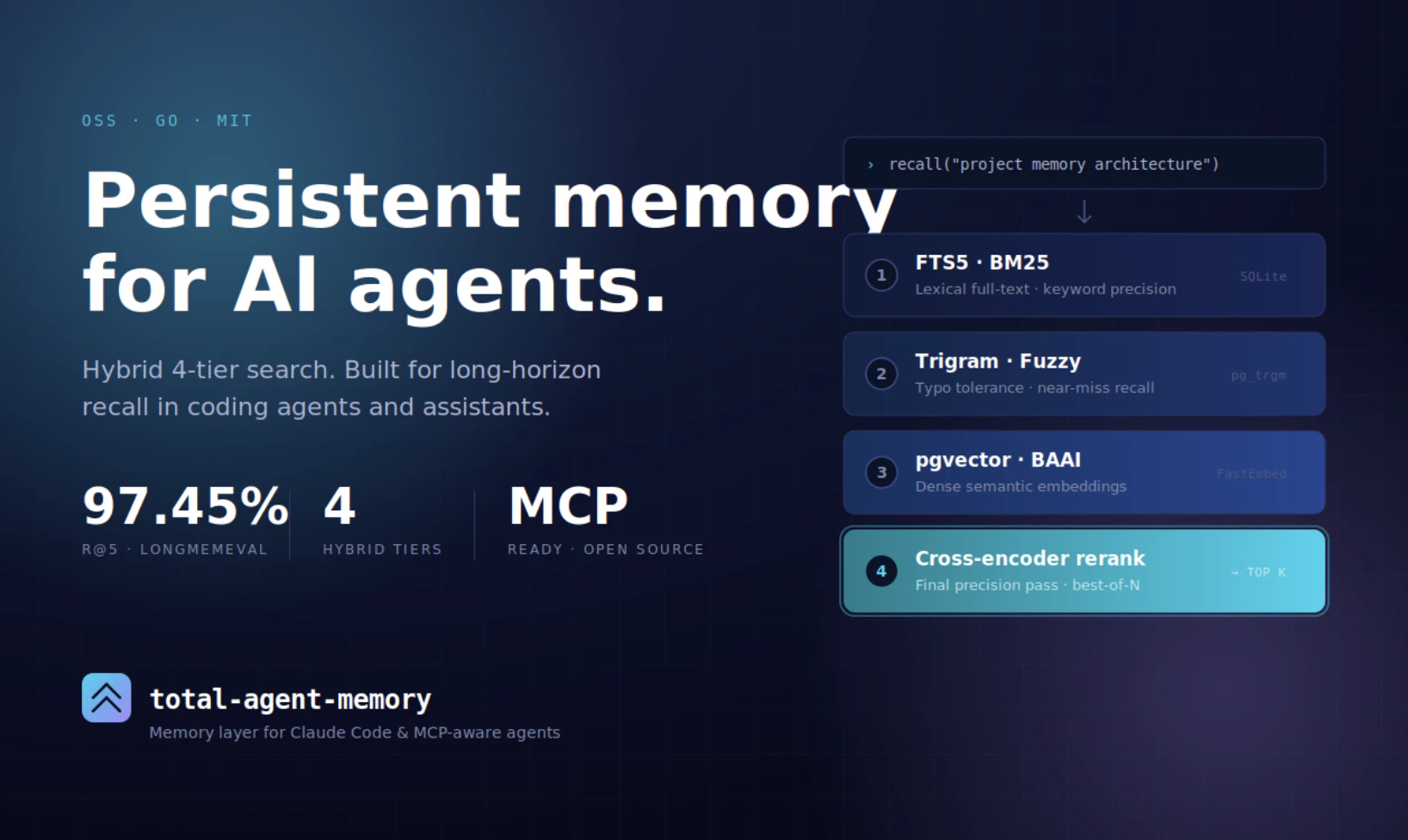
Open-source MCP server. #5 on LoCoMo. 100% local. MIT.
May 2026 · totalmemory.dev
- 21

- 22

- 23IA
1. Headless mode Headless mode allows you to use the AI as a command-line utility for automation and scripting. In Claude Code you run it with the -p flag: claude -p, in codex - exec, opencode - run. 2. Ask human The traditional communication channel with the operator won't work in headless mode - we need to implement a dedicated tool. Here is an example of how this can be done https://github.com/sermakarevich/claude/tree/main/mcp/ask_hu... 3. Tasks queue Beads is a lightweight distributed graph issue tracker for AI agents, powered by Dolt. You can…
Jun 2026
- 24


Ranked by how close each launch is in meaning, then by votes. Refine with a description →