
Risk Analysis Database of Every MCP Server
Hi HN, We’re building security tooling around agentic AI systems. Today, we're releasing our public MCP catalog with detailed risk analysis for every MCP server we've found on the internet: https://mcp.armor1.ai/mcp-directory We all love agents and the power that MCPs unlock: suddenly your AI assistant can query databases, manage files, call APIs, and interact with the real world. But when we started adopting MCPs ourselves, we kept running into the same nagging questions: Is this MCP safe? Where is my data actually going? Could it execute destructive actions? Is it…
Risk Analysis Database of Every MCP Server launched on February 5, 2026 with 22 votes, #730 of 16,627 launches that month and more than 90% of that year's launches.
In plain words
Risk Analysis Database of Every MCP Server is a public catalog that provides detailed security assessments for MCP (Model Context Protocol) servers found across the internet. It helps users evaluate whether specific MCP servers are safe to use by analyzing potential risks including data exposure, destructive actions, prompt injection vulnerabilities, and data exfiltration between servers. The tool is designed for organizations and developers adopting agentic AI systems who need to understand the security implications of connecting AI assistants to external tools and APIs.
written from the facts on this page · September 2026
From the sources
In the maker’s words, at launch
Hi HN, We’re building security tooling around agentic AI systems. Today, we're releasing our public MCP catalog with detailed risk analysis for every MCP server we've found on the internet: https://mcp.armor1.ai/mcp-directory We all love agents and the power that MCPs unlock: suddenly your AI assistant…
Does a similar job
all alternatives → Cloud-Ready Postgres MCP Server2025 · github.com · ▲167
Hey HN, I built pg-mcp, a Model Context Protocol (MCP) server for PostgreSQL that provides structured schema inspection and query execution for LLMs and agents. It's multi-tenant and runs over HTTP/SSE (not stdio) Features - Supports multiple database connections from multiple agents - Schema Introspection: Returns table structures, types, indexes and constraints; enriched with descriptions from pg_catalog. (for well documented databases) - Read-Only Queries: Controlled execution of queries via MCP. - EXPLAIN Tool: Helps smart agents optimize queries before execution. - Extension…
 MCP-Shield – Detect security issues in MCP servers2025 · github.com · ▲134
I noticed the growing security concerns around MCP (https://news.ycombinator.com/item?id=43600192) and built an open source tool that can detect several patterns of tool poisoning attacks, exfiltration channels and cross-origin manipulations. MCP-Shield scans your installed servers (Cursor, Claude Desktop, etc.) and shows what each tool is trying to do at the instruction level, beyond just the API surface. It catches hidden instructions that try to read sensitive files, shadow other tools' behavior, or exfiltrate data. Example of what it detects: - Hidden instructions…
 MCP by Alloy Automation2025 · ai.runalloy.com · ▲101
I'm Mike, Head of Eng/Product at Alloy Automation. We built MCP by Alloy Automation to give your AI agents structured access to business-critical systems without the integration headache. We've built MCP servers covering thousands of tools across platforms like Quickbooks, Xero, Notion, HubSpot, and Salesforce. Pick the tools you need, provision a server, and ship faster. Need more control? Our Connectivity API gives you programmatic access to all the same tools for custom integrations beyond MCP. Everything runs with scoped auth utilizing our battle-tested credential management system…
 Mcp-Agent – Build effective agents with Model Context Protocol2025 · github.com · ▲80
Hey HN, I spent my xmas break building an agent framework called mcp-agent [1](https://github.com/lastmile-ai/mcp-agent) for Model Context Protocol [2]. It makes it easy to build AI apps with MCP servers, and implements every pattern from the popular Building Effective Agents blog [3] as well as OpenAI’s Swarm [4]. I’m sharing it early to get community feedback on where to take it from here, and to ask for contributions. For those who aren’t familiar with MCP, I think of it as a standardized interface to let AI communicate with software via tool calls, resources and…
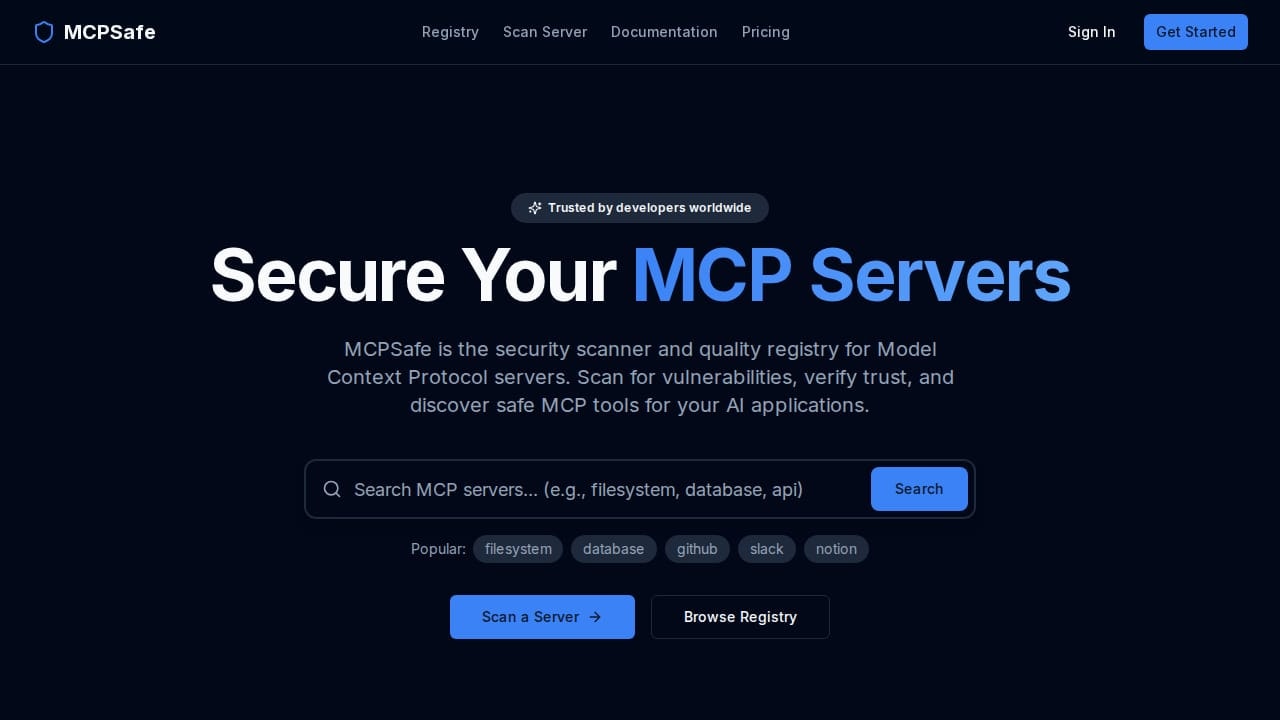 MCPSafeFeb 2026 · mcpsafe.org · ▲6
We've been scanning MCP (Model Context Protocol) servers to understand the security posture of the ecosystem. After 306 servers and 1,211 vulnerabilities, here's what we found: - 69 critical vulnerabilities - 32 servers using eval() on untrusted input - 31 SQL injection vulnerabilities - 32 servers with hardcoded API credentials 10.5% of servers have at least one critical vulnerability. MCP servers run with your permissions. AI agents trust them implicitly. A prompt injection can exploit them remotely. MCPSafe (https://mcpsafe.org) lets you scan before you connect. Free tier…
 Representing Agents as MCP Servers2025 · github.com · ▲58
Hey HN! A few months ago we shared mcp-agent (https://github.com/lastmile-ai/mcp-agent) [1][2], a lightweight framework that implements every agent pattern from Anthropic’s Building Effective Agents blog [3] and handles MCP server/client management seamlessly. Our core bet is that connecting LLMs to tools, resources, and external systems will soon be MCP-native by default. Today we're launching a significant update: Agents as MCP servers. Currently "agentic" behavior exists only on the MCP client side – clients like Claude or Cursor use MCP servers to solve tasks.…
More ai this month
the category →


Paintings by AI models: programs run through a simulation of oil paint.
AI · 21d ago · stillwet.art
 PixVerse R2▲381
A real-time world model you can explore and change
AI · 29d ago · world.pixverse.video

Source: Show HN post ↗ · launch text quoted in part
Launched alongside, February 2026
the whole month →


 Lovon AI Therapy▲801
Feel closer and have more fun with your partner every day!
AI · Feb 2026 · lovon.app

Hello my name is Ben Ward for the past 3 years I have been remastering the financial game Wall Street Raider created by Michael Jenkins originally on DOS in 1986. It has been a rough journey but I finally see the light at the end of the tunnel. I just recently redid the website and thought maybe the full story of how this project came to be would interest you all. Thank you for reading.
Work · Feb 2026 · wallstreetraider.com