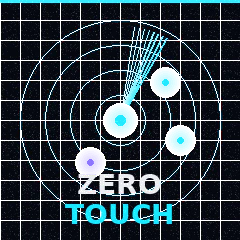
Zero Touch
Human presence detection through walls, $4 chip, no camera
What it does
Zero Touch is two open-source research projects — PRISM and AURA — that detect and track humans using radio waves and electric fields instead of cameras. PRISM uses a single $4 ESP32 to localize people across room zones through walls using Wi-Fi CSI signals. AURA controls your cursor by hovering your hand over a capacitive sensor — no contact needed. Both run real-time ML inference on commodity hardware.
Does the same job
all alternatives →- PTPut this touch sensor on a robot and learn super precise tasks2024 · any-skin.github.io · ▲390
We just released a very excited touch sensor that finally simplifies touch sensing for robotics. Our most exciting result: Learned visuotactile policies for precise tasks like inserting USBs and credit card swiping, that work out-of-the-box when you replace skins! To the best of our knowledge, this has never been shown before with any existing tactile sensor. Why is this important? For the first time, you could now collect data and train models on one sensor and expect them to generalize to new copies of the sensor -- opening the door to the kind of large foundation models that have…
- GTGlasses to detect smart-glasses that have camerasNov 2025 · github.com · ▲509
Hi! Recently smart-glasses with cameras like the Meta Ray-bans seem to be getting more popular. As does some people's desire to remove/cover up the recording indicator LED. I wanted to see if there's a way to detect when people are recording with these types of glasses, so a little bit ago I started working this project. I've hit a little bit of a wall though so I'm very much open to ideas! I've written a bunch more on the link (+photos are there), but essentially this uses 2 fingerprinting approaches: - retro-reflectivity of the camera sensor by looking at IR reflections. mixed results…


More ai this month
the category →
I trained a 125M-parameter transformer to autocomplete piano performances in real time (~108 notes/sec on an iPhone 15). The idea is basically GitHub Copilot or Tabnine, except instead of prompting it with code, you prompt it by playing a few notes on a MIDI piano. The model then continues what you played, entirely on-device. The app is free if anyone wants to try it. Happy to answer questions about the model, training, Core ML, or the many things that didn't work.
AI · 17d ago · simedw.com
 Astute▲585
Automate your B2B brand going viral, with new media creators
AI · 18d ago · company-app.joinastute.com


Hey HN, Henry from Cactus here! We previously released Cactus Needle, a 14MB agentic LLM for tool call, device use, and structured extraction for phones, wearables, smart homes, small robots and microcontrollers. We got really great feedback here, and have now incorporated the suggestions to release Needle 2. The whole model is a single 14MB binary that runs a full session in 28MB of RAM; 45m parameters at 2bit compression. Needle hits 500 tokens/sec decode speed on a Raspberry Pi 5, sits between 400-1,500 tokens/sec on VR devices like Meta Quest 3S and Apple Vision Pro, and ranges…
AI · 27d ago · cactuscompute.com


Launched alongside, May 2026
the whole month →

Parallel agents, diff reviewer, and multi-model comparisons
Dev tools · May 2026 · kilo.ai


- NW
Hey HN, Henry here from Cactus. We open-sourced Needle, a 26M parameter function-calling (tool use) model. It runs at 6000 tok/s prefill and 1200 tok/s decode on consumer devices. We were always frustrated by the little effort made towards building agentic models that run on budget phones, so we conducted investigations that led to an observation: agentic experiences are built upon tool calling, and massive models are overkill for it. Tool calling is fundamentally retrieval-and-assembly (match query to tool name, extract argument values, emit JSON), not reasoning. Cross-attention…
Life & fun · May 2026 · github.com
- FM
Dev tools · May 2026 · github.com