Alternatives
Products that do what ArcBrain – Persistent AI Memory Layer does
Persistent AI memory for Copilot, Cursor & Claude Desktop
- 1

- 2
- 3

- 4

- 5RG
Hey HN! I'm José, and I built Recall to solve a problem that was driving me crazy. The Problem: I use Claude for coding daily, but every conversation starts from scratch. I'd explain my architecture, coding standards, past decisions... then hit the context limit and lose everything. Next session? Start over. The Solution: Recall is an MCP (Model Context Protocol) server that gives Claude persistent memory using Redis + semantic search. Think of it as long-term memory that survives context limits and session restarts. How it works: - Claude stores important context as "memories" during…
Oct 2025 · npmjs.com
- 6

- 7CI
Hi, I'm Daniel from Zep. I've integrated the Cursor IDE with Graphiti, our open-source temporal knowledge graph framework, to provide Cursor with persistent memory across sessions. The goal was simple: help Cursor remember your coding preferences, standards, and project specs, so you don't have to constantly remind it. Before this integration, Cursor (an AI-assisted IDE many of us already use daily) lacked a robust way to persist user context. To solve this, I used Graphiti’s Model Context Protocol (MCP) server, which allows structured data exchange between the IDE and Graphiti's temporal…
2025
- 8

One memory across OpenClaw, ChatGPT, Claude & Gemini
Feb 2026 · maximem.ai
- 9SC
I got tired of Claude Code forgetting all my context every time I open a new session: set-up decisions, how I like my margins, decision history. etc. We built a shared memory layer you can drop in as a Claude Code Skill. It’s basically a tiny memory DB with recall that remembers your sessions. Not magic. Not AGI. Just state. Install in Claude Code: /plugin marketplace add https://github.com/mutable-state-inc/ensue-skill /plugin install ensue-memory # restart Claude Code What it does: (1) persists context between sessions (2) semantic & temportal search (not just…
Dec 2025 · github.com
- 10

- 11

- 12

- 13

- 14
 Cortex▲2
Persistent memory layer for AI coding tools (Claude, Cursor)
Jun 2026 · cortex-vercel-omega.vercel.app
- 15RA
Hey HN! I built Retain as the evolution of claude-reflect (github.com/BayramAnnakov/claude-reflect). The original problem: I use Claude Code/Codex daily for coding, plus claude.ai and ChatGPT occasionally. Every conversation contains decisions, corrections, and patterns I forget existed weeks later. I kept re-explaining the same preferences. claude-reflect was a CLI tool that extracted learnings from Claude Code sessions. Retain takes this further with a native macOS app that: - Aggregates conversations from Claude Code, claude.ai, ChatGPT, and Codex CLI - Instant full-text…
Jan 2026 · github.com
- 16CO
I keep running in the same problem of each AI app “remembers” me in its own silo. ChatGPT knows my project details, Cursor forgets them, Claude starts from zero… so I end up re-explaining myself dozens of times a day across these apps. The deeper problem 1. Not portable – context is vendor-locked; nothing travels across tools. 2. Not relational – most memory systems store only the latest fact (“sticky notes”) with no history or provenance. 3. Not yours – your AI memory is sensitive first-party data, yet you have no control over where it lives or how it’s queried. Demo video:…
2025 · github.com
- 17

An OKF-backed Model Context Protocol (MCP) server delivering persistent long-term memory and SQLite FTS5 search for AI agents. - fellowgeek/mcp-memory
24d ago · github.com
- 18BA
Tired of AI coding tools that forget everything between sessions? Every time I open a new chat with Claude or fire up Copilot, I'm back to square one explaining my codebase structure. So I built something to fix this. It's called In Memoria. Its an MCP server that gives AI tools persistent memory. Instead of starting fresh every conversation, the AI remembers your coding patterns, architectural decisions, and all the context you've built up. The setup is dead simple: `npx in-memoria server` then connect your AI tool. No accounts, no data leaves your machine. Under the hood it's TypeScript +…
2025 · github.com
- 19CM
2024 · github.com
- 20PM
I built an MCP server that gives Claude Code long-term memory across sessions, backed by infrastructure you control. Every Claude Code session starts from zero, no memory of previous sessions. This server uses mem0ai as a library and exposes 11 MCP tools for storing, searching, and managing memories. Qdrant handles vector storage, Ollama runs embeddings locally (bge-m3), and Neo4j optionally builds a knowledge graph. Some engineering details HN might find interesting: - Zero-config auth: auto-reads Claude Code's OAT token from ~/.claude/.credentials.json, detects token type (OAT vs…
Feb 2026 · github.com
- 21

- 22

- 23PM
Dec 2025 · github.com
- 24
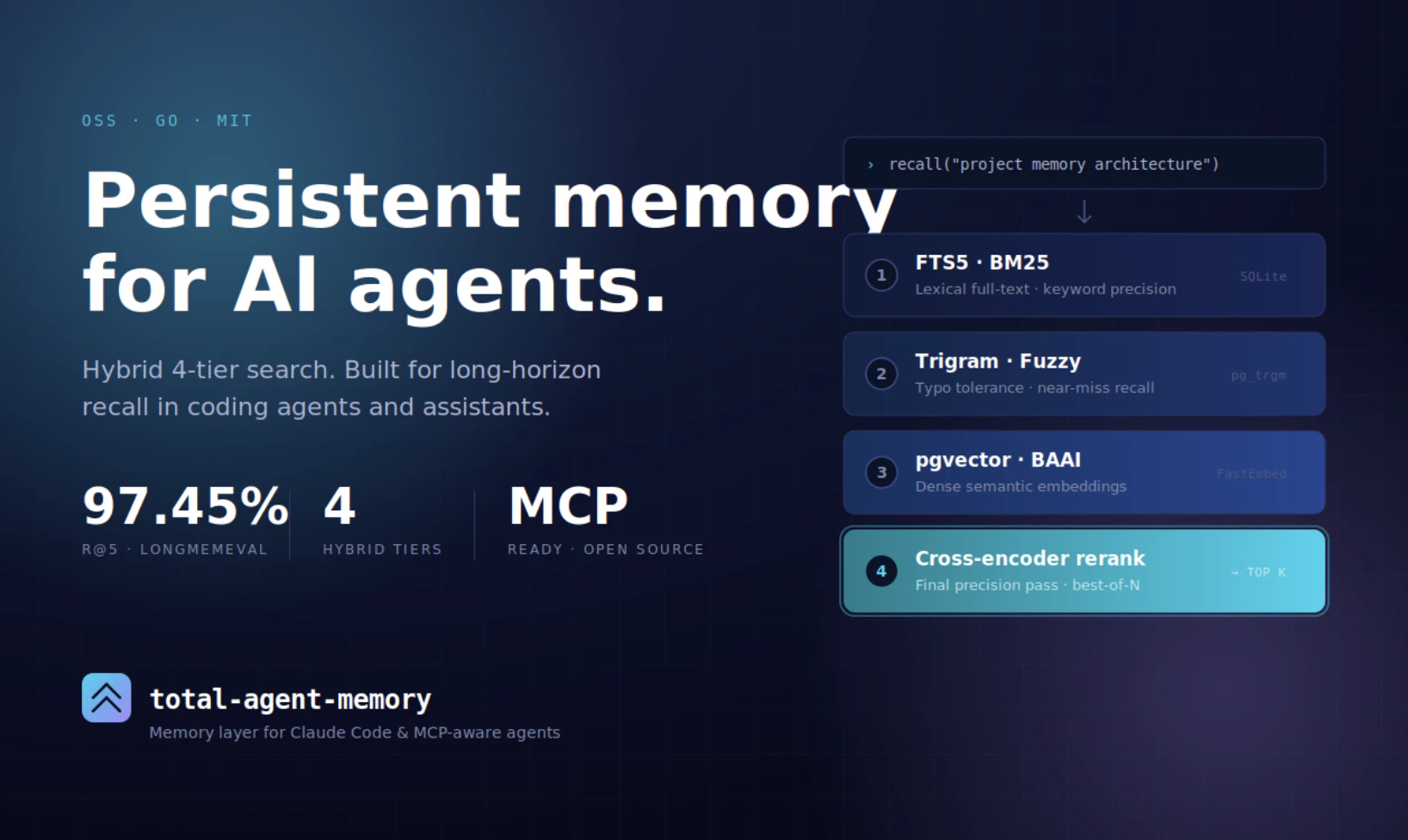
Open-source MCP server. #5 on LoCoMo. 100% local. MIT.
May 2026 · totalmemory.dev
Ranked by how close each launch is in meaning, then by votes. Refine with a description →