Dev tools · alternatives · 2026

24 alternatives to Arraymancer v0.4, Nim tensor library now with OpenCL and Keras-like API
A fast, ergonomic and portable tensor library in Nim with a deep learning focus for CPU, GPU and embedded devices via OpenMP, Cuda and OpenCL backends - mratsim/Arraymancer
Arraymancer is a tensor library for the Nim programming language that provides numerical computing capabilities similar to Python's NumPy. Version 0.4 introduces OpenCL support for GPU acceleration and a Keras-like API… Below are 24 products that do a similar job, ranked by how close each is in meaning and then by launch-day votes. Arraymancer v0.4, Nim tensor library now with OpenCL and Keras-like API launched in 2018; newer entries below may have overtaken it.
- 1

A fast, ergonomic and portable tensor library in Nim with a deep learning focus for CPU, GPU and embedded devices via OpenMP, Cuda and OpenCL backends - mratsim/Arraymancer
2017 · github.com · its alternatives →
- 2
 TensorFlow 1.0▲823
Open-source machine learning library by Google
2017 · tensorflow.org · its alternatives →
- 3

Hi HN, Over the past few months, I've been building `dsc`, a tensor library from scratch in C++/CUDA. My main focus has been on getting the basics right, prioritizing a clean API, simplicity, and clear observability for running small LLMs locally. The key features are: - C++ core with CUDA support written from scratch. - A familiar, PyTorch-like Python API. - Runs real models: it's complete enough to load a model like Qwen from HuggingFace and run inference on both CUDA and CPU with a single line change[1]. - Simple, built-in observability for both Python and C++. Next on the roadmap is…
2025 · github.com · its alternatives →
- 4

An Open Source Machine Learning Framework for Everyone - tensorflow/tensorflow/core/distributed_runtime at master · tensorflow/tensorflow
2016 · github.com · its alternatives →
- 5

Open-source machine learning library by Google
2018 · tensorflow.org · its alternatives →
- 6
 TensorZero▲307
Hi HN! We're Gabriel & Viraj, and we're excited to open source TensorZero. To be a little cheeky, TensorZero is an open-source platform that helps LLM applications graduate from API wrappers into defensible AI products. 1. Integrate our model gateway 2. Send metrics or feedback 3. Unlock compounding improvements in quality, cost, and latency It enables a data & learning flywheel for LLMs by unifying: • Inference: one API for all LLMs, with <1ms P99 overhead • Observability: inference & feedback → your database • Optimization: better prompts, models, inference strategies • Experimentation:…
2025 · github.com · its alternatives →
- 7

:satellite: Simple and ready-to-use tutorials for TensorFlow - GitHub - instillai/TensorFlow-Course: :satellite: Simple and ready-to-use tutorials for TensorFlow
2018 · github.com · its alternatives →
- 8
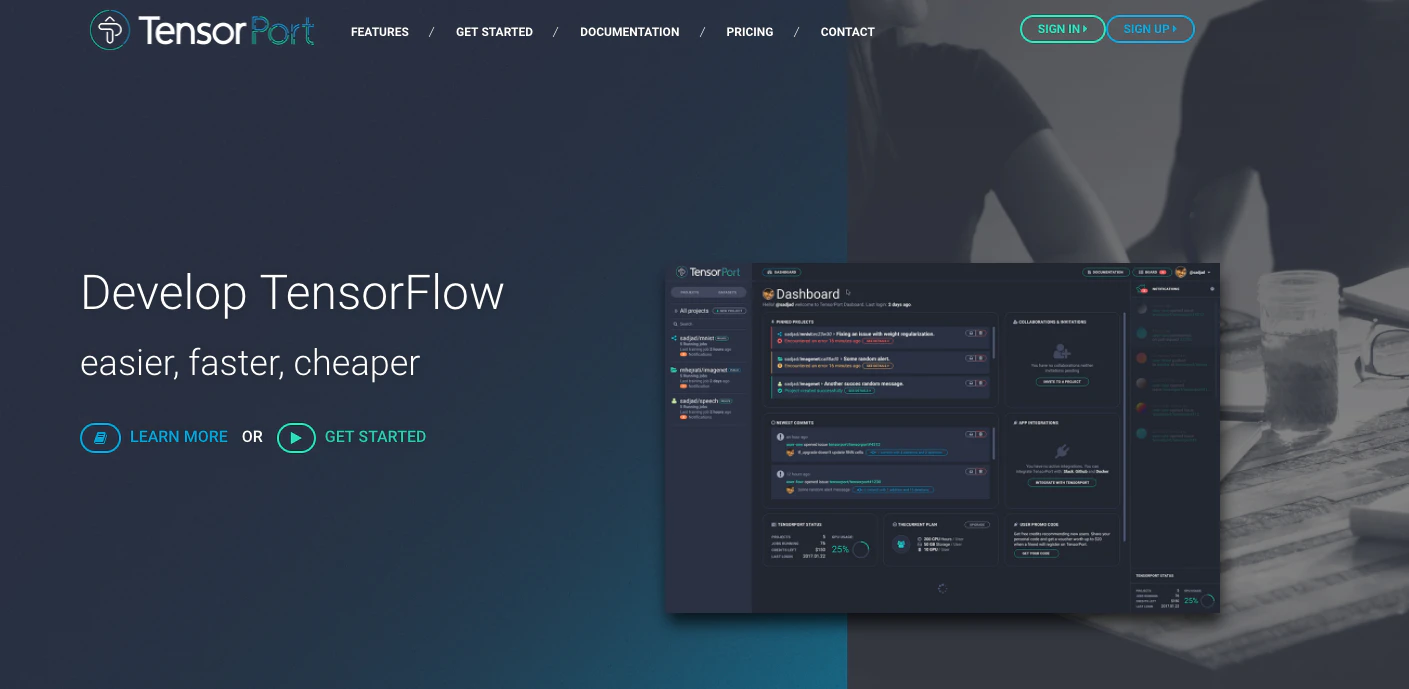
- 9

Hey HN, We just recently launched Forge – an AI model API platform that lets you access and call AI models from multiple providers in one place. Find it on our website: https://tensorblock.co/forge Some key features: Unified API Key – Store multiple provider API keys and access all with a single Forge API key. OpenAI API Compatible – Drop-in replacement for any application that uses OpenAI’s API. Advanced Security – Strong Encryption for API keys with JWT-based authentication. Client Management – Easy key and user management via included command-line interface. Open-source –…
2025 · tensorblock.co · its alternatives →
- 10

An on-premises, bare-metal solution for deploying GPU-powered applications in containers - emergingstack/es-dev-stack
2016 · github.com · its alternatives →
- 11PO
Our company Vertex.AI has been working on this for a while but this is the first public release. We're starting with using PlaidML to bring OpenCL support to Keras and more frameworks, platforms, etc are coming. Yes, this means you can use use your AMD GPU for deep learning dev. Sorry, no Mac or Windows support yet although the brave can try building from source (it should work). http://vertex.ai/blog/announcing-plaidml https://github.com/plaidml/plaidml
2017 · its alternatives →
- 12
 Apple MLX▲138
An array framework for machine learning on Apple silicon
2023 · pypi.org · its alternatives →
- 13

- 14

I ported Microsoft's TRELLIS.2 (4B parameter image-to-3D model) to run on Apple Silicon via PyTorch MPS. The original requires CUDA with flash_attn, nvdiffrast, and custom sparse convolution kernels: none of which work on Mac. I replaced the CUDA-specific ops with pure-PyTorch alternatives: a gather-scatter sparse 3D convolution, SDPA attention for sparse transformers, and a Python-based mesh extraction replacing CUDA hashmap operations. Total changes are a few hundred lines across 9 files. Generates ~400K vertex meshes from single photos in about 3.5 minutes on M4 Pro (24GB). Not as fast as…
Apr 2026 · github.com · its alternatives →
- 15

Easily craft fast Neural Networks on iOS! Use TensorFlow models. Metal under the hood. - xmartlabs/Bender
2017 · github.com · its alternatives →
- 16

:satellite: Organized & Useful Resources about Deep Learning with TensorFlow - astorfi/TensorFlow-World-Resources
2018 · github.com · its alternatives →
- 17
- 18

Absolute minimalistic implementation of a GPT-like transformer using only numpy (<650 lines). - joennlae/tensorli
2023 · github.com · its alternatives →
- 19AC
I've been building a C++ tensor library that tries to bring the ergonomics of NumPy/PyTorch to native code. The main goals were: - Familiar API (operator overloading, method chaining, same function names) - Actual GPU acceleration via Metal (not just matmul, but all ops) - Cross-platform with SIMD on x86/ARM/RISC-V via xsimd - einops-style rearrange/reduce patterns It started because I wanted NumPy's API but needed to deploy on edge devices without Python. Ended up going deeper than expected (28k LOC+) into BLAS backends, memory views, and GPU kernels. Some things I'm…
Feb 2026 · its alternatives →
- 20

Hey HN, I am the founder of Tensorlake. Prototyping LLM applications have become a lot easier, building decision making LLM applications that work on constantly updating data is still very challenging in production settings. The systems engineering problems that we have seen people face are - 1. Reliably process ingested content in real time if the application is sensitive to freshness of information. 2. Being able to bring in any kind of model, and run different parts of the pipeline on GPUs and CPUs. 3. Fault Tolerance to ingestion spike, compute infrastructure failure. 4. Scaling compute,…
2024 · getindexify.ai · its alternatives →
- 21RX
Hi all, long time lurker, first time poster. I want to share with you all something we've been working on for a while at Lambda: the Razer x Lambda Tensorbook: https://www.youtube.com/watch?v=wMh6Dhq7P_Q But before I tell you about it, I want to make this all about me, because I built this for me. See, while I'm genuinely interested in hearing from the community what you think as this is the culmination of a lot of effort from a lot of people across so many different fields (seriously, the number of folks across manufacturing, engineering, design, logistics, and marketing who…
2022 · its alternatives →
- 22AG
This is a vector index I built that supports insertion and k-nearest neighbors (k-NN) querying, optimized for GPUs. It operates entirely in CUDA and can process queries on half a billion vectors in under 200 milliseconds. The codebase is structured as a standalone library with an HTTP API for remote access. It’s intended for high-performance search tasks—think similarity search, AI model retrieval, or reinforcement learning replay buffers. The codebase is located at https://github.com/rodlaf/BinaryGPUIndex.
2025 · rlafuente.com · its alternatives →
- 23GA
2016 · erkaman.github.io · its alternatives →
- 24
 TensorFlow▲17
An Open Source Library for Machine Intelligence (by Google)
2015 · tensorflow.org · its alternatives →
Also compare
Ranked by how close each launch is in meaning, then by votes. Prices were read from each product’s own site when checked and can change. Refine with your own description →