AI · alternatives · 2026

24 alternatives to Blender for AI Agents
Creating 3D is hard. LLMs seem to be getting better at tool use and spatial understanding. While MCPs have proved to be a good way to use these tools- the current methods have these challenges: - Access to scene graph and core C modules of Blender - Lack of parallelism, only way is to run blender headless - Lack of deterministic and fast verification layer - Inference stack- only way to use inference is to hook another MCP We're building Mixar, think Cursor for 3D. One access point to all generative inference, an agent to build scenes/blockouts, do boring stuff like UVs and export…
Below are 24 products that do a similar job, ranked by how close each is in meaning and then by launch-day votes. Prices are shown for the 1 we have checked on their own sites, 1 of them free or with a free tier.
- 1
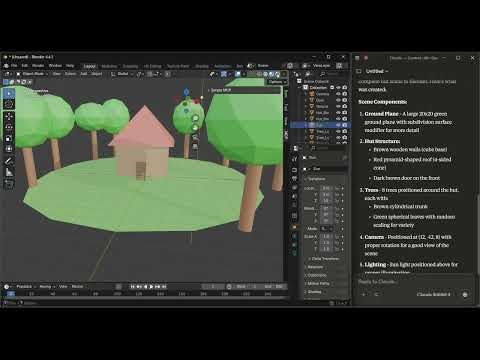
Hi HN! I built a custom MCP (Model Context Protocol) server that connects Blender to LLMs like ChatGPT, Claude, and any other llm supporting tool calling and mcps, enabling the AI to understand and control 3D scenes using natural language. You can describe an entire environment like: > “Create a small village with 5 huts arranged around a central bonfire, add a river flowing on the left, place a wooden bridge across it, and scatter trees randomly.” And the system parses that, reasons about the scene, and builds it inside Blender — no manual modeling or scripting needed. What it can do: -…
2025 · blender-mcp-psi.vercel.app · its alternatives →
- 2
 mcp-usefree tier, from $25/mo▲581
Hi HN, Luigi here. We maintain mcp-use an open-source TypeScript framework for building MCP servers and MCP Apps: https://github.com/mcp-use/mcp-use MCP is now (finally) stateless so we rewrote mcp-use v2 from scratch for the 2026-07-28 MCP spec revision: https://blog.modelcontextprotocol.io/posts/2026-07-28/ Thanks to the rebuild: - Throughput: +27% → from 8,615 to 10,982 median ops/sec - Cold launch: 2.2x faster → from 151.6 ms to 68.1 ms - Clean install: 82% smaller → from 404.6 MiB to 74.4 MiB Benchmark with methodology here:…
2025 · manufact.com · its alternatives →
- 3

Allow AI Agents to help you with Figma designs!
Jan 2026 · exdst.com · its alternatives →
- 4

I'm Dan, and I built a CLI that lets AI agents design in Figma. What it does: 100 commands to create shapes, text, frames, components, modify styles, export assets. JSX importing that's ~100x faster than any plugin API import. Works with any LLM coding assistant. Why I built it: The official Figma MCP server can only read files. I wanted AI to actually design — create buttons, build layouts, generate entire component systems. Existing solutions were either read-only or required verbose JSON schemas that burn through tokens. Demo (45 sec): https://youtu.be/9eSYVZRle7o Tech…
Jan 2026 · github.com · its alternatives →
- 5
 Figma for Agents▲580
Design with AI agents, connected to your design system
Apr 2026 · figma.com · its alternatives →
- 6

Open-source MCP bridge for Blender AI workflows
Aug 2026 · github.com · its alternatives →
- 7
 Instant3d.ai▲142
Copilot for generating 3d assets for Blender/Unity
2025 · instant3d.ai · its alternatives →
- 8

Transform 2D images into immersive 3D models with AI
2025 · its alternatives →
- 9

Design automation in Figma using AI and natural language
Jan 2026 · figma.com · its alternatives →
- 10

- 11

- 12

Give your agent tools to create beautiful, codebase-aware UI
Apr 2026 · aidesigner.ai · its alternatives →
- 13

Hey HN, I spent my xmas break building an agent framework called mcp-agent [1](https://github.com/lastmile-ai/mcp-agent) for Model Context Protocol [2]. It makes it easy to build AI apps with MCP servers, and implements every pattern from the popular Building Effective Agents blog [3] as well as OpenAI’s Swarm [4]. I’m sharing it early to get community feedback on where to take it from here, and to ask for contributions. For those who aren’t familiar with MCP, I think of it as a standardized interface to let AI communicate with software via tool calls, resources and…
2025 · github.com · its alternatives →
- 14
 Basin MCP▲168
tl;dr - try Basin AI with Cursor/Windsurf, instruction here (https://mcp.basin.ai), and use API key hackernews to gain access. Hey HN — I’m Henry, co-founder of Basin, and I wanted to share something we’ve been working on called Basin MCP, a kind of QA infrastructure for AI coding copilots like Cursor, Windsurf, etc. We built Basin because we kept noticing the same thing: agentic coding tools are great at generating code, but have no idea if the thing they built actually works — or even matches the original intent, and so they're prong to hallucinations. Basically, they have…
2025 · mcp.basin.ai · its alternatives →
- 15

Learn how MCP-Agent powers Deep Research Agents with simple orchestration, external memory, and scalable workflows. Open-source on GitHub.
2025 · thealliance.ai · its alternatives →
- 16

- 17

- 18AL
Hi HN friends, we're Nima (nimabanai) and Craig (cbschind) from Assemble Labs (https://assemblelabs.co) building the hardware context layer for AI to help you write better firmware faster. We’ve built an MCP server that plugs into any AI tool you’re using (Cursor, Claude Code, Gemini, etc.) and brings complete hardware context (schematics, datasheets, etc.) to your existing environment (new app fatigue is real...) with accuracy and in real time. Our goal is to make writing and debugging firmware on custom hardware faster and easier. Try out the free beta release:…
2025 · its alternatives →
- 19

Hey HN! A few months ago we shared mcp-agent (https://github.com/lastmile-ai/mcp-agent) [1][2], a lightweight framework that implements every agent pattern from Anthropic’s Building Effective Agents blog [3] and handles MCP server/client management seamlessly. Our core bet is that connecting LLMs to tools, resources, and external systems will soon be MCP-native by default. Today we're launching a significant update: Agents as MCP servers. Currently "agentic" behavior exists only on the MCP client side – clients like Claude or Cursor use MCP servers to solve tasks.…
2025 · github.com · its alternatives →
- 20OS
Large Language Models (LLMs) are powerful, but they’re limited by fixed context windows and outdated knowledge. What if your AI could access live search, structured data extraction, OCR, and more—all through a standardized interface? We built the JigsawStack MCP Server, an open-source implementation of the Model Context Protocol (MCP) that lets any AI model call external tools effortlessly. Here’s what it unlocks: - Web Search & Scraping: Fetch live information and extract structured data from web pages. - OCR & Structured Data Extraction: Process images, receipts, invoices, and handwritten…
2025 · its alternatives →
- 21LF
We built a no/low-code tool that lets you spin up MCPs from a single prompt. MCPs give LLMs access to tools, data, and actions—but they’re hard to build and deploy. Our tool abstracts that: describe what you want, and it auto-generates and hosts the necessary components. No UI flows, no manual chaining—just prompt and go. Examples: • Pull email, parse a DocSend, check Reddit, draft reply • Extract data from a niche site + send a Slack alert • Combine tools without writing glue code Live demo: https://www.youtube.com/watch?v=4uCiaQrgfoE Built over a weekend after getting…
2025 · generatemcp.com · its alternatives →
- 22MM
I built MCPlexor to solve a token waste problem I kept running into with MCP-based agents. The Problem: MCP (Model Context Protocol) is great for giving LLMs access to external tools. But if you connect multiple servers (GitHub, Linear, Postgres, Slack), you end up with 40-50k tokens of tool definitions injected into every request – before the agent even does anything. On a 200k context model, that's 25% gone. On smaller models, it's worse. And most runs only use 1-2 tools. The Solution: MCPlexor sits between your agent and your MCP servers. Instead of loading all tool definitions upfront:…
Feb 2026 · mcplexor.com · its alternatives →
- 23

A while back, I built a simple app to track stocks. It pulled market data and generated daily reports based on my risk tolerance. Basically a personal investment assistant. It worked well enough that I kept going. Now, the same framework helps me with real estate: comparing neighborhoods, checking flood risk, weather patterns, school zones, old vs. new builds, etc. It’s a messy, multi-variable decision—which turns out to be a great use case for AI agents. Instead of ChatGPT or Grok 4, I use mcp-agent, which lets me build a persistent, multi-agent system that pulls live data, remembers my…
2025 · github.com · its alternatives →
- 24

We built a reference MCP server that lets your editor/agent learn a codebase directly from source (signatures, types, AST, comments). Docs are optional. The reference impl runs on our open-source project’s codebase. Why we built it Docs are important, but they add another abstraction layer between your code and your users. Keeping them at the right quality is hard (especially at a startup), and LLM-generated docs are often mediocre until you invest real polish. Exposing code to the model in a structured way keeps answers grounded and current, and it’s always available. You can even…
2025 · github.com · its alternatives →
Also compare
Ranked by how close each launch is in meaning, then by votes. Prices were read from each product’s own site when checked and can change. Refine with your own description →