A "Codebase" as an MCP Server
We built a reference MCP server that lets your editor/agent learn a codebase directly from source (signatures, types, AST, comments). Docs are optional. The reference impl runs on our open-source project’s codebase. Why we built it Docs are important, but they add another abstraction layer between your code and your users. Keeping them at the right quality is hard (especially at a startup), and LLM-generated docs are often mediocre until you invest real polish. Exposing code to the model in a structured way keeps answers grounded and current, and it’s always available. You can even…
A "Codebase" as an MCP Server launched on September 10, 2025 with 20 votes, #588 of 8,160 launches that month and more than 90% of that year's launches. The site was not reachable when checked in September 2026.
In plain words
An MCP server that enables editors and AI agents to learn codebases directly from source code by analyzing signatures, types, abstract syntax trees, and comments. Designed for developers who want AI tools to understand their code structure without relying on separate documentation. The server keeps information current and grounded in actual code rather than maintaining separate docs, and supports switching between different branches or releases.
written from the facts on this page · September 2026
From the sources
In the maker’s words, at launch
We built a reference MCP server that lets your editor/agent learn a codebase directly from source (signatures, types, AST, comments). Docs are optional. The reference impl runs on our open-source project’s codebase. Why we built it Docs are important, but they add another abstraction layer between your code and…
Does a similar job
all alternatives → Mastra FactoryAug 2026 · mastra.ai · ▲536
We wanted to build a course for new Mastra devs to get started quickly. However, we knew videos would go out of date and be more difficult to maintain. We decided to launch our "course" as an MCP server. This way your coding agent actually teaches the course content to you and can help you write the code. We think this is a really interactive way to learn. Using an editor with MCP support (such as Cursor, Windsurf, or VSCode), your code agent will call the appropriate MCP tools which will return context for the agent. This context tries to instruct the agent that it should be teaching you…
 CodeHealth MCP Server by CodeSceneApr 2026 · codescene.com · ▲224
Keep AI-generated code healthy and maintainable
 Moxie Docs: KnowledgebasesJul 2026 · moxiedocs.com · ▲168
Built this because I'm sick of keeping documentation up to date when everyone's using AI tools now. It will not only generate missing docs / update / remove docs as they need alignment, but you can hook up the MCP to whatever agent is being used these days and it'll inform it of codebase conventions & relevant documentation, telling it to update docs as it find them or as it makes changes (in the same PR as related work), and reduces spend on tokens by getting things right the first time without having to grep the whole codebase for context or go through 5 rounds of "follow our…
 How we leapfrogged traditional vector based RAG with a 'language map'2024 · twitter.com · ▲162
TL;DR: Vector-based RAG performs poorly for many real-world applications like codebase chats, and you should consider 'language maps'. Part of our mission at Mutable.ai is to make it much easier for developers to build and understand software. One of the natural ways to do this is to create a codebase chat, that answer questions about your repo and help you build features. It might seem simple to plug in your codebase into a state-of-the-art LLM, but LLMs have two limitations that make human-level assistance with code difficult: 1. They currently have context windows that are too small to…
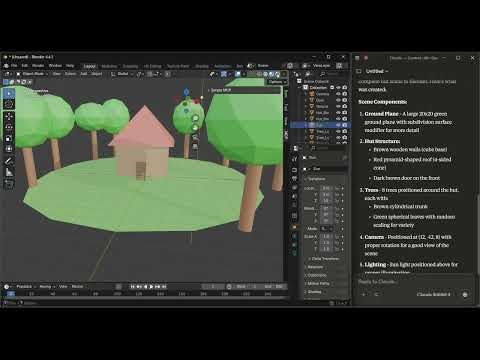 MCP server for Blender that builds 3D scenes via natural language2025 · blender-mcp-psi.vercel.app · ▲151
Hi HN! I built a custom MCP (Model Context Protocol) server that connects Blender to LLMs like ChatGPT, Claude, and any other llm supporting tool calling and mcps, enabling the AI to understand and control 3D scenes using natural language. You can describe an entire environment like: > “Create a small village with 5 huts arranged around a central bonfire, add a river flowing on the left, place a wooden bridge across it, and scatter trees randomly.” And the system parses that, reasons about the scene, and builds it inside Blender — no manual modeling or scripting needed. What it can do: -…

More ai this month
the category →


Paintings by AI models: programs run through a simulation of oil paint.
AI · 20d ago · stillwet.art
 PixVerse R2▲381
A real-time world model you can explore and change
AI · 29d ago · world.pixverse.video

Source: Show HN post ↗ · launch text quoted in part
Launched alongside, September 2025
the whole month →

The site hit #1 on HN about a year ago. Got enough traffic that I turned it into a proper API. What's there: - REST API — 35k products, manually filterable by category, free key, 60 req/min - CLI — npx anycrap random -c food - faker.js plugin — bundled, no API call, works offline - HuggingFace dataset — full 35k rows for ML/training https://anycrap.shop/developers
AI · 2025 · anycrap.shop

I made a built-from scratch Wayland Compositor to display any GUI app* in the terminal! I think there is a lot of unexplored potential in custom Wayland compositors, a lot of really cool things you can embed existing applications into! So, I started with embedding apps into the terminal because that is the easiest input/output (output is just utf-8 and I use the great `chafa` library for that, and I just read from stdin for the input). If you have any other ideas for cool Wayland compositors, let me know. I purposedly wrote 80% the app in Typescript to appeal to the most developers and…
Dev tools · 2025 · github.com
- IR
Years ago I stumbled across a basic version of this concept and it stuck with me. I knew if I was ever going to take on such a project, it would need to be flawless, but without coding experience it was just another idea that would never happen. By the end of 2024, as AI coding tools exploded everywhere, I finally had a way to make it real. I started from zero knowledge and spent months collaborating with AI agents as a learning experience. Every pixel and every function went through me. The AI translated what I asked for into code, but every decision was human. I didn't use existing OS…
AI · 2025 · mitchivin.com