AI · alternatives · 2026

24 alternatives to Cloning a musical instrument from 16 seconds of audio
In 2020, Magenta released DDSP [1], a machine learning algorithm / python library which made it possible to generate good sounding instrument synthesizers from about 6-10 minutes of data. While working with DDSP for a project, we realised how it was actually quite hard to find 6-10 minute of clean recordings of monophonic instruments. In this project, we have combined the DDSP architecture with a domain adaptation technique from speech synthesis [2]. This domain adaptation technique works by pre-training our model on many different recordings from the Solos dataset [3] first and then…
This tool creates playable instrument synthesizers from just 16 seconds of audio recording, using machine learning to clone the sound of monophonic instruments. It combines Google's DDSP algorithm with domain… Below are 24 products that do a similar job, ranked by how close each is in meaning and then by launch-day votes. Cloning a musical instrument from 16 seconds of audio launched in 2022; newer entries below may have overtaken it.
- 1
 Stable Audio 2.0▲156
One shot sample generation for the SignalsAndSorcery.com platform - shiehn/sas-sample-generator
2024 · stability.ai · its alternatives →
- 2

High-quality voice clones with just 60 seconds of audio
2023 · wavel.ai · its alternatives →
- 3FA
Hi all, I've spent some time working on music demixing or music source separation algorithms, which take in a mixed song and output estimates of isolated components (e.g. vocals, drums, bass, other). I took a popular PyTorch model with good performance (Open-Unmix, UMX-L weights), reimplemented the inference steps in C++, and compiled it to WebAssembly for a free client-side music demixer.
2023 · sevag.xyz · its alternatives →
- 4

If you already know what bytebeat is, you don't need an explanation. If not, check my project :) Here is how it looks: SELECT mono(output( arraySum(x -> 1 / 6 * running_envelope(30 * (1 + x / 6), time, 0.05 * x, 0.005, lfo(0, 0.25, sine_wave, time / 8), 0.1) * sine_wave(time * 80 * exp2(x / 3)), range(12)))) FROM table; To check how it sounds, find the examples in the repository https://github.com/ClickHouse/NoiSQL
2023 · github.com · its alternatives →
- 5

An intuitive 64-step drum sequencer progressive web app built using React, Redux, and Tone.js
2021 · sequencer64.com · its alternatives →
- 6

- 7MA
I am excited to announce a new tool for music producers and audio enthusiasts - a music audio search engine. With just a simple description of the groove you're looking for, our semantic search engine will output the most similar audio in seconds. I used the Freesound.org API to upload over 3,000 grooves to MongoDB, and combined all the relevant data such as tags, title, description, BPM, etc. into OpenAI's Text-Davinci to generate a unique description of each sound. I then embedded these descriptions using the Ada Embeddings Model and inserted them into Pinecone DB vector database, making…
2023 · muzic-sage.vercel.app · its alternatives →
- 8WB
2012 · blog.beatmaticapp.com · its alternatives →
- 9

I recently got Ableton Move and was disappointed by how difficult it was to convert samples into Move-compatible drum racks, so I made a simple CLI tool for that. I hope others find it useful, and at some point, Ableton sees the need and provides us with a built-in solution.
2024 · github.com · its alternatives →
- 10

A text to music AI model by Google
2023 · google-research.github.io · its alternatives →
- 11IU
Hi Hacker News, This is definitely out of my comfort zone. I just wanted to show you guys because I'm super proud of it. It's a 100% faithful recreation based off of the schematics, patents, and ROMs that were found online. So please watch the video and tell me what you think https://youtu.be/auOlZXI1VxA The reason why I think this is relevant is because I've been a programmer for 25 years and AI scares the shit out of me. I'm not a programmer anymore. I'm something else now. I don't know what it is but it's multi-disciplinary, and it doesn't involve writing code myself--for…
Jan 2026 · its alternatives →
- 12
 Kodai App▲65
Convert audio recordings to midi, organize and collaborate
2021 · kodai.app · its alternatives →
- 13WA
Hi, I'm the author of this little Web Audio toy which does physical modeling synthesis using a simple spring-mass system. My current area of research is in sparse, event-based encodings of musical audio (https://blog.cochlea.xyz/sparse-interpretable-audio-codec-pa...). I'm very interested in decomposing audio signals into a description of the "system" (e.g., room, instrument, vocal tract, etc.) and a sparse "control signal" which describes how and when energy is injected into that system. This toy was a great way to start learning about physical modeling synthesis, which seems…
2025 · blog.cochlea.xyz · its alternatives →
- 14T1
2017 · inverted3.gitlab.io · its alternatives →
- 15IF
Hi HN, Last time I showed free-music-demixer, which people seemed to enjoy. It was a static website with a Javascript + WASM module to perform music demixing (or music source separation) using an AI model UMX-L (Open-Unmix) running client-side in the browser. Since then, I have overhauled the project and made several improvements: - The demixing/separation quality is higher now, since I implemented the missing post-processing step - Memory usage is lower now by performing a custom segmented inference with a streaming LSTM, which should allow larger tracks (or, dare I say,…
2023 · freemusicdemixer.com · its alternatives →
- 16

I built k-synth as an experiment to see if a minimalist, K-inspired array language could make sketching waveforms faster and more intuitive than traditional code. I’ve put together a web-based toolkit so you can try the syntax directly in the browser without having to touch a compiler: Live Toolkit: https://octetta.github.io/k-synth/ If you visit the page, here is a quick path to an audio payoff: - Click "patches" and choose dm-bell.ks. - Click "run"—the notebook area will update. Click the waveform to hear the result. - Click the "->0" button below the waveform to copy…
Mar 2026 · octetta.github.io · its alternatives →
- 17

A powerful realtime node-based audio synthesizer. Contribute to monadgroup/axiom development by creating an account on GitHub.
2018 · github.com · its alternatives →
- 18

- 19
 Magenta Studio▲113
Make music & art using machine learning
2018 · magenta.tensorflow.org · its alternatives →
- 20

Made an MCP server that lets you design sounds on the Digitone 2 synth with natural language — real-time control over MIDI. https://www.youtube.com/watch?v=EXf6lOTjla8
2025 · github.com · its alternatives →
- 21
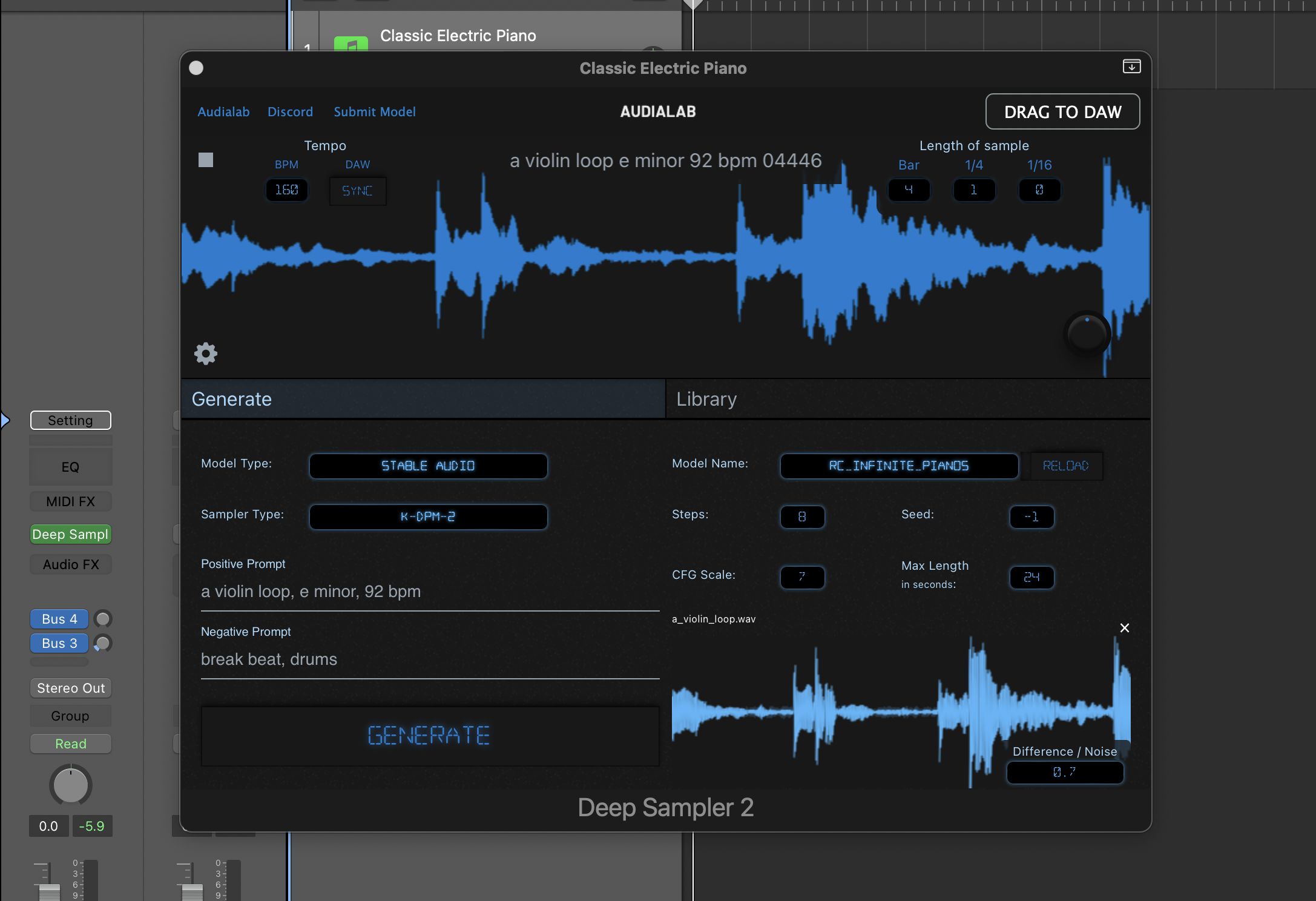
AI-generated samples and effects for producers (FREE VST)
2024 · audialab.com · its alternatives →
- 22PM
2017 · blog.buildo.io · its alternatives →
- 23IB
Hey HN, I’m an ex-Google engineer trying to get back into music production. I needed a way to sequence my hardware synths using AI contexts without constantly switching windows, so I built this. It runs entirely in the browser using WebMIDI. No login required. It connects to your local MIDI devices (if you're on Chrome/Edge) and lets you generate patterns. Tech stack: [React / WebMIDI API / etc]. Link: www.simplychris.ai/droplets Code is a bit messy, but it works. Feedback welcome.
Dec 2025 · simplychris.ai · its alternatives →
- 24
 SongDonkey▲88
Artificial intelligence audio separation, free web app
2021 · songdonkey.ai · its alternatives →
Also compare
Ranked by how close each launch is in meaning, then by votes. Prices were read from each product’s own site when checked and can change. Refine with your own description →