AI · alternatives · 2026

24 alternatives to CodeWatchdog
AI scans. Human audits. Zero stored code.
Below are 24 products that do a similar job, ranked by how close each is in meaning and then by launch-day votes.
- 1

Automatic AI-powered code reviews the moment you open a PR
Jan 2026 · kilo.ai · its alternatives →
- 2
 The New Waydev▲299
Measure the full AI SDLC. From token to production.
Apr 2026 · waydev.co · its alternatives →
- 3

- 4
 CodeBurn▲103
See where your AI coding spend actually goes
Aug 2026 · codeburn.app · its alternatives →
- 5

Hey HN, We’re two developers (co-founders) with a team of 20 who got tired of spending hours reviewing PRs, so we built Infinitcode.ai, an AI-powered code reviewer that: - *Summarizes PRs in plain English*: No more deciphering 1,000-line diff jungles - *Catches more than bugs*: Security holes, performance pitfalls, code smells, even typos (yes, we’ll flag “vurnerabilities” and vulnerabilities) - *Zero onboarding*: Works instantly—no “let me learn your codebase for weeks” nonsense. Why we’re posting: We’re in alpha and need brutal honesty. Roast our tool, mock our UI, or tell us why AI will…
2025 · infinitcode.ai · its alternatives →
- 6

Hey HN, I’m Henry, cofounder and CTO at Span (https://span.app/). Today we’re launching AI Code Detector, an AI code detection tool you can try in your browser. The explosion of AI generated code has created some weird problems for engineering orgs. Tools like Cursor and Copilot are used by virtually every org on the planet – but each codegen tool has its own idiosyncratic way of reporting usage. Some don’t report usage at all. Our view is that token spend will start competing with payroll spend as AI becomes more deeply ingrained in how we build software, so understanding how…
2025 · code-detector.ai · its alternatives →
- 7

Hi HN, I'm one of the creators of HoundDog.ai (https://github.com/hounddogai/hounddog). We currently handle privacy scanning for Replit's 45M+ creators. We built HoundDog because privacy compliance is usually a choice between manual spreadsheets or reactive runtime scanning. While runtime tools are useful for monitoring, they only catch leaks after the code is live and the data has already moved. They can also miss code paths that aren't actively triggered in production. HoundDog traces sensitive data in code during development and helps catch risky flows (e.g., PII…
Feb 2026 · github.com · its alternatives →
- 8

- 9
 AIVory Guard▲62
Real-time compliance & security validation for AI coding
Dec 2025 · aivory.net · its alternatives →
- 10
 Skilled▲76
Dashboard to find agent skills you no longer need
May 2026 · github.com · its alternatives →
- 11

Hi, I’m Kenny, I’ve been building aislop. I starting working on this after using Claude Code, codex and opencode several times and noticing some slops. They aren’t syntax and passes most tests, they are patterns like empty catch blocks, useless comments, duplicated helpers, dead code and many more. So I built a tool to scan and check for these patterns and wired it into hooks so after each tool call, the agent checks for the slops. You can try it out with npx aislop scan. It’s all local and no code is transferred. Thank you.
May 2026 · github.com · its alternatives →
- 12FL
Hi HN! We just launched Codacy Guardrails, an IDE extension with a CLI for code analysis and MCP server that enforces security & quality rules on AI-generated code in real-time. It hooks into AI coding assistants (like VS Code Agent Mode, Cursor, Windsurf), silently scanning and fixing AI-suggested code that has vulnerabilities or violates your coding standards, while the code it’s being generated. We built this because coding agents can be a double-edged sword. They do boost productivity, but can easily introduce insecure or non-compliant code. One recent research team at NYU found that 40%…
2025 · its alternatives →
- 13
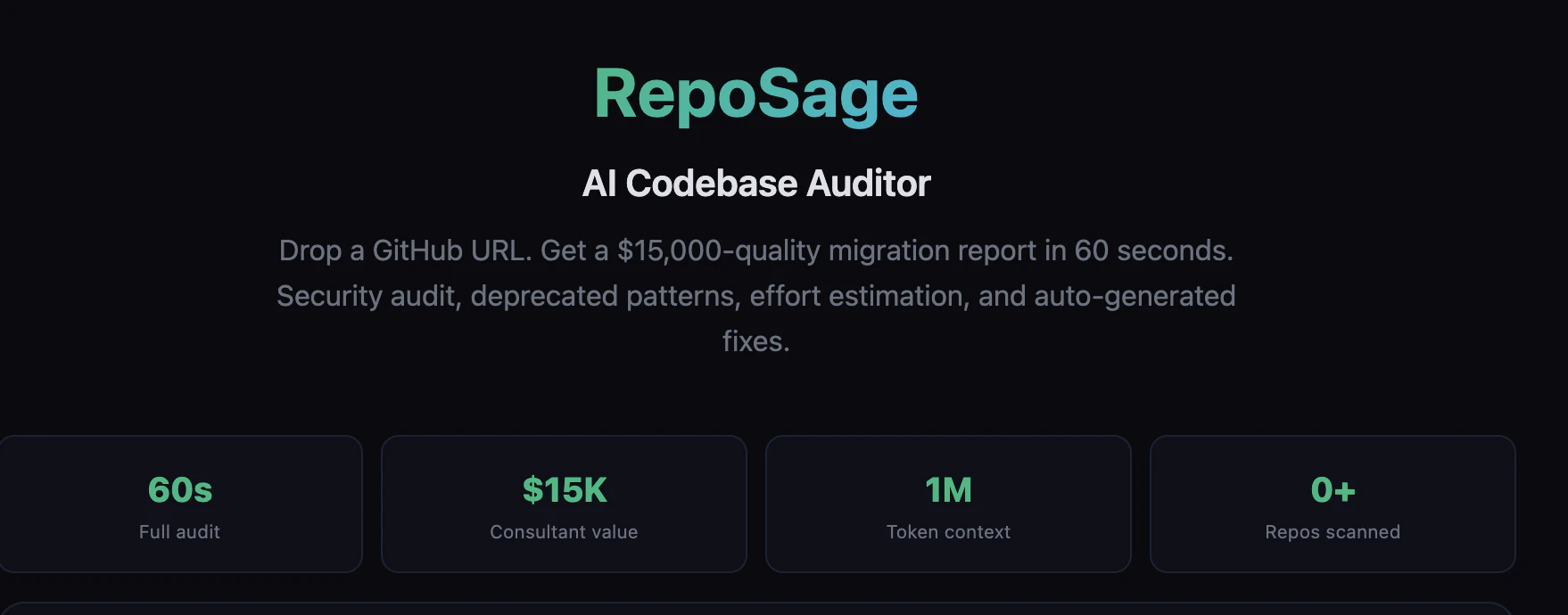
AI that audits your entire codebase in 60 seconds
May 2026 · triyambakam-apex-corp.hf.space · its alternatives →
- 14

We now write most of our code with agents. For a while, PRs piled up, causing review fatigue, and we had this sinking feeling that standards were slipping. Consistency is tough at this volume. I’m sharing the solution we found, which has become our main product. Continue (https://docs.continue.dev) runs AI checks on every PR. Each check is a source-controlled markdown file in `.continue/checks/` that shows up as a GitHub status check. They run as full agents, not just reading the diff, but able to read/write files, run bash commands, and use a browser. If it finds…
Feb 2026 · docs.continue.dev · its alternatives →
- 15
 Recall▲16
One developer solves it. Every developer knows it.
Feb 2026 · recall.team · its alternatives →
- 16

Tool-agnostic TypeScript library for observing coding agent sessions. Built-in Cursor provider, extensible to Claude Code, Codex, and OpenCode. - vtemian/agentprobe
Mar 2026 · github.com · its alternatives →
- 17AC
Hey HN! I’m Julien, the founder of Code Inspector, a platform that helps developers and managers produce better code and reduce technical debt. We would love to get some feedback from the Hacker News community. Our platform inspects code, looks for defects (security, vulnerability, design, performance, lack of documentation), automates code reviews and reports on team activity. You can customize violation alerts to reduce false positives. We currently support GitHub, Bitbucket and Gitlab. I’d love to hear your thoughts on what you would expect from such a platform (what you like, dislike)…
2021 · its alternatives →
- 18

Your AI has your code's text, never its map. Fix that.
Jun 2026 · luuuc.github.io · its alternatives →
- 19
 0pirate▲7
The zero-knowledge engineer that fixes code without seeing
Nov 2025 · 0pirate.com · its alternatives →
- 20

Octopus reviews every pull request in minutes with AI. Works with GitHub, GitLab, and Bitbucket. Indexes your codebase, analyzes diffs, and posts severity-rated findings to catch bugs before they merge.
Mar 2026 · octopus-review.ai · its alternatives →
- 21

I started using Claude Code (claude --dangerously-skip-permissions) and Codex (codex --yolo) and realized I had no reliable way to know what they actually did. The agent's own output tells you a story, but it's the agent's story. logira records exec, file, and network events at the OS level via eBPF, scoped per run. Events are saved locally in JSONL and SQLite. It ships with default detection rules for credential access, persistence changes, suspicious exec patterns, and more. Observe-only – it never blocks. https://github.com/melonattacker/logira
Mar 2026 · github.com · its alternatives →
- 22HW
A bunch of companies that I spoke to had their own claude & codex OTel dashboards that showed spend + seats per month. However, none of the dashboards actually analyzed how the engineers worked with the tools and if there were any areas for improvement! That's why I created https://www.promptster.ai. Managers get aggregate level view of code quality and how that ties with team workflows (nothing on a per-engineer level). While engineers get personalized coaching on how they can save tokens while keeping output high. We also have a tool built for individuals to test their local…
Jul 2026 · its alternatives →
- 23

Real time code analysis, as you write code, powered by AI
2025 · codesherlock.ai · its alternatives →
- 24
 Aether▲26
Since coding agents like Claude Code and Codex came out, I've been pretty obsessed with them. It's hard not to when you're getting a 20x discount on inference. I've also been frustrated by them a lot. I hated walking around with my laptop lid open while connected to a hotspot on my phone, having to tediously accept commands so I don't lose my root directory, and running out of RAM when running multiple agents that were spinning up dev servers in different worktrees at once. A lot of people would say existing cloud agents are the solution to this, as none of the above problems apply to any…
Jul 2026 · runaether.dev · its alternatives →
Also compare
Ranked by how close each launch is in meaning, then by votes. Prices were read from each product’s own site when checked and can change. Refine with your own description →