Alternatives
Products that do what Daem0n does
Eternal Memory for the Digital Familiar
- 1

- 2

- 3

- 4RG
Hey HN! I'm José, and I built Recall to solve a problem that was driving me crazy. The Problem: I use Claude for coding daily, but every conversation starts from scratch. I'd explain my architecture, coding standards, past decisions... then hit the context limit and lose everything. Next session? Start over. The Solution: Recall is an MCP (Model Context Protocol) server that gives Claude persistent memory using Redis + semantic search. Think of it as long-term memory that survives context limits and session restarts. How it works: - Claude stores important context as "memories" during…
Oct 2025 · npmjs.com
- 5MO
Hey HN! We're Taranjeet and Deshraj, the founders of Mem0 (https://mem0.ai). Mem0 adds a stateful memory layer to AI applications, allowing them to remember user interactions, preferences, and context over time. This enables AI apps to deliver increasingly personalized and intelligent experiences that evolve with every interaction. There’s a demo video at https://youtu.be/VtRuBCTZL1o and a playground to try out at https://app.mem0.ai/playground. You'll need to sign up to use the playground – this helps ensure responses are more tailored to you by…
2024 · github.com
- 6

- 7

- 8

The memory layer that decides what's worth remembering
13d ago · skynetlab-cortex.com
- 9
- 10

- 11

An OKF-backed Model Context Protocol (MCP) server delivering persistent long-term memory and SQLite FTS5 search for AI agents. - fellowgeek/mcp-memory
24d ago · github.com
- 12

- 13RA
Hey HN! I built Retain as the evolution of claude-reflect (github.com/BayramAnnakov/claude-reflect). The original problem: I use Claude Code/Codex daily for coding, plus claude.ai and ChatGPT occasionally. Every conversation contains decisions, corrections, and patterns I forget existed weeks later. I kept re-explaining the same preferences. claude-reflect was a CLI tool that extracted learnings from Claude Code sessions. Retain takes this further with a native macOS app that: - Aggregates conversations from Claude Code, claude.ai, ChatGPT, and Codex CLI - Instant full-text…
Jan 2026 · github.com
- 14

- 15CL
I have a proposal that addresses long-term memory problems for LLMs when new data arrives continuously (cheaply!). The program involves no code, but two Markdown files. For retrieval, there is a semantic filesystem that makes it easy for LLMs to search using shell commands. It is currently a scrappy v1, but it works better than anything I have tried. Curious for any feedback!
Apr 2026 · github.com
- 16PM
This is my attempt in building a memory that evolves and persist for claude code. My approach is inspired from Zettelkasten method, memories are atomic, connected and dynamic. Existing memories can evolve based on newer memories. In the background it uses LLM to handle linking and evolution. I have only used it with claude code so far, it works well with me but still early stage, so rough edges likely. I'm planning to extend it to other coding agents as I use several different agents during development. Looking for feedbacks!
Jan 2026 · github.com
- 17BA
Tired of AI coding tools that forget everything between sessions? Every time I open a new chat with Claude or fire up Copilot, I'm back to square one explaining my codebase structure. So I built something to fix this. It's called In Memoria. Its an MCP server that gives AI tools persistent memory. Instead of starting fresh every conversation, the AI remembers your coding patterns, architectural decisions, and all the context you've built up. The setup is dead simple: `npx in-memoria server` then connect your AI tool. No accounts, no data leaves your machine. Under the hood it's TypeScript +…
2025 · github.com
- 18ML
Jun 2026 · github.com
- 19LA
Hi HN, Working with multiple projects, I got tired of re-explaining our complex multi-node system to LLMs. Documentation helped, but plain text is hard to search without indexing and doesn't work across projects. I built Linggen to solve this. My Workflow: I use the Linggen VS Code extension to "init my day." It calls the Linggen MCP to load memory instantly. Linggen indexes all my docs like it’s remembering them—it is awesome. One click loads the full architectural context, removing the "cold start" problem. The Tech: Local-First: Rust + LanceDB. Code and embeddings stay on your machine. No…
Dec 2025 · github.com
- 20

- 21PM
I built an MCP server that gives Claude Code long-term memory across sessions, backed by infrastructure you control. Every Claude Code session starts from zero, no memory of previous sessions. This server uses mem0ai as a library and exposes 11 MCP tools for storing, searching, and managing memories. Qdrant handles vector storage, Ollama runs embeddings locally (bge-m3), and Neo4j optionally builds a knowledge graph. Some engineering details HN might find interesting: - Zero-config auth: auto-reads Claude Code's OAT token from ~/.claude/.credentials.json, detects token type (OAT vs…
Feb 2026 · github.com
- 22
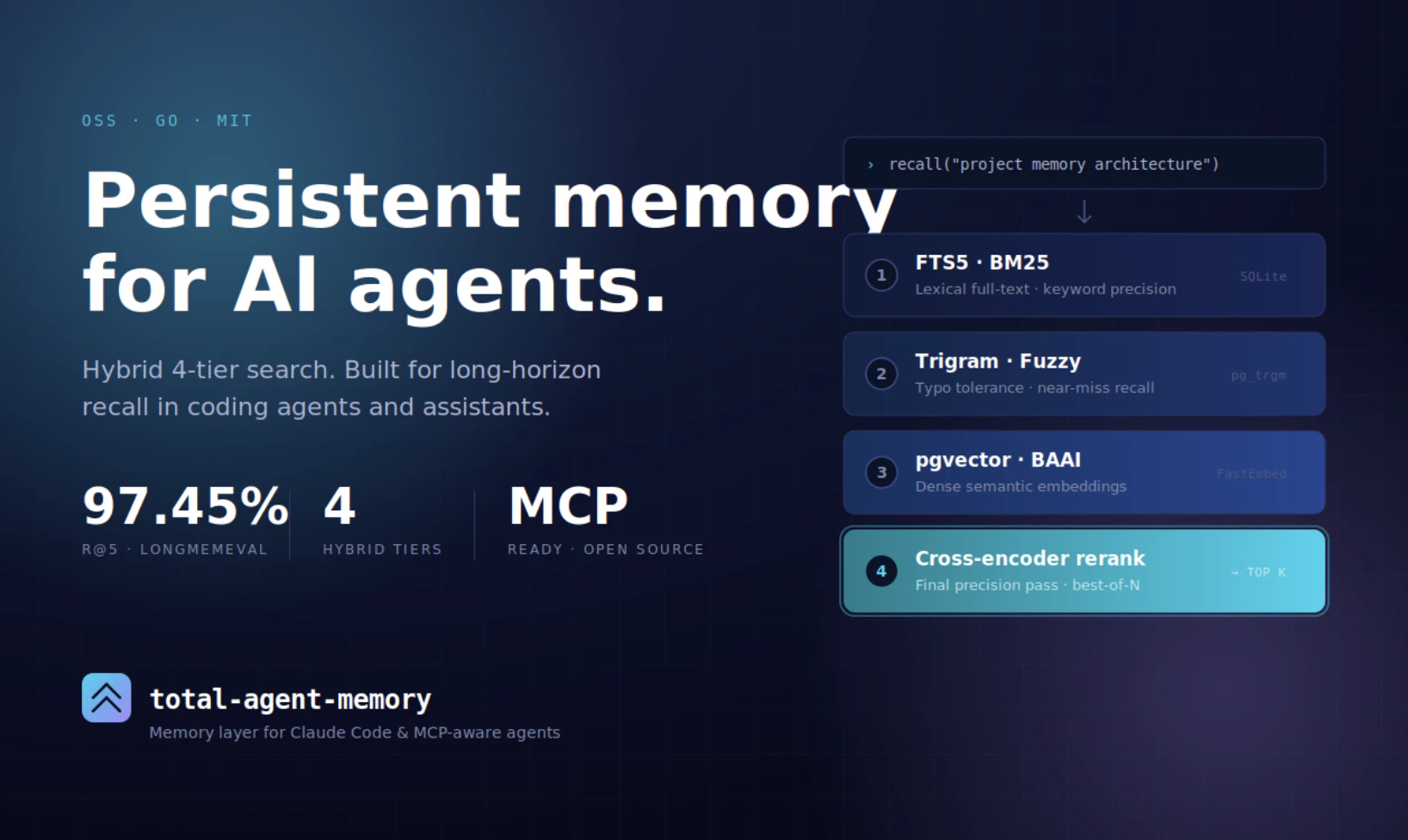
Open-source MCP server. #5 on LoCoMo. 100% local. MIT.
May 2026 · totalmemory.dev
- 23PM
Dec 2025 · github.com
- 24

Ranked by how close each launch is in meaning, then by votes. Refine with a description →