Alternatives
Products that do what Echidra does
Deceptive honeypot + attacker classifier, fully self-hosted
- 1

- 2WB
Jul 2026 · honeypotlive.cc
- 3

- 4OS
2014 · sshpot.com
- 5

- 6

Lightweight LAN decoys with cloud-based alerts.
Jun 2026 · honeypot.app.dataforgecanada.com
- 7

- 8LZ
Hey HN We’ve been building Logdash as a lightweight observability tool for side projects and prototypes. Most logging/metrics tools (Prometheus, Grafana, ELK...) are amazing, but feel like overkill when you're just hacking on something small. Logdash gives you: - Real-time logs and custom metrics - Zero config (no YAML, no setup) - One tiny SDK to drop in - Hosted UI with live dashboards We use Logdash to monitor Logdash — our own prod dashboard is public here: https://logdash.io/demo-dashboard Would love feedback, ideas, or questions!
2025 · logdash.io
- 9AB
Most other IP lookup tools I've found are mostly just trying to push you to signup for their API, which is fine but less useful if you're just trying to figure out which IP addresses in your log files are from sketchy locations and likely to do bad things to your application. I merged together a bunch of APIs and some of our own honeypot collected data to make something I hope devs and security folks find useful. If you want to try out a "bad" IP, try this one: https://wafris.org/ip-lookup/104.244.72.115
2023 · wafris.org
- 10

- 11RA
Hi HN! I built RustNet, a Terminal UI based network monitor written in Rust that shows real-time connections with process identification and protocol detection. What may make it interesting: • Deep packet inspection for HTTP, HTTPS/TLS (with SNI), DNS, and QUIC protocol detection • Process identification using eBPF on Linux (experimental) and PKTAP on macOS which does also catch short-lived processes that polling procfs or lsof would miss • Multi-threaded packet processing with lock-free data structures for the UI • Cross-platform (Linux, macOS, Windows but process identification so far…
Sep 2025 · github.com
- 12AM
I built an open-source AIOps MCP (Monitoring & Control Plane) that detects anomalies in logs using Isolation Forest. It accepts logs from agents, apps, or collectors, parses and extracts features, and identifies unusual patterns in real time. Alerts can be sent to Slack, Webhooks, or PagerDuty. It’s lightweight, easy to deploy with Kubernetes & Helm, and designed to plug into existing observability stacks. I built this to experiment with combining ML-based anomaly detection and flexible alerting for DevOps/SRE teams. Most AIOps platforms are either too heavyweight or closed-source — I…
2025 · github.com
- 13BO
We’re open-sourcing a simple way to add “canary tools” to AI agents via MCP honeypots. These are functions your agent should never call during normal operation. If a canary is invoked, you get a high-fidelity signal of prompt-injection, tool hijacking, or lateralization—no heuristics, no extra model calls. What it is: - Go framework exposing decoy tools over MCP that look legitimate (names/params/descriptions), return safe dummy output, and emit telemetry when invoked. - Runs alongside your real tools; ship events to stdout/webhook or your pipeline (Prometheus/Grafana,…
Sep 2025
- 14UB
2014 · bitcoinvigil.com
- 15BS
I built Bugsink because I wanted error tracking I could run myself, without maintaining a complex stack. It runs with pip install or a single Docker container, stores events locally (SQLite, MySQL, or Postgres), and is easy to run and keep running. It’s API compatible with the Sentry SDKs, so you can keep your existing client setup. Bugsink focuses on error tracking only and is fast enough to process millions of events per day on modest hardware. The 1.5 release introduces sourcemaps support: https://www.bugsink.com/blog/bugsink-1.5-introducing-sourcem... Can't you just…
2025 · bugsink.com
- 16IM
Hello I'm Jack, I was previously a Site Reliability Engineer and i've been working on monitro.dev which makes log monitoring simple for individuals or small teams. It allows you to easily forward any logs to multiple channels such as Slack, Discord & Telegram. The events are also viewable though the admin dashboard and are easily filterable. Currently there is only an NPM package with javascript / typescript support but i have plans to expand this to other languages such as Python, Rust etc. The package has many options, one of them is forwarding any uncaught exception and as an event…
2024 · monitro.dev
- 17

- 18AA
We’ve published a set of open-source reference implementations on how to build production-grade Agentic AI applications on AWS. What’s in the repo: • Agentic RAG, memory, and planning workflows with LangGraph & CrewAI • Strands-based flows with observability using OTEL & Arize • Evaluation with LLM-as-judge and cost/performance regressions • Built with Bedrock, S3, Step Functions, and more GitHub: https://github.com/aws-samples/sample-agentic-frameworks-on-... Would love your thoughts — feedback, issues, and stars welcome!
2025 · github.com
- 19

- 20

- 21
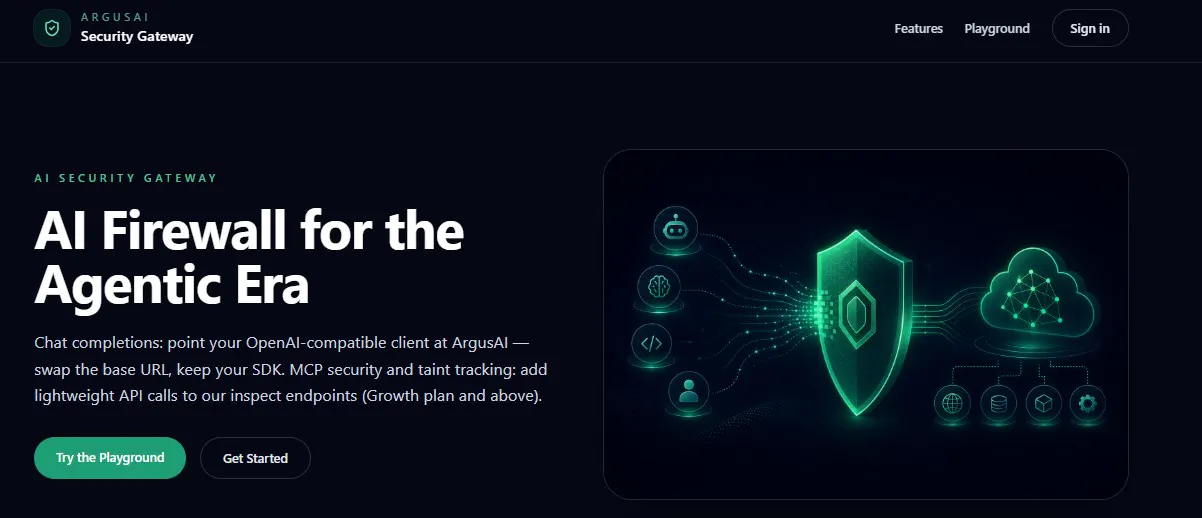 ArgusAI ▲7
AI firewall for LLM calls, MCP tools, and agentic workflows
Jul 2026 · argusai-tau.vercel.app
- 22MY
LLM observability is an absolute must-have for anyone running something in prod (or prod-like). While all the observability startups are great, you're essentially sending all your OpenAI usage history - prompts, generations, chats - to a random third party. So this script deploys a basic proxy in your Azure account, catches all incoming OpenAI requests, stores logs in your own resource group, and comes with visualizations premade (charts, timelines, chat history, cost estimation, etc). Thanks for any thoughts and feedback!
2023 · github.com
- 23OS
I built a network discovery tool in Rust that helps identify public Ollama LLM servers. It scans IP ranges to find Ollama instances and catalogs their available models. Important note: This is intended for educational purposes and authorized security testing only.
2025
- 24VB
Hey HN! We're Ben and Izak, the cofounders of Vigilant. Vigilant is a lightweight tool for managing structured logs. It lets you centralize your logs, search them, and create alerts. We used Cloudwatch for logs on our last product, and it was quite painful. Even basic searches felt tedious. We’ve used dedicated observability tools at past jobs, but most of them have a steep learning curve and require widespread integration (and some still feel clunky). With Vigilant, we're focused on making logs feel fast and simple. We operate at the application layer with an sdk. We're trying a unique…
2025 · vigilant.run
Ranked by how close each launch is in meaning, then by votes. Refine with a description →