Dev tools · alternatives · 2026

24 alternatives to Framework to create linters for Python, YAML, TOML, JSON
Hi, this is a Python framework I have created to make my life a little easier when creating custom linting rules. Key features: - Quick to use (~20 LOC to create a functioning linter/checker) - Works with different file formats (as in the description) - Supports multiple ignore/noqa directives (per-line ignores, range ignores, whole file, rules choice during runs) - Single check can span all elements of the file or even all files - Works directly with Python's AST - Tutorials and API reference to make users life easier All in all seems to be quite functional for my private (yet)…
Below are 24 products that do a similar job, ranked by how close each is in meaning and then by launch-day votes.
- 1

A linter to prevent exception handling antipatterns in Python (limited only for those who like dinosaurs). - guilatrova/tryceratops
2021 · github.com · its alternatives →
- 2

2021 · lona-web.org · its alternatives →
- 3
 Lint for HTTP▲138
Validator for HTTP. Contribute to vfaronov/httpolice development by creating an account on GitHub.
2016 · github.com · its alternatives →
- 4

Colin here, creator of Nub. I’ve had the general shape of this in mind for years. Nub runs your code with stock `node`, augmented with a `--require` preload hook[0] that adds a transpiler (oxc-powered, packaged as a Node-API add-on), registers a module resolution hook[1], and injects polyfills as needed for APIs like `Worker`, `Temporal`, etc. All purely additive, your code ultimately runs using Node’s actual engine & stdlib implementations. [0] https://nodejs.org/api/cli.html#-require-module [1]…
Jun 2026 · github.com · its alternatives →
- 5EA
eno [1] - A modern plaintext language w/ libraries [2] for JavaScript, Python, Ruby & soon more! We migrated a big relational research database to a file-based solution - requirements were: - Super fast and easy editability for users - Highest performance for parsing/validating >10K documents on every user change. Our trials with YAML/TOML showed us that we wanted something both faster [3][4] and easier [4], something tailored for file-based content management ... and after months of research & development it's now publicly available (under MIT license) for everyone! Last but…
2018 · its alternatives →
- 6

We're excited to announce Lowdefy V4, a full-stack web framework built on top of Next.js that simplifies building web applications, internal tools, admin panels, BI dashboards, and CRUD apps using YAML or JSON configuration files. New in V4: Next.js: Lowdefy now runs on top of the Next.js framework. All of Auth.js: App auth is now handled by Auth.js supported providers, adapters and callbacks and events, easy to configure, but all of which can be customized. Plugin extensibility: Apps can now be extended with any npm or pnpm workspace plugins. Our story: We have developed a simple…
2021 · lowdefy.com · its alternatives →
- 7

Find static code analysis tools and linters for Java, JavaScript, PHP, Python, Ruby, C/C++, C#, Go, Swift, and more. All tools and linters are peer-reviewed by fellow developers to select the best tools available. Avoid bugs in production, outages on weekends, and angry customers.
2020 · analysis-tools.dev · its alternatives →
- 8

Easy JSON Query Processor with a Lispy syntax in Go - cube2222/jql
2020 · github.com · its alternatives →
- 9
 markuplint▲62
Linter that gives peace of mind in your markup
2021 · markuplint.dev · its alternatives →
- 10

Define and run pattern-based custom linting rules. - quasilyte/go-ruleguard
2020 · github.com · its alternatives →
- 11

Catch webapp errors before customers do
2022 · webapp.io · its alternatives →
- 12

⚡🐍 Extends built-in Python collections with LINQ-style methods - borzunov/dontasq
2015 · github.com · its alternatives →
- 13

- 14

Useful JSON online tools
2022 · jsonformatter.net · its alternatives →
- 15

What's your tool chain for data and document processing? - jq is great, but limited to JSON; and jQuery limited to HTML; templating systems get messy for non-trivial logic; TypeScript lacks pattern matching and schema support. So I built Lambda — an expressive functional language that combines the power of Lisp, TypeScript, and many DSLs like jq, jQuery, RelaxNG, etc. It has a lightweight 9 MB runtime, built from scratch in C/C++, that provides an end-to-end document processing pipeline (parse → validate/query/transform → layout → render/view). Internally, Lambda parse…
Mar 2026 · github.com · its alternatives →
- 16
 LINQ for Go▲84
.NET LINQ capabilities in Go. Contribute to ahmetb/go-linq development by creating an account on GitHub.
2014 · github.com · its alternatives →
- 17

lint large and complex OpenAPI documents, build custom rules using JS or go.
2024 · github.com · its alternatives →
- 18

a restricted python to javascript / c# / go / ruby compiler - pseudo-lang/pseudo-python
2016 · github.com · its alternatives →
- 19EC
2015 · ruanyf.github.io · its alternatives →
- 20

- 21

Hey HN, I’m the author. I built Misata because existing tools (Faker, Mimesis) are great for random rows but terrible for relational or temporal integrity. I needed to generate data for a dashboard where "Timesheets" must happen after "Project Start Date," and I wanted to define these rules via natural language. How it works: LLM Layer: Uses Groq/Llama-3.3 to parse a "story" into a JSON schema constraint config. Simulation Layer: Uses Vectorized NumPy (no loops) to generate data. It builds a DAG of tables to ensure parent rows exist before child rows (referential integrity).…
Dec 2025 · github.com · its alternatives →
- 22AS
Took a stab at building my own string diffing JS package. I built an interactive demo for TypeIt’s website (https://typeitjs.com/build-your-own) a while back. The approach I took to handle user input necessitated a way to calculate the difference between the versions of a user’s text input. I searched around for a package to help me out and found a couple of good ones (like fast-diff), but I either didn’t really like their API or didn’t want to take on a huge new dependency. Instead, I thought I’d give it a shot myself (famous last words). I dove into it having no real formal…
2022 · its alternatives →
- 23
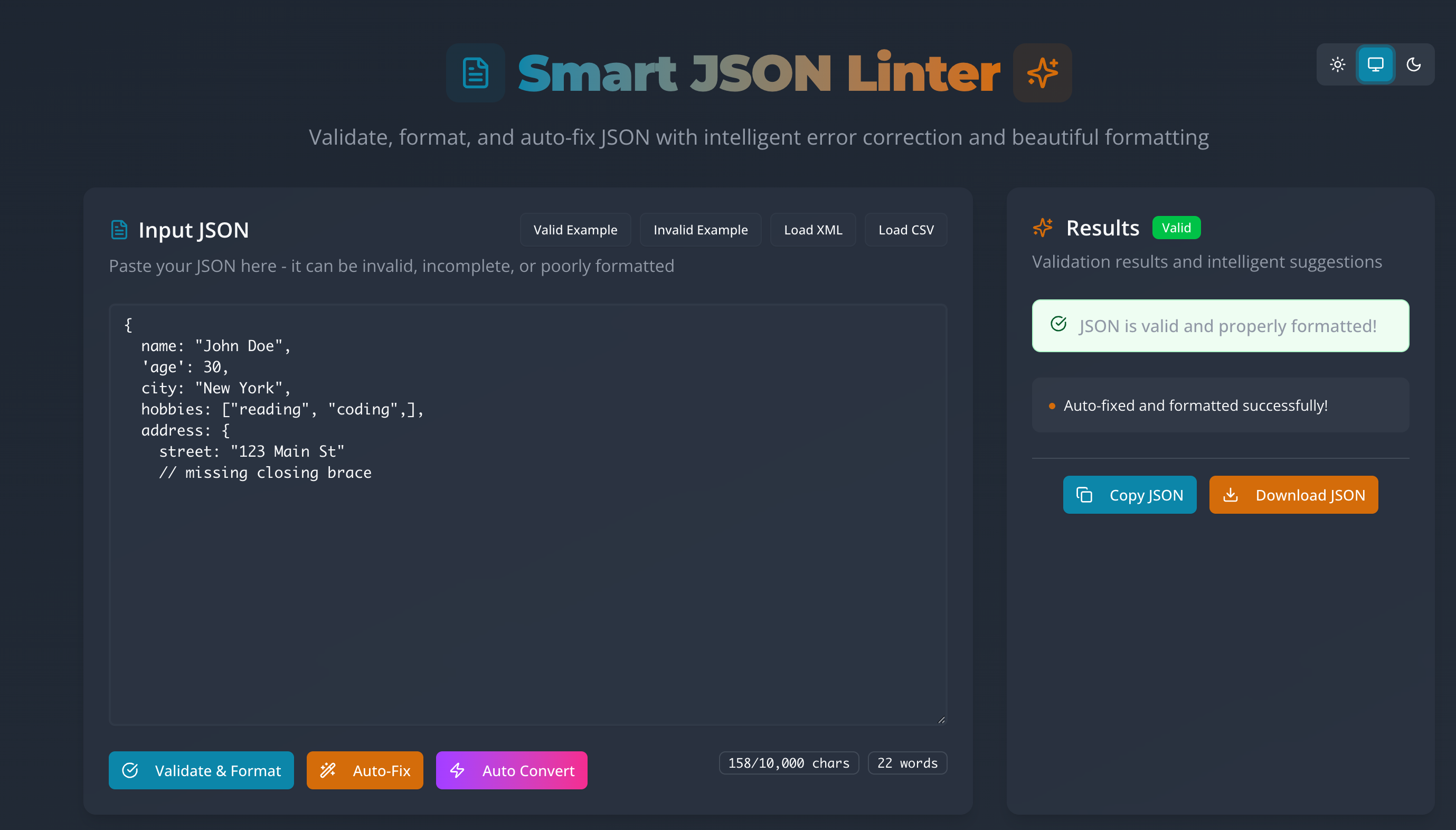
- 24

AI coding assistants are productive but sloppy. They produce code that looks right but: - Imports packages that don't exist - Uses placeholder functions that do nothing - Leaks patterns from JavaScript, Java, Ruby into Python - Leaves behind dead code and duplicates - Uses mutable default arguments I built sloppylint to catch these "AI slop" patterns before they hit production. pip install sloppylint sloppylint . It detects 100+ patterns across categories: - Hallucinated imports (20% of AI imports reference non-existent packages) - Placeholder code (`pass`, `...`, `TODO`) - Wrong-language…
Dec 2025 · github.com · its alternatives →
Also compare
- A New Python Linter alternatives
- Lona – Framework for responsive web apps in full Python without JS alternatives
- Lint for HTTP alternatives
- Nub – A Bun-like all-in-one toolkit for Node.js alternatives
- Eno – A lightning fast, user-friendly YAML/TOML alternative alternatives
- Lowdefy – Build internal tools with YAML on an open-source framework alternatives
Ranked by how close each launch is in meaning, then by votes. Prices were read from each product’s own site when checked and can change. Refine with your own description →