Alternatives
Products that do what GitHub does
Mind-map of your codebase to see what your agent builds
- 1IB
https://the-pocket.github.io/Tutorial-Codebase-Knowledge/
2025 · github.com
- 2

- 3GF
hi guys. been working on something i think is fundamentally missing in today's workflow with ai agents. vcs. i find myself struggling with questions that agents can't answer like "why did you do it?", "when did u delete this folder? why?", etc. or trying to /rewind (after a /compact...) or basically `bisect` to find when and why something was done by the agent in the current / previous session. just like git did for code, i think we are the same core capabilities with ai agents so... i developed an open source solution for that (currently supporting claude code) would love to…
May 2026 · github.com
- 4

- 5

- 6MA
I've been exploring the (not so=) amazing potential of AI in coding and have compiled a list of tools. From AI-powered IDEs to code generators, this resource is my contribution to the community. I'm still on the fence about including txt2sql projects, as their functionality seems too basic to me. And I'm personally maintaining this, so your feedback is wellcome.
2025 · aicode.danvoronov.com
- 7

- 8

- 9

- 10WC
Hi all, I'm Ivan, and together with Alex, we're building a diagram visualization tool for codebases. Alex and I are devs, and we've noticed that recently we've been super productive at writing code (prompting :D). But when it comes to understanding big systems, prompting doesn't work that well — for that, diagrams are best imo. Most tools out there don't scale to big projects (e.g. PyTorch), so we're building CodeBoarding — a recursive visualizer for codebases. It starts from the highest level of abstractions and lets you dive deeper. We use static analysis and LLM agents. The control-flow…
2025 · github.com
- 11CI
Hey HN, we are Alex and Ivan, two developers who’ve spent too many afternoons trying to understand unfamiliar repos. Like most devs, we don’t enjoy wading through dense docs to get up to speed — so we built CodeBoarding to make codebase onboarding a more interactive experience. Last year, I (Alex) was onboarding at a biotech company in the R&D phase applying ML. As you can imagine, when a team of scientists from non CS-background come together, the code gets pretty messy and full of domain-specific quirks. During my time there, I asked a lot of questions, yet when my internship came to an…
2025 · github.com
- 12

Give your agent tools to create beautiful, codebase-aware UI
Apr 2026 · aidesigner.ai
- 13BC
We are a small group of undergrads interested in building human in the loop coding agents. We dream of a world where building complex agent workflows feels as simple and creative as playing with legos. When we were building stuff we needed a tool that made it easy to try out different code embedding models so that we could see which ones worked best in different scenarios and understand their strengths and weaknesses. So to speed that process up we made PurpleSearch an 'instant' search engine for your local codebases. This tool lets you quickly deploy any open source embedding model on…
2025
- 14

Your AI has your code's text, never its map. Fix that.
Jun 2026 · luuuc.github.io
- 15

- 16

- 17AC
We built a reference MCP server that lets your editor/agent learn a codebase directly from source (signatures, types, AST, comments). Docs are optional. The reference impl runs on our open-source project’s codebase. Why we built it Docs are important, but they add another abstraction layer between your code and your users. Keeping them at the right quality is hard (especially at a startup), and LLM-generated docs are often mediocre until you invest real polish. Exposing code to the model in a structured way keeps answers grounded and current, and it’s always available. You can even…
Sep 2025 · github.com
- 18CA
Codebased combines Tree Sitter for code awareness (find functions, data structures, constants, etc. not just lines of code), full-text search using SQLite, and semantic search using OpenAI embeddings + FAISS. Despite being implemented in Python, supporting semantic search, making multiple API calls for embedding and re-ranking, it is faster than ripgrep for runng searches against the Linux kernel (takes ~1 second vs. ~2 seconds, obviously depends on system, temperature, time of day, tidal forces, etc.) Up next: - A Perplexity-like agent for interpreting results, making multiple follow-up…
2024 · codebased.sh
- 191D
We just open-sourced the internal system we built at Assembled for running coding agents as a team. Coding agents worked well for individual engineers, but the surrounding workflow was a bit of a mess. We generally found that many engineers had different MCP connections and context for their agents, personal automations running that other people couldn’t access, and very little introspection for what a human’s input into the coding agent looked like. So we built an internal system that converted coding agents into shared team infrastructure. The system runs Codex, Claude Code, OpenCode, and…
Jun 2026
- 20CA
I built this because I was tired of creating pull requests in 20 repositories just to change a single line of workflow job version. With Infra as AI, just mention the change. Agents work on all repos in parallel, read the docs, make a bunch of PRs and fill in the description. You can see the demo of the actual dashboard in the landing. Let me know your thoughts :) It means a lot to me!
Sep 2025 · infrastructureas.ai
- 21AT
Hi everyone! We just launched Depth AI - a tool that helps you onboard to large and messy codebases. Unlike most dev tools that help in codegen and building smaller apps, this one mainly aims at understanding large repos better - so we have focussed a lot of code search quality. We also launched the first version on product hunt https://www.producthunt.com/posts/depth-ai. Do check us out. Would love to hear feedback here and discuss more how our approach to code search is different.
2024
- 22WA
Today you can easily adopt AI coding tools because you have git for branching and rolling back if AI writes bad code. We haven't seen this same capability for data and decided to build it ourselves. Nile is a new kind of data lake, purpose built for using with AI. It can act as your data engineer or data analyst creating new tables and rolling back bad changes in seconds. We support real versions for data, schema, and ETL. We'd love your feedback on any part of what we are building - https://getnile.ai/ What do you think?
Jan 2026
- 23IB
After years of struggling with onboarding to new projects, I got tired of spending weeks just trying to grasp the basics of a codebase. The README rarely tells the whole story, and "just read the code" isn't practical for large repos. I built RepoIQ to create personalized learning paths through any GitHub repository. It analyzes the codebase structure, identifies key components, and creates a step-by-step guide tailored to your learning needs.
2025 · repoiq.be
- 24
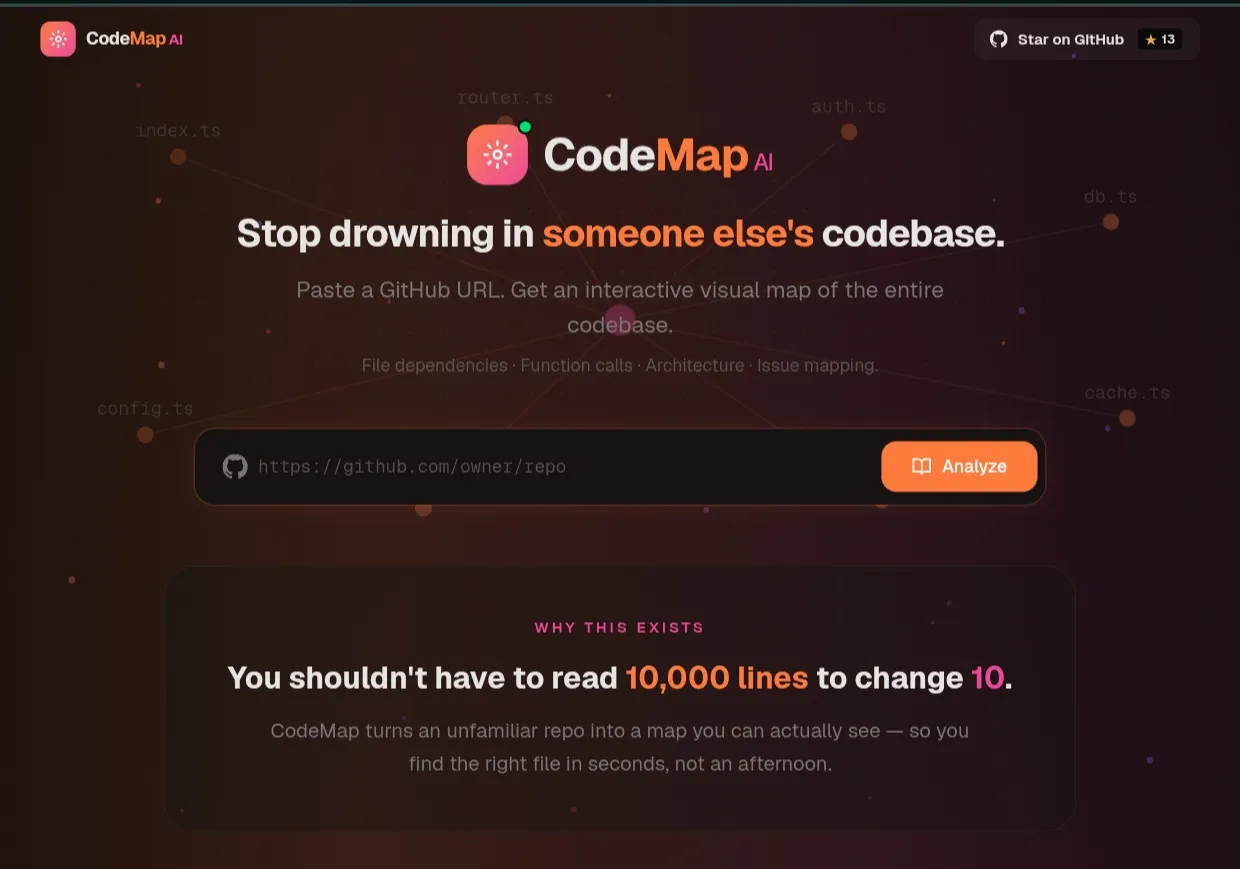
Understand any large GitHub repos and solve issues faster
Jul 2026 · code-map-ai-mu.vercel.app
Ranked by how close each launch is in meaning, then by votes. Refine with a description →