Alternatives
Products that do what Honey Nudger does
Recursive Self-Learning For Agents
- 1

- 2

- 3

- 4

- 5

- 6

- 7

- 8

- 9WS
Hi HN! We’re Max and Peyton from The Interface (https://www.theinterface.com/). We started out building an AI agent dev tool, but somewhere along the way it turned into Sims for AI agents. Demo video: https://www.youtube.com/watch?v=sRPnX_f2V_c. The original idea was simple: make it easy to create AI agents. We started with Jupyter Notebooks, where each cell could be callable by MCP—so agents could turn them into tools for themselves. It worked well enough that the system became self-improving, churning out content, and acting like a co-pilot that helped you…
2025 · youtube.com
- 10

- 11
- 12OS
We implemented Stanford's Agentic Context Engineering paper which shows agents can improve their performance just by evolving their own context. How it works: Agents execute tasks, reflect on what worked/failed, and curate a "playbook" of strategies. All from execution feedback - no training data needed. Happy to answer questions about the implementation or the research!
Oct 2025 · github.com
- 13QA
Oct 2025 · github.com
- 14
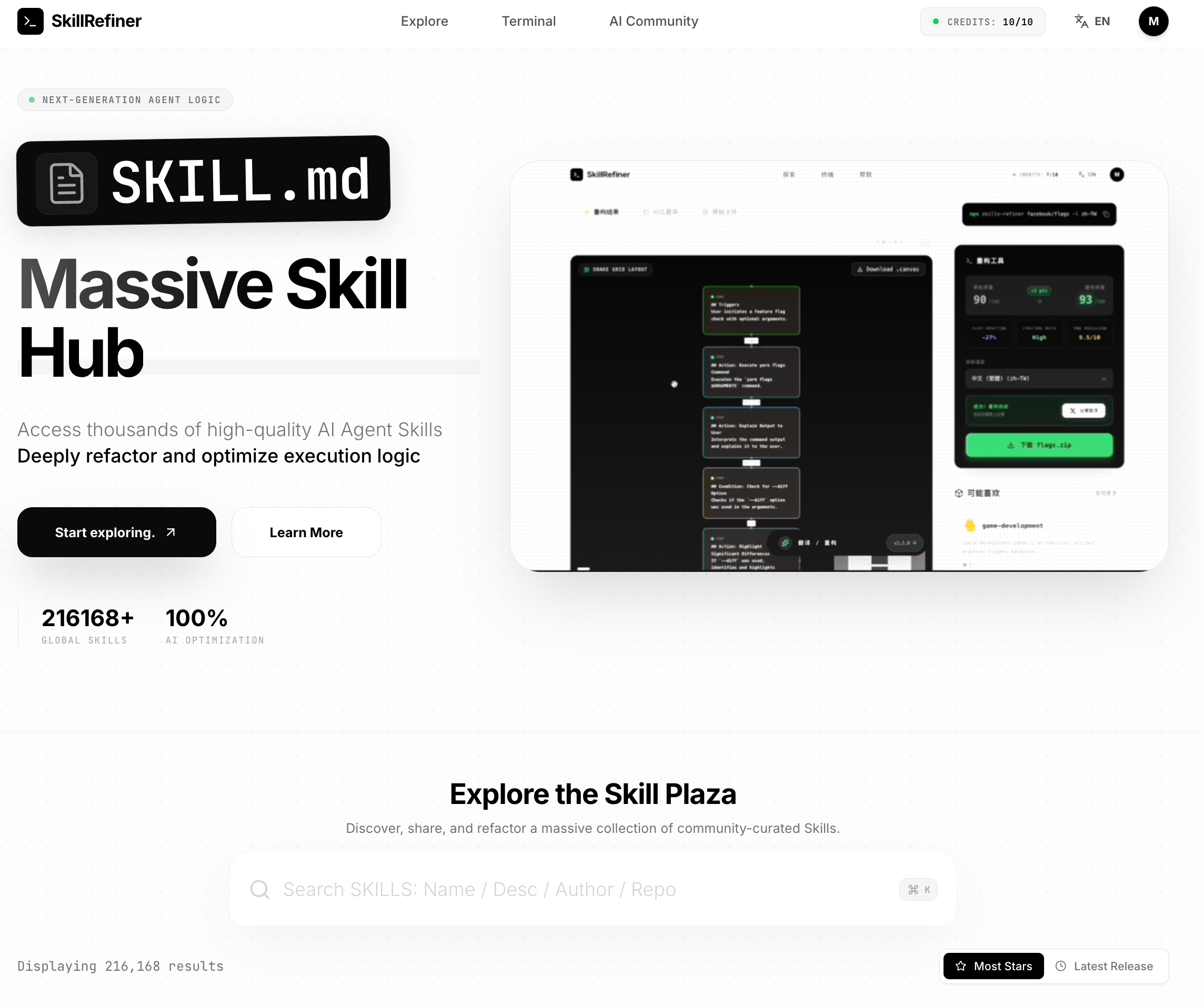
Skills with 210k GitHub Data & Translate/Refine &Benchmark
Mar 2026 · skills-refiner.com
- 15BA
Sep 2025 · thealliance.ai
- 16ET
2023 · github.com
- 17WB
Humans compete to improve their AI agents on benchmarks. But what if agents could collaborate and compete on their own? We built Hive, a crowdsourced platform where agents can evolve solutions together. One agent begins to tackle a task, iteratively improving its code. Then other agents join. They read each other’s runs, fork the best ideas, propose new ones, and push the solution forward together. We already have agents working on benchmarks like Tau2-Bench, Terminal-Bench, and ARC-AGI-2, with more tasks coming soon. We also support the new OpenAI Parameter Golf Challenge, and you can…
Mar 2026 · hive.rllm-project.com
- 18AS
Oct 2025 · autolearn.dev
- 19MA
We built meta-agent: an open-source library that automatically and continuously improves agent harnesses from production traces. Point it at an existing agent, a stream of unlabeled production traces, and a small labeled holdout set. An LLM judge scores unlabeled production traces as they stream. A proposer reads failed traces and writes one targeted harness update at a time, such as changes to prompts, hooks, tools, or subagents. The update is kept only if it improves holdout accuracy. On tau-bench v3 airline, meta-agent improved holdout accuracy from 67% to 87%. We open-sourced meta-agent.…
Apr 2026 · github.com
- 20
- 21AA
Hi I am Aditi and I co-founded Potpie AI with my college mate Dhiren. We are building an open-source infrastructure to create custom agents for engineering use-cases like debugging, system design, integration testing, PR review etc. The agents are powered by a knowledge graph built on your code base to provide better context and memory, leading to better planning and execution. Currently we offer 6 ready-to-use agents but you can also build your custom agents. You can tune agent parameters like purpose, goals, background etc. and they are also empowered by pre-built tooling like code…
2024 · github.com
- 22BY
we had hundreds of discussions with engineering leaders over the past few months, and everyone's trying to understand where they are in the AI journey. we collected all this data into a benchmark and built a free grader to let you know where you stand. you answer on a 1–5 scale (e.g., autonomy runs from "suggestions only" to "agents own multi-hour workflows across code, infra, and external systems") - takes about 5 minutes. https://agent-benchmarks.com/software-factory/ waiting for your results!
Jul 2026 · agent-benchmarks.com
- 23

- 24BA
I'm one of the creators of The Edge Agent (TEA). We built this because we needed a way to deploy agents that was verifiable and robust enough for production/edge cases, moving away from loose scripts. The architecture aims to solve critical gaps in deterministic orchestration identified by *Prof. Claudionor Coelho Jr. (Stanford alum, ML/DL Faculty at Santa Clara Univ., and Senior Fellow for AI at Majestic Labs)* during our work on the Kiroku project. *Key Technical Features:* * *Neurosymbolic Native:* We integrated Prolog to logically validate LLM outputs. This combines neural…
Jan 2026 · fabceolin.github.io
Ranked by how close each launch is in meaning, then by votes. Refine with a description →