AI · alternatives · 2026

24 alternatives to KI-Hardware-Test | Win, Mac, Linux
Testing which AI models your hardware really creates
Below are 24 products that do a similar job, ranked by how close each is in meaning and then by launch-day votes.
- 1

Find the local LLM that actually runs and performs best on your hardware. Ranked by real, recency-aware benchmarks, not parameter count. One command, run it instantly. - Andyyyy64/whichllm
May 2026 · github.com · its alternatives →
- 2

- 3

Pick hardware and a model, and feel the real speed of a local LLM before you buy. Simulates tokens/sec and time-to-first-token from verified benchmarks for GPUs, Macs, and more.
6d ago · llmspeed.dev · its alternatives →
- 4
 Local▲107
Super excited to launch our new app Local today. What we’ve learned at Base Compute over the last months is that running AI directly on your laptop or workstation gives you maximum privacy and it’s free, but it’s also a massive headache to configure. So we’ve decided what matters is making the experience completely frictionless for users. Local analyses the hardware of your laptop, optimises the AI for it, and recommends the best models for your specific device. It let’s you do what you’re doing with cloud AI already, just for free and on your own machine: Chatting with PDF’s, Recording and…
Aug 2026 · basecompute.co · its alternatives →
- 5

We built a computer use agent once and got it benchmarked at the 2nd position in the biggest benchmark for this field but in the process, we realized one thing, how outdated and inefficient these benchmarks are and how they don't truly capture how these tasks went. So we thought a community led benchmarking arena would be the way to go about. https://coarena.ai/. You just have to put in a task and two side by side windows with hidden models will show up and do the same task and at the end you vote which one did better(or none). We have a leaderboard where we rank all the…
Aug 2026 · coarena.ai · its alternatives →
- 6

🔎 Monitor deep learning model training and hardware usage from your mobile phone 📱 - labml/guides/hardware_monitoring.md at master · labmlai/labml
2021 · github.com · its alternatives →
- 7

The world’s most powerful chip’ for AI
2024 · nvidia.com · its alternatives →
- 8IM
2023 · vram.asmirnov.xyz · its alternatives →
- 9

- 10
 Chiplab▲85
Test firmware on a virtual chip with no hardware needed
Aug 2026 · veecle.ai · its alternatives →
- 11

Compare AI models side-by-side on same prompt
Feb 2026 · testaimodels.com · its alternatives →
- 12

Create codeless tests that fix themselves with AI
2022 · testkit.app · its alternatives →
- 13WM
Pick a Mac and a model, get the memory it needs and the tokens/sec to expect. Covers M1 to M6, every unified memory size, Q4 to FP16. Formula fitted and validated on our own measurements on two machines.
6d ago · macyou.co · its alternatives →
- 14DA
Write a task in plain English. An AI agent runs it on a simulator on your Mac and tells you if a real user could complete it. Save the successful run as a regression check you can replay later.
Aug 2026 · app.deltix.ai · its alternatives →
- 15

- 16

## What's it for? - *Daily performance monitoring*: Test your hardware anytime, anywhere, right from your browser. - *Buying a new device*: Use the online hardware test to make sure your new PC, iPad, or phone performs as expected and has no potential factory defects. - *Diagnosing an old device*: Perform a hardware check to pinpoint performance bottlenecks and potential issues, providing data to support repairs or upgrades. ## Website Website: https://volumeshader.org/ ## Detailed Features - *GPU Test*: Three different levels of online GPU testing. - *Screen Test*: Check for…
2025 · volumeshader.org · its alternatives →
- 17

Clean hardware and cognitive benchmarking tools.
Jul 2026 · inputbenchmark.com · its alternatives →
- 18

Built a simple web app that tells you which open-source LLMs will work on your hardware. It auto-detects your specs, shows compatible models from Hugging Face, gives realistic performance estimates (tokens/sec), and recommends quantization settings. You can also manually input specs to see "what if I upgraded my RAM?" Made this after wasting time downloading giant models only to find they crawled on my hardware. Hope it saves you some frustration!
2025 · caniusellm.com · its alternatives →
- 19
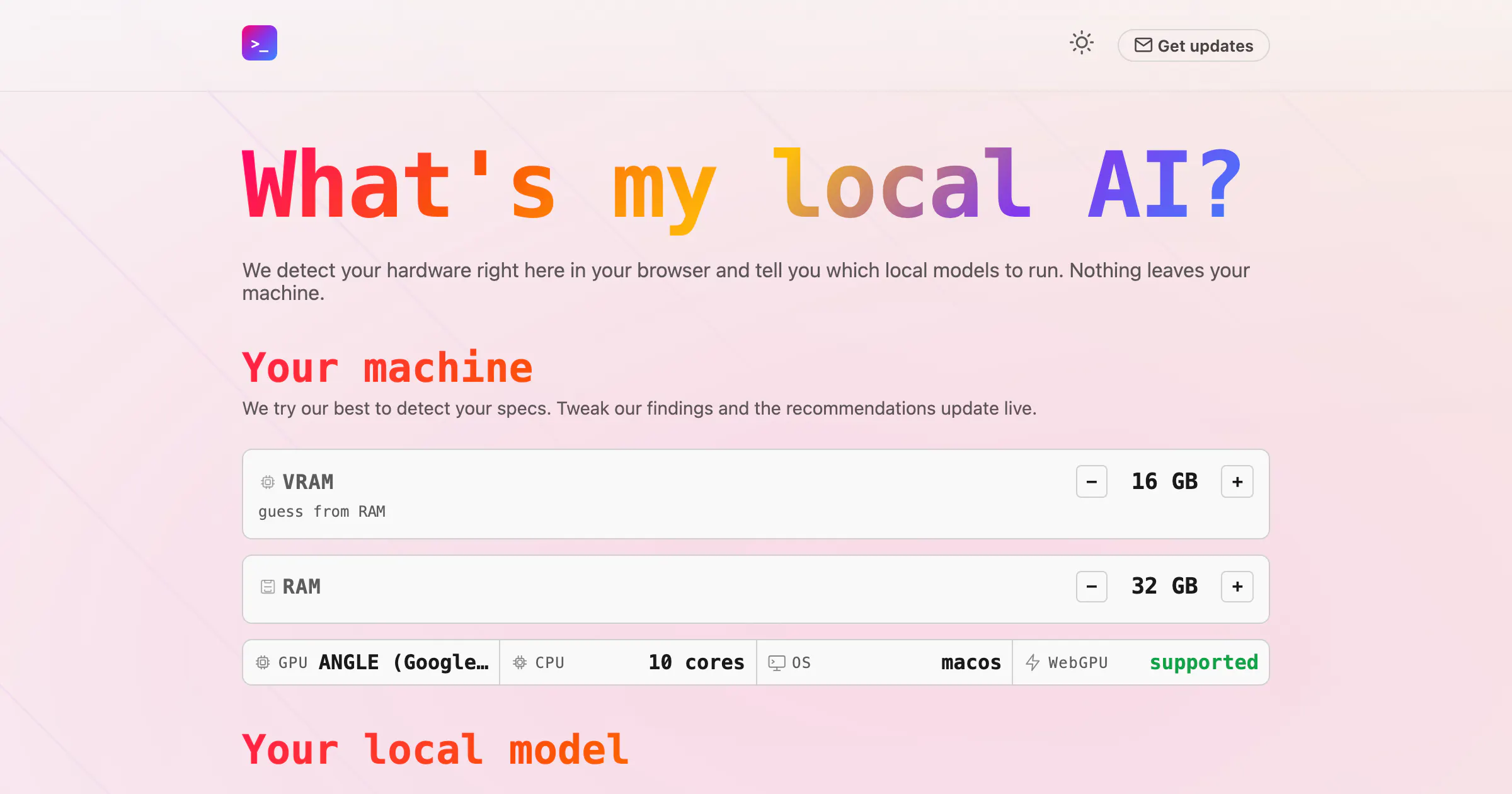
Find the best local model for your machine
Aug 2026 · whatsmylocal.ai · its alternatives →
- 20AL
Hi HN friends, we're Nima (nimabanai) and Craig (cbschind) from Assemble Labs (https://assemblelabs.co) building the hardware context layer for AI to help you write better firmware faster. We’ve built an MCP server that plugs into any AI tool you’re using (Cursor, Claude Code, Gemini, etc.) and brings complete hardware context (schematics, datasheets, etc.) to your existing environment (new app fatigue is real...) with accuracy and in real time. Our goal is to make writing and debugging firmware on custom hardware faster and easier. Try out the free beta release:…
2025 · its alternatives →
- 21

- 22

- 23
 LanHive▲24
Access all the best AI models for Video, Images, & Audio
Jan 2026 · lanhive.com · its alternatives →
- 24

If I have this hardware, Can I run that LLM model ?
2025 · can-i-run-this-llm-blue.vercel.app · its alternatives →
Also compare
Ranked by how close each launch is in meaning, then by votes. Prices were read from each product’s own site when checked and can change. Refine with your own description →