AI · alternatives · 2026

24 alternatives to Limits – Control layer for AI agents that take real actions
Prompt instructions like 'never do X' don't hold up in production. LLMs ignore them when context gets long or users push hard. Limits sits between your agent and the real world. Every action — database writes, API calls, refunds — gets intercepted and checked against your rules before it executes. Deterministically. No LLM involved in enforcement. Three modes: Conditions: hard rules on structured data Guideance: validate LLM output before it reaches the user and give the agent chance to reason and retry Guardrails: scan for PII, toxicity, prompt injection etc One line to integrate: npm…
Below are 24 products that do a similar job, ranked by how close each is in meaning and then by launch-day votes. Prices are shown for the 1 we have checked on their own sites, 1 of them free or with a free tier.
- 1

Many teams connecting LLMs to external tools eventually encounter the same architectural issue: as more tools and agents are added, the integration pattern becomes an N×M mesh of direct connections. Each agent implements its own auth, retries, rate limiting, and logging; each tool needs credentials distributed to multiple places and observability becomes fragmented. We built LLM gateway with this goal to provide a single place to manage authentication, authorization, routing, and observability for MCP servers, with a path toward a more general agent-gateway architecture in the future. The…
Dec 2025 · truefoundry.com · its alternatives →
- 2
 Kastrafree tier, from $19.99/mo▲332
Hi HN, Fernando and I built Kastra. Kastra intercepts AI agent tool calls and evaluates them against deterministic policies before they execute. We built this product to control pre- and post-inference workloads. This is aimed at developers using coding agents like Claude Code, Codex, Cursor, and OpenClaw. Kastra pushes an allow, hold, and deny decision before the action runs. You can build these policies in plain English from the web app. The interception engine evaluates the tools, targets, and parameters of every action at sub 1ms at a scale of billions of interceptions per day. We also…
Jul 2026 · kastra.ai · its alternatives →
- 3

Single-agent LLMs suck at long-running complex tasks. We’ve open-sourced a multi-agent orchestrator that we’ve been using to handle long-running LLM tasks. We found that single LLM agents tend to stall, loop, or generate non-compiling code, so we built a harness for agents to coordinate over shared context while work is in progress. How it works: 1. Orchestrator agent that manages task decomposition 2. Sub-agents for parallel work 3. Subscriptions to task state and progress 4. Real-time sharing of intermediate discoveries between agents We tested this on a Putnam-level math problem, but the…
Feb 2026 · github.com · its alternatives →
- 4

We’re shipping an execution model that sits between LLM code generation and autonomous agents. The LLM generates only the glue logic between two deterministic interfaces: - a UI schema the frontend knows how to render - a constrained runtime interface exposed by the backend, from specific functions like list_comments to broader primitives like a restricted http_call Both interfaces are fixed, typed, and inspectable. The LLM can’t invent UI components or backend capabilities. It only composes what already exists. This is adjacent to A2UI, but the cut is different. A2UI renders agent actions…
2021 · cased.com · its alternatives →
- 5

Precision Context Protocols for High-Fidelity AI.
May 2026 · ai-rules-context-library.terminalvelocityai.tech · its alternatives →
- 6

New ways of breaking app-integrated LLMs . Contribute to greshake/llm-security development by creating an account on GitHub.
2023 · github.com · its alternatives →
- 7

Hi HN, Matvey, Ildar, Joey, and Dominik here. If you're building LLM agents that use tools, you're probably worried about prompt injection attacks that can hijack those tools. We were too, and found that solutions like prompt-based filtering or secondary "guard" LLMs can be unreliable. Our thesis is that agent security should be handled at the network level between the agent and the LLM, just like a traditional web application firewall. So we built Archestra Platform: an open-source gateway that acts as a secure proxy for your AI agents. It's designed to be a deterministic firewall against…
2025 · archestra.ai · its alternatives →
- 8OS
Hello HN, I’ve been building AI agents lately and ran into a common "Context Bloat" problem. When an agent has 20+ skills, stuffing every system prompt, reference doc, and tool definition into a single request quickly hits token limits and degrades model performance (the "lost in the middle" problem). To solve this, I built OpenSkills, an open-source SDK that implements a Progressive Disclosure Architecture for agent skills. The Core Concept: Instead of loading everything upfront, OpenSkills splits a skill into three layers: Layer 1 (Metadata): Light-weight tags and triggers (always loaded…
Jan 2026 · its alternatives →
- 9

As a Security Engineer with over 10+ years in industry, I kept running into the same problem with coding agents: Instructions are not guarantees. I put guidance in `CLAUDE.md`, `AGENTS.md`, memory files, MCP descriptions, and tool documentation. I explicitly told the agent things like: - Use the code graph for architecture questions instead of grepping the repository. - Do not use deprecated APIs or Unsafe code. - Prefer specific tools for specific tasks. The agent would still ignore those instructions surprisingly often. It would grep the entire repo, use deprecated APIs, or choose a slower…
Apr 2026 · sigmashake.com · its alternatives →
- 10AG
Hi HN, we’re building AxonFlow for teams running LLMs or agents in real production systems. Once agent workflows move past demos, failures are rarely model issues. They tend to show up as execution problems during real runs. Short 2-minute technical demo showing execution control and auditability in practice: https://youtu.be/FNgnESo9RtI AxonFlow is a self-hosted, source-available (BSL 1.1) control plane that sits inline in the execution path and governs LLM calls, tool calls, retries, approvals, and policy enforcement step by step. It does not replace your orchestrator and…
Jan 2026 · its alternatives →
- 11
 Linden▲8
Validate AI Outputs Before They Reach Your Application
Jul 2026 · ai-reliability-frontend.vercel.app · its alternatives →
- 12

Block malicious web content before it reaches your AI.
Jan 2026 · its alternatives →
- 13
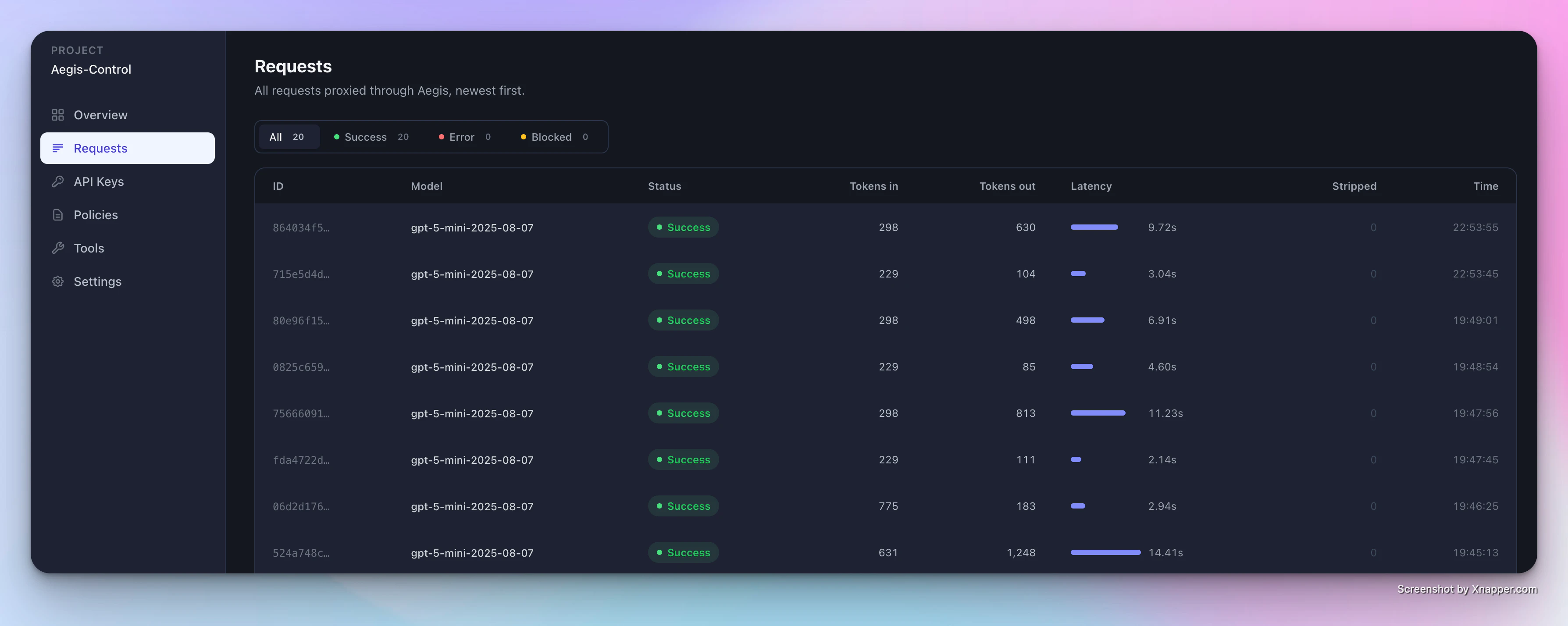
Policy enforcement for LLM tool calls.
Apr 2026 · aegis-control-io.github.io · its alternatives →
- 14
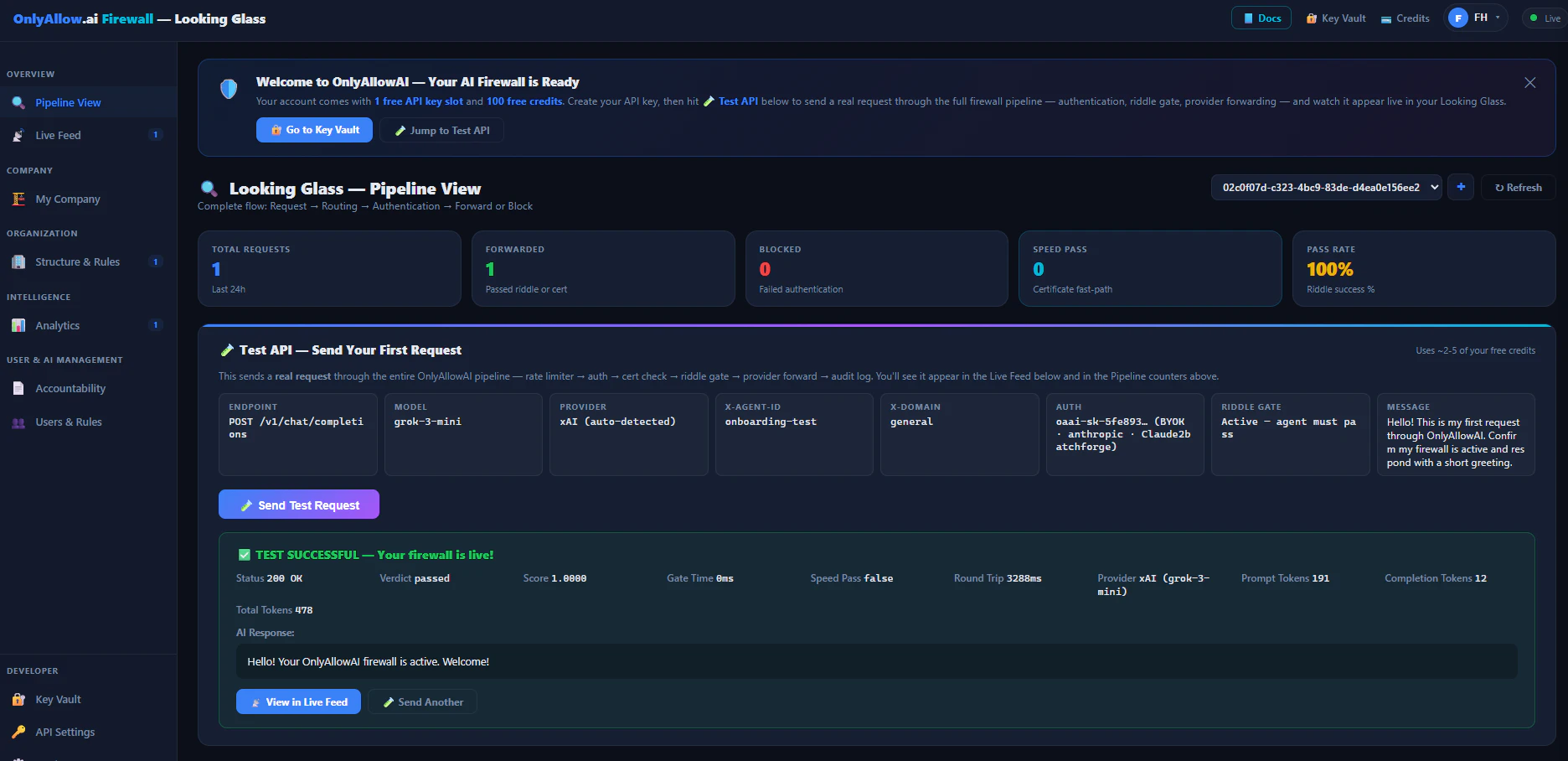
Take control of your API Infrastructure
Jun 2026 · onlyallow.ai · its alternatives →
- 15

Hey HN, I've been building AutoAgents, an AI agent framework in Rust. Today I'm sharing a feature I haven't seen done well elsewhere: composable middleware layers for LLM inference pipelines. The problem Every agent framework lets you swap LLM providers. Almost none of them give you a structured way to enforce safety, caching, or data sanitization in the inference path itself. You end up with guardrails as application-level if-statements, caching bolted on as a separate service, and PII handling as a "we'll add it later" TODO that never ships. This gets worse with local models. Cloud APIs…
Mar 2026 · github.com · its alternatives →
- 16

We combined Stanford's ACE (agents learning from execution feedback) with the Reflective Language Model pattern. Instead of reading traces in a single pass, an LLM writes and runs Python in a sandbox to programmatically explore them - finding cross-trace patterns that single-pass analysis misses. The framework achieved 2x consistency improvement on τ2-bench.
Mar 2026 · github.com · its alternatives →
- 17

We’re building an open-source tool that makes it easy to expose secure, LLM-optimized APIs on top of your structured data—without manually designing endpoints or worrying about compliance. AI agents and LLM-powered applications need structured access to data, but traditional APIs and databases weren’t built with AI workloads in mind. Our tool automatically generates APIs that: - Filter out PII & sensitive data to comply with GDPR, CPRA, SOC 2, and other regulations. - Provide traceability & auditing, so AI apps aren’t black boxes, and security teams stay in control. - Optimize for AI…
2025 · github.com · its alternatives →
- 18

At testup.io we have been working for a while to bring artificial intelligence to the field of test automation. Just a few years ago, the primary challenge laid in accurately identifying UI elements following minor structural changes, such as updates to IDs or paths. The emergence of Large Language Models (LLMs) raised the bar for what it meant to be smart. Now, we anticipate the robot to do lots of things autonomously, such as retry in cases of unresponsiveness or handle minor error reports. A more challenging, but soon expected feature, would involve the test robot navigating your web shop…
2024 · github.com · its alternatives →
- 19IS
Hey HN! For that last 8 months I've been trying to make agents that can hack web applications to find vulnerabilities in them - An AI Security Tester. The system has 29 agents in total, a custom LLM Orchestration framework which works on the task-subtask architecture (old-school but works amazingly for my use case, and is pretty reliable) with custom agent calling mechanism. No Auo-Gen, Langchain and Crew AI - Everything custom built for pentesting. Each test runs in an isolated Kali linux environment (on AWS Fargate), where the agents have full access to the environment to undertake any…
2025 · its alternatives →
- 20
 RuleMesh▲2
RuleMesh structures regulatory requirements, maps them to controls, and specifies the evidence that proves them. Your coding agent calls it over MCP; RuleMesh never accesses your code.
Jul 2026 · rulemesh.com · its alternatives →
- 21

A runtime behavioral probing framework for LLM agents
Jul 2026 · github.com · its alternatives →
- 22
 KDD▲4
KDD▲4Govern AI agents with deterministic gates. No LLM judging.
Jul 2026 · mauricioperera.github.io · its alternatives →
- 23

Check which model your AI agent is really using
Jul 2026 · verifyllmapi.com · its alternatives →
- 24

Also compare
Ranked by how close each launch is in meaning, then by votes. Prices were read from each product’s own site when checked and can change. Refine with your own description →