AI · alternatives · 2026
24 alternatives to LoraLand – 25 fine-tuned LLMs that beat GPT-4
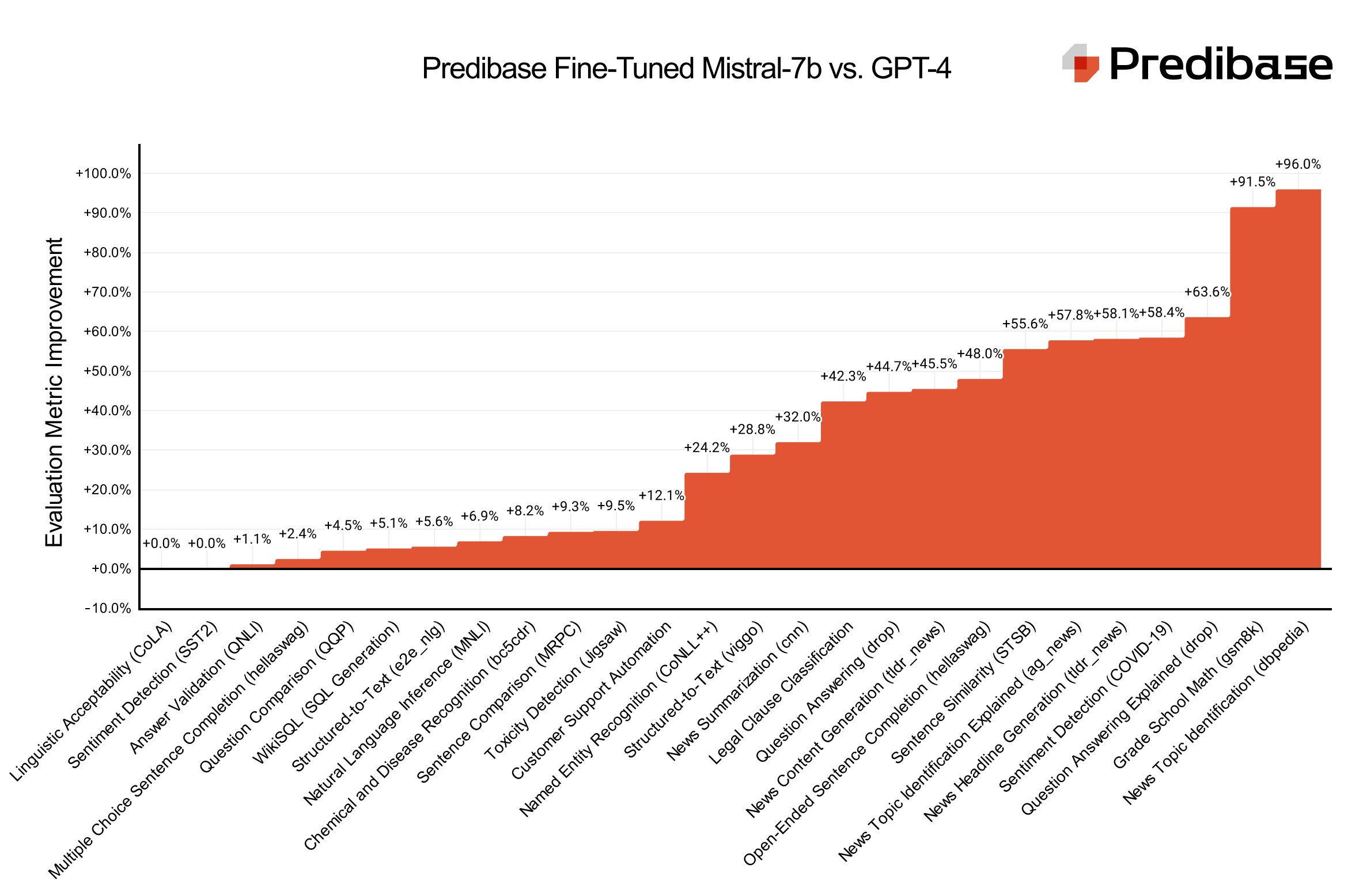
Hi all, today we're excited to launch LoraLand: 25 fine-tuned mistral-7b models that outperform #gpt4 on task-specific applications ranging from sentiment detection to question answering. All 25 fine-tuned models… - Outperform GPT-4, GPT-3.5-turbo, and mistral-7b-instruct for specific tasks - Are cost-effectively served from a single GPU through LoRAX - Were trained for less than $8 each on average You can prompt all of the fine-tuned models today and compare their results to mistral-7b-instruct in real time! We'd love to hear comments and feedback from the community
LoraLand offers 25 fine-tuned versions of the Mistral-7B language model, each optimized for specific tasks like sentiment detection and question answering. Designed for developers and businesses seeking cost-effective… Below are 24 products that do a similar job, ranked by how close each is in meaning and then by launch-day votes. LoraLand – 25 fine-tuned LLMs that beat GPT-4 launched in 2024; newer entries below may have overtaken it.
- 1
 LoraLand▲11
25 fine-tuned Mistral-7b models that outperform GPT-4
2024 · rubrik.com · its alternatives →
- 2

I've been playing around with https://github.com/zphang/minimal-llama/ and https://github.com/tloen/alpaca-lora/blob/main/finetune.py, and wanted to create a simple UI where you can just paste text, tweak the parameters, and finetune the model quickly using a modern GPU. To prepare the data, simply separate your text with two blank lines. There's an inference tab, so you can test how the tuned model behaves. This is my first foray into the world of LLM finetuning, Python, Torch, Transformers, LoRA, PEFT, and Gradio. Enjoy!
2023 · github.com · its alternatives →
- 3

Hi HN! I'm just sharing a project I've been working on during the LLM Efficiency Challenge - you can now finetune Llama with QLoRA 5x faster than Huggingface's original implementation on your own local GPU. Some highlights: 1. Manual autograd engine - hand derived backprop steps. 2. QLoRA / LoRA 80% faster, 50% less memory. 3. All kernels written in OpenAI's Triton language. 4. 0% loss in accuracy - no approximation methods - all exact. 5. No change of hardware necessary. Supports NVIDIA GPUs since 2018+. CUDA 7.5+. 6. Flash Attention support via Xformers. 7. Supports 4bit and 16bit…
2023 · github.com · its alternatives →
- 4
 Mistral Small 3▲446
High performance in a 24b open-source model
2025 · mistral.ai · its alternatives →
- 5

Fine-tune LLMs from one YAML. Layer streaming trains an 8B model on a 4 GB laptop GPU. - MakazhanAlpamys/Soup
Aug 2026 · github.com · its alternatives →
- 6
 Mistral Large▲271
Cheaper GPT-4 rival that supports 32K-token context windows
2024 · mistral.ai · its alternatives →
- 7

100% bootstrapped new startup. It lets you fine tune Mistral-7B and SDXL. In particular, for the LLM fine tuning we implemented a dataprep pipeline that turns websites/pdfs/doc files into question-answer pairs for training the small LLM using an big LLM. It includes a GPU scheduler that can do finegrained GPU memory scheduling (Kubernetes can only do whole-GPU, we do it per-GB of GPU memory to pack both inference and fine tuning jobs into the same fleet) to fit model instances into GPU memory to optimally trade off user facing latency with GPU memory utilization It's a pretty…
2023 · docs.helix.ml · its alternatives →
- 8

- 9

- 10

- 11

I wanted to share our new speech to text model, and the library to use them effectively. We're a small startup (six people, sub-$100k monthly GPU budget) so I'm proud of the work the team has done to create streaming STT models with lower word-error rates than OpenAI's largest Whisper model. Admittedly Large v3 is a couple of years old, but we're near the top the HF OpenASR leaderboard, even up against Nvidia's Parakeet family. Anyway, I'd love to get feedback on the models and software, and hear about what people might build with it.
Feb 2026 · github.com · its alternatives →
- 12
 LLM Stats▲293
I was overspending on GPT-4o. It was really hard to compare different models I could switch to, so I built this LLM comparison tool. It shows leaderboards, pricing, and performance data across 100+ LLMs (including all major providers and open-source models). Key features: - Live pricing comparisons - Benchmark Scores (MMLU, HumanEval, GPQA, etc.) - Context length vs cost analysis - Speed/throughput tests across providers - Quality vs price visualizations - Open source (all data verifiable) Try it out: https://llmstats.com I'd like to know your opinion :) Tech stack: Next.js,…
Oct 2025 · llm-stats.com · its alternatives →
- 13

Hey HN, we wanted to share our repo where we fine-tuned Llama 3.1 on Google TPUs. We’re building AI infra to fine-tune and serve LLMs on non-NVIDIA GPUs (TPUs, Trainium, AMD GPUs). The problem: Right now, 90% of LLM workloads run on NVIDIA GPUs, but there are equally powerful and more cost-effective alternatives out there. For example, training and serving Llama 3.1 on Google TPUs is about 30% cheaper than NVIDIA GPUs. But developer tooling for non-NVIDIA chipsets is lacking. We felt this pain ourselves. We initially tried using PyTorch XLA to train Llama 3.1 on TPUs, but it was rough: xla…
2024 · github.com · its alternatives →
- 14WM
Try it out! https://glhf.chat/ Hey HN! We’ve been working for the past few months on a website to let you easily run (almost) any open-source LLM on autoscaling GPU clusters. It’s free for now while we figure out how to price it, but we expect to be cheaper than most GPU offerings since we can run the models multi-tenant. Unlike Together AI, Fireworks, etc, we’ll run any model that the open-source vLLM project supports: we don’t have a hardcoded list. If you want a specific model or finetune, you don’t have to ask us for it: you can just paste the Hugging Face link in and…
2024 · glhf.chat · its alternatives →
- 15
 TensorZero▲307
Hi HN! We're Gabriel & Viraj, and we're excited to open source TensorZero. To be a little cheeky, TensorZero is an open-source platform that helps LLM applications graduate from API wrappers into defensible AI products. 1. Integrate our model gateway 2. Send metrics or feedback 3. Unlock compounding improvements in quality, cost, and latency It enables a data & learning flywheel for LLMs by unifying: • Inference: one API for all LLMs, with <1ms P99 overhead • Observability: inference & feedback → your database • Optimization: better prompts, models, inference strategies • Experimentation:…
2025 · github.com · its alternatives →
- 16

Fast and efficient models optimized for coding and subagents
Mar 2026 · openai.com · its alternatives →
- 17

Hey HN! We’re building FinetuneDB (https://finetunedb.com/), an LLM fine-tuning platform. It enables teams to easily create and manage high-quality datasets, and streamlines the entire workflow from fine-tuning to serving and evaluating models with domain experts. You can check out our docs here: (https://docs.finetunedb.com/) FinetuneDB exists because creating and managing high-quality datasets is a real bottleneck when fine-tuning LLMs. The quality of your data directly impacts the performance of your fine-tuned models, and existing tools didn’t offer an easy…
2024 · finetunedb.com · its alternatives →
- 18

Hey HN! We’ve forked Jupyter Lab and added AI code generation features that feel native and have all the context about your notebook. You can see a demo video (2 min) here: https://www.tella.tv/video/clxt7ei4v00rr09i5gt1laop6/view Try a hosted version here: https://pretzelai.app Jupyter is by far the most used Data Science tool. Despite its popularity, it still lacks good code-generation extensions. The flagship AI extension jupyter-ai lags far behind in features and UX compared to modern AI code generation and understanding tools (like…
2024 · github.com · its alternatives →
- 19

One balance. Every model. Chat, image, video & audio.
Jun 2026 · lounge.llmgateway.io · its alternatives →
- 20

Hi HN community, I have been working on benchmarking publicly available LLMs these past couple of weeks. More precisely, I am interested on the finetuning piece since a lot of businesses are starting to entertain the idea of self-hosting LLMs trained on their proprietary data rather than relying on third party APIs. To this point, I am tracking the following 4 pillars of evaluation that businesses are typically look into: - Performance - Time to train an LLM - Cost to train an LLM - Inference (throughput / latency / cost per token) For each LLM, my aim is to benchmark them for…
2023 · github.com · its alternatives →
- 21

We recently used DeepSeek V4 Flash as a teacher for finance tasks with GPT-OSS-120B. Distillation works well on this problem. At a constrained 8k token budget, our self-distilled 120B scores 83.61% on FinanceReasoning, above Kimi K3 (81.93%) and Inkling (65.13%). We released the 20B open weights. With V4 as the teacher though, we realized it would be timely to measure if the censorship characteristic of it transferred to the distilled version of the base model. tl;dr it didn't, the teacher answered politically sensitive questions 7 SDs differently than expected, but the distilled model's…
Jul 2026 · ctgt.ai · its alternatives →
- 22

Minimal, readable LLM post-training experiments on one 8GB GPU. Measures forgetting, seed variance, and RL emergence. - pochenai/nano-llm-posttraining
Aug 2026 · github.com · its alternatives →
- 23

- 24
 GPT4All▲107
A chatbot trained on a massive collection of clean data
2023 · github.com · its alternatives →
Also compare
Ranked by how close each launch is in meaning, then by votes. Prices were read from each product’s own site when checked and can change. Refine with your own description →