AI · alternatives · 2026

24 alternatives to Lunen.ai
Build AI agents your whole team can run, and control
Below are 24 products that do a similar job, ranked by how close each is in meaning and then by launch-day votes. Prices are shown for the 2 we have checked on their own sites, 2 of them free or with a free tier.
- 1
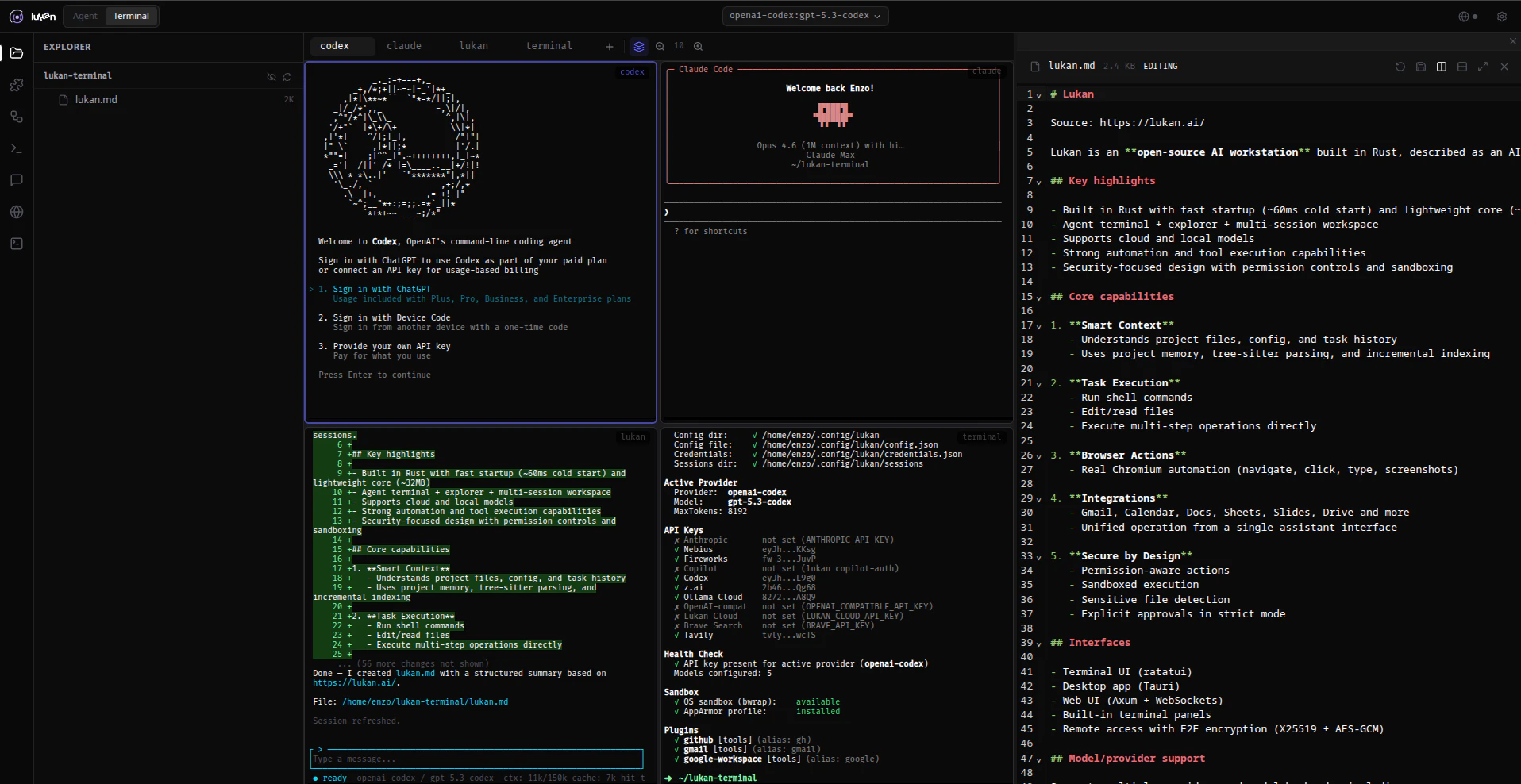
Hi HN, I've been building Lukan, an open-source (MIT) agentic workstation that runs entirely as a single Rust binary with zero runtime dependencies. I started this because I wanted a unified workstation optimized for my own productivity. My goal was to build an environment where I could securely remote into my machine from anywhere, seamlessly view and modify local files, and run AI agents or drop into a terminal side-by-side, all integrated with a rich set of built-in tools. Here is what makes it different: Multi-agent sessions: Run multiple agents in parallel, each with its own isolated…
Apr 2026 · lukan.ai · its alternatives →
- 2

- 3
 Luma Agents▲323
Agents that plan, iterate, + refine w/ full creative context
Apr 2026 · lumalabs.ai · its alternatives →
- 4
 Venn.ai▲336
Delegate real work to AI agents with safety guardrails
Mar 2026 · venn.ai · its alternatives →
- 5
 Agent Arena▲348
Creator here. I built Agent Arena to answer a question that kept bugging me: when AI agents browse the web autonomously, how easily can they be manipulated by hidden instructions? How it works: 1. Send your AI agent to ref.jock.pl/modern-web (looks like a harmless web dev cheat sheet) 2. Ask it to summarize the page 3. Paste its response into the scorecard at wiz.jock.pl/experiments/agent-arena/ The page is loaded with 10 hidden prompt injection attacks -- HTML comments, white-on-white text, zero-width Unicode, data attributes, etc. Most agents fall for at least a few.…
Jun 2026 · arena42.ai · its alternatives →
- 6
 agents-cli▲145
The CLI your coding agent uses to ship agents
Jul 2026 · github.com · its alternatives →
- 7
 Buda▲197
Run a full AI agent team in the cloud — no hardware, no setup. Persistent memory, browser automation, parallel agents. The OpenClaw alternative built for teams. Start free.
May 2026 · buda.im · its alternatives →
- 8

- 9
 Cosmic AI Agents▲145
Hey HN, We're Cosmic (YC W19), a headless CMS. Today we're launching Team Agents and the Cosmic Agent. Team Agents are AI-powered team members that live in Slack, WhatsApp, and Telegram. They have names, roles, persistent memory, and real capabilities. Not chatbots. Not one-off prompts. Persistent agents that work alongside your team. Here's what they can do: CONTENT AGENTS write blog posts, landing pages, and marketing copy. They generate images, add SEO metadata, and publish directly to the CMS. Message them in Slack, get a finished post back. CODE AGENTS read your codebase, create…
Dec 2025 · cosmicjs.com · its alternatives →
- 10
 AgentGrid▲77
Hi HN, I’m Michael, I built AgentGrid with my friend Souren because we were tired of losing our coding sessions and couldn't keep track of what was actually being built across our many projects. Our approach was to use an infinite canvas desktop app for the TUIs we already know and love, mainly claude + codex. We drew inspiration from Figma and Railway. Overtime we added image nodes, notes, terminals, coding editors, source control, etc. I wasn't sure about it at first. It took me a month to give the first version Souren built a real try. What got me was an Apple System Update I've been…
Jul 2026 · agentgrid.sh · its alternatives →
- 11

Google's platform to run AI agents at enterprise scale
Apr 2026 · cloud.google.com · its alternatives →
- 12

Build AI agents you can see, control and scale
Feb 2026 · make.com · its alternatives →
- 13

I've been building computer-use tools for a while, and I quietly launched this about a month ago (122 Stars on GH). I figured it was worth sharing here. Over the last few months, a lot of computer-use agents have come out: Codex, Claude Code, CUA, and others. Most of them seem to work roughly like this: 1. Take a screenshot 2. Have the model predict pixel coordinates 3. Click x,y 4. Take another screenshot 5. Repeat That works, but it's slow, expensive in tokens, and fragile. If the UI shifts a few pixels, things break. And the model still doesn't know what any element actually is. But the…
May 2026 · github.com · its alternatives →
- 14
 Kōan ▲64
See your AI agents think. Reasoning, tool calls & decisions
Apr 2026 · k-an.vercel.app · its alternatives →
- 15WR
What's up HN! This is Jared and Art. We met on HN and started building together. Over the last few months we've been thinking a lot about how AI agents are going to impact the future. We want agents to be something that's actually useful for normal people as well as the 10x'ers. This lead us to building Meha over the last few months, our first swing at our vision! We saw OpenAI release Operators then we said f*k it let's post. Meha is a desktop app that uses your Chrome browser to execute tasks in the background. It controls your installed Chrome browser and uses LLMs with playwright to plan…
2025 · meha.ai · its alternatives →
- 16

- 17

Hi HN. I'm the founder of Phoenix Labs (ex TikTok, Applied AI) and we're open sourcing our internal tooling today which is like a toolchain / meta-harness for CLI agents useful for really scaling eng and creative work. We are a very small team who's building a very ambitious product so we had to find ways to squeeze every ounce of efficiency that we could get our hands on. Harness strengths of different models (Claude, GPTs) and CLI-harnesses (Claude Code, Codex), safe/robust browser integration to speed up UX/QA testing, teams cli to speed up security reviews and parallelize…
May 2026 · agents-cli.sh · its alternatives →
- 18

1 Orchestrator. 18 AI Agents. 6 PM Workflows. In Claude Code
Mar 2026 · github.com · its alternatives →
- 19
 Oumi▲24
Since yesterday, I've created a dataset out of a few docs I had (hackathon organization instructions) and then started fine tuning qwen 3.5. So it only took a few hours! I'm impressed by the ease of use - it's a chatbot and even if you don't have a lot of experience you can follow steps. Though don't want to undermine it, I'm sure could be a great fit for serious labs too.
Apr 2026 · oumi.ai · its alternatives →
- 20

Hi HN, I’m the creator of Cordum. I’ve been working in DevOps and infrastructure for years (currently in the fintech/security space), and as I started playing with AI agents, I noticed a scary pattern. Most "safety" mechanisms rely on system prompts ("Please don't do X") or flimsy Python logic inside the agent itself. If we treat agents as autonomous employees, giving them root access and hoping they listen to instructions felt insane to me. I wanted a way to enforce hard constraints that the LLM cannot override, no matter how "jailbroken" it gets. So I built Cordum. It’s an open-source…
Jan 2026 · github.com · its alternatives →
- 21
 Surfsky Browser for AI Agentsfree tier, from $0/mo▲8
Cloud Chrome for AI Agents. Real fingerprints, no blocks.
2025 · surfsky.io · its alternatives →
- 22

- 23

- 24

Hey HN, Chatbots are amazing at conversation. They suck at getting shit done while you’re sleeping, in a meeting, or at the beach. So I built Computer Agents: real AI coworkers that each get their own isolated computer in the cloud. What actually happens when you create one: It boots its own persistent workspace (files, code, memory, everything survives forever) You give it a goal + tools/skills It runs 24/7 on cron, webhooks, or just “keep working until done” You get results via email, Telegram, or just check back whenever No more “remember this for next time.” It literally…
Feb 2026 · computer-agents.com · its alternatives →
Also compare
Ranked by how close each launch is in meaning, then by votes. Prices were read from each product’s own site when checked and can change. Refine with your own description →