AI · alternatives · 2026

24 alternatives to MyPhiloEngine
Run local LLMs without guessing what your hardware can run
Below are 24 products that do a similar job, ranked by how close each is in meaning and then by launch-day votes.
- 1CI
One of the most frequent questions one faces while running LLMs locally is: I have xx RAM and yy GPU, Can I run zz LLM model ? I have vibe coded a simple application to help you with just that. Update: A lot of great feedback for me to improve the app. Thank you all.
2025 · can-i-run-this-llm-blue.vercel.app · its alternatives →
- 2
 LM Studio▲209
Discover, download, and run local LLMs (incl. DeepSeek R1)
2025 · lmstudio.ai · its alternatives →
- 3

Find the local LLM that actually runs and performs best on your hardware. Ranked by real, recency-aware benchmarks, not parameter count. One command, run it instantly. - Andyyyy64/whichllm
May 2026 · github.com · its alternatives →
- 4
- 5

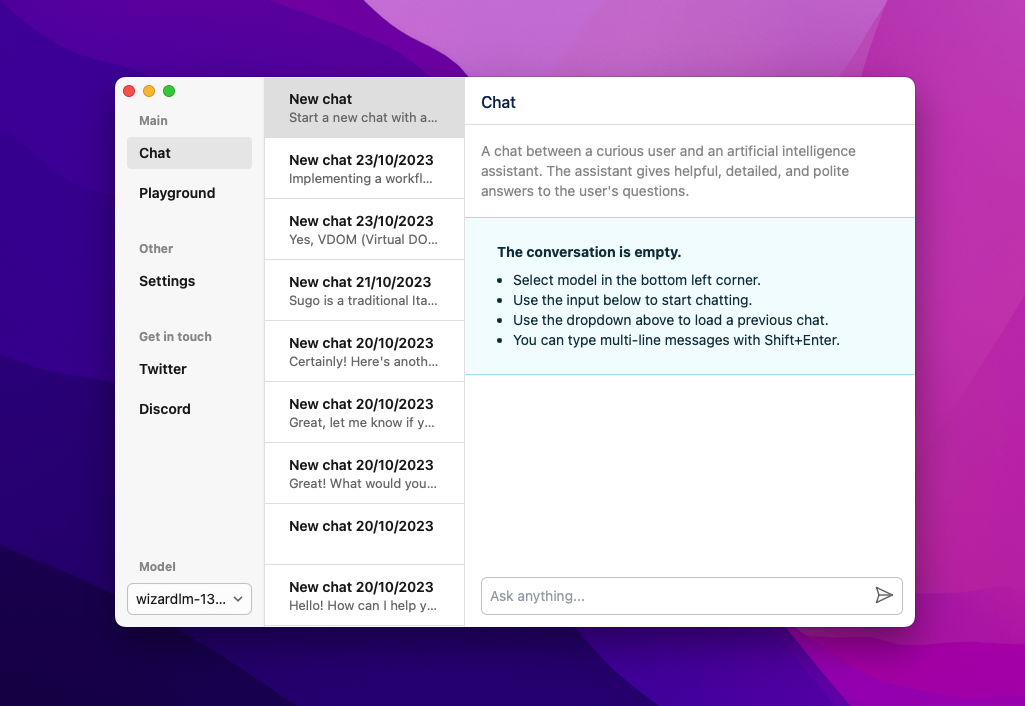
Hi HN A few folks and I have been working on this project for a couple weeks now. After previously working on the Docker project for a number of years (both on the container runtime and image registry side), the recent rise in open source language models made us think something similar needed to exist for large language models too. While not exactly the same as running linux containers, running LLMs shares quite a few of the same challenges. There are "base layers" (e.g. models like Llama 2), specific configuration to run correctly (parameters, temperature, context window sizes etc). There's…
2023 · github.com · its alternatives →
- 6

- 7

Hey Folks! I've been building an open source benchmark for measuring local LLM performance on your own hardware. The benchmarking tool is a CLI written on top of Llamafile to allow for portability across different hardware setups and operating systems. The website is a database of results from the benchmark, allowing you to explore the performance of different models and hardware configurations. Please give it a try! Any feedback and contribution is much appreciated. I'd love for this to serve as a helpful resource for the local AI community. For more check out: - Website:…
2025 · localscore.ai · its alternatives →
- 8

- 9

Pick hardware and a model, and feel the real speed of a local LLM before you buy. Simulates tokens/sec and time-to-first-token from verified benchmarks for GPUs, Macs, and more.
7d ago · llmspeed.dev · its alternatives →
- 10MG
Hello HN, I've been working on this project for a while, and it has been in an "open" beta for some time. I finally believe it's ready for its first release. I hope you like it. Here are some potential questions that may arise: 1. How does it compare to LM Studio? It's likely that if you're already using LM Studio, you'll continue to do so. This project is designed to be more user-friendly. 2. Is it open-source? No, it is not. 3. Does it use any open-source libraries? Yes, it uses llama.cpp and a few others, as indicated in the license information included with the application. 4. Why is not…
2023 · avapls.com · its alternatives →
- 11

- 12

Built a simple web app that tells you which open-source LLMs will work on your hardware. It auto-detects your specs, shows compatible models from Hugging Face, gives realistic performance estimates (tokens/sec), and recommends quantization settings. You can also manually input specs to see "what if I upgraded my RAM?" Made this after wasting time downloading giant models only to find they crawled on my hardware. Hope it saves you some frustration!
2025 · caniusellm.com · its alternatives →
- 13

Hi everyone, we’re a small team, supported by Mozilla, who are working on re-imagining a UI for training, tuning and testing local LLMs. Everything is open source. If you’ve been training your own LLMs or have always wanted to, we’d love for you to play with the tool and give feedback on what the future development experience for LLM engineering could look like.
2025 · github.com · its alternatives →
- 14

This lets you talk to local LLMs in Apple Notes. I saw Obsidian Ollama (https://github.com/hinterdupfinger/obsidian-ollama) and thought it was handy, but I'm too lazy to migrate away from the Apple ecosystem, so I quickly hacked this together. I tend to use Notes as a scratchpad for prompts, so it's nice to do some quick inference without leaving the app. Notes doesn't really support plugins so I'm using the macOS accessibility API for reading selections and then stream responses using the clipboard (not ideal but it works).
2024 · smallest.app · its alternatives →
- 15

Build local LLMs using top data science libraries
2023 · its alternatives →
- 16LR
I built localLLLM: a small community project for running local models. Live: https://locallllm.fly.dev The goal is simple: if someone has model + OS + GPU + RAM, they should get steps that actually work (ideally one liner) I need help populating and validating guides. If you run local models, please submit one working recipe (or report what failed). Would love to hear general feedback as well!
Apr 2026 · locallllm.fly.dev · its alternatives →
- 17

Your personal, private, powerful AI assistant | Free & OSS
2025 · getbodhi.app · its alternatives →
- 18

If I have this hardware, Can I run that LLM model ?
2025 · can-i-run-this-llm-blue.vercel.app · its alternatives →
- 19

What it is A single 45 MB Windows .exe that embeds llama.cpp and a minimal Tk UI. Copy it (plus any .gguf model) to a flash drive, double-click on any Windows PC, and you’re chatting with an LLM—no admin rights, Cloud, or network. Why I built it Existing “local LLM” GUIs assume you can pip install, pass long CLI flags, or download GBs of extras. I wanted something my less-technical colleagues could run during a client visit by literally plugging in a USB drive. How it works PyInstaller one-file build → bundles Python runtime, llama_cpp_python, and the UI into a single PE. On first launch, it…
2025 · github.com · its alternatives →
- 20

Hi HN, I'm excited to share Bodhi App, a tool designed to simplify running open-source Large Language Models (LLMs) locally on your laptops. While we currently support M2 Macs, we plan to support other platforms as our community grows. # Problem To use LLMs, you typically need to purchase a subscription from providers like OpenAI or Anthropic, or use OpenAI API credits with compatible Chat UIs. These options can not only burden you financially, but also raise data security and privacy concerns. Many laptops are capable of running powerful open-source LLMs, but for non-tech users, setting…
2024 · github.com · its alternatives →
- 21
 Perssua▲61
Real-time guidance from any LLM (including local ones)
Nov 2025 · perssua.com · its alternatives →
- 22AT
I recently built a small open-source tool to benchmark different LLM API endpoints — including OpenAI, Claude, and self-hosted models (like llama.cpp). It runs a configurable number of test requests and reports two key metrics: • First-token latency (ms): How long it takes for the first token to appear • Output speed (tokens/sec): Overall output fluency Demo: https://llmapitest.com/ Code: https://github.com/qjr87/llm-api-test The goal is to provide a simple, visual, and reproducible way to evaluate performance across different LLM providers, including…
2025 · llmapitest.com · its alternatives →
- 23

hey hn, I built an open-source Perplexity clone that can run local LLMs and cloud LLMs. It's fully self-hostable through Docker and uses ollama to support local LLMs. The demo video in the repository shows me running it locally with llama3 on my M1 Macbook Pro. I'm open to any suggestions or feedback, thanks!
2024 · github.com · its alternatives →
- 24

Free tool to check if your GPU can run local LLMs.
Jul 2026 · llmconfigurator.com · its alternatives →
Also compare
Ranked by how close each launch is in meaning, then by votes. Prices were read from each product’s own site when checked and can change. Refine with your own description →