AI · alternatives · 2026
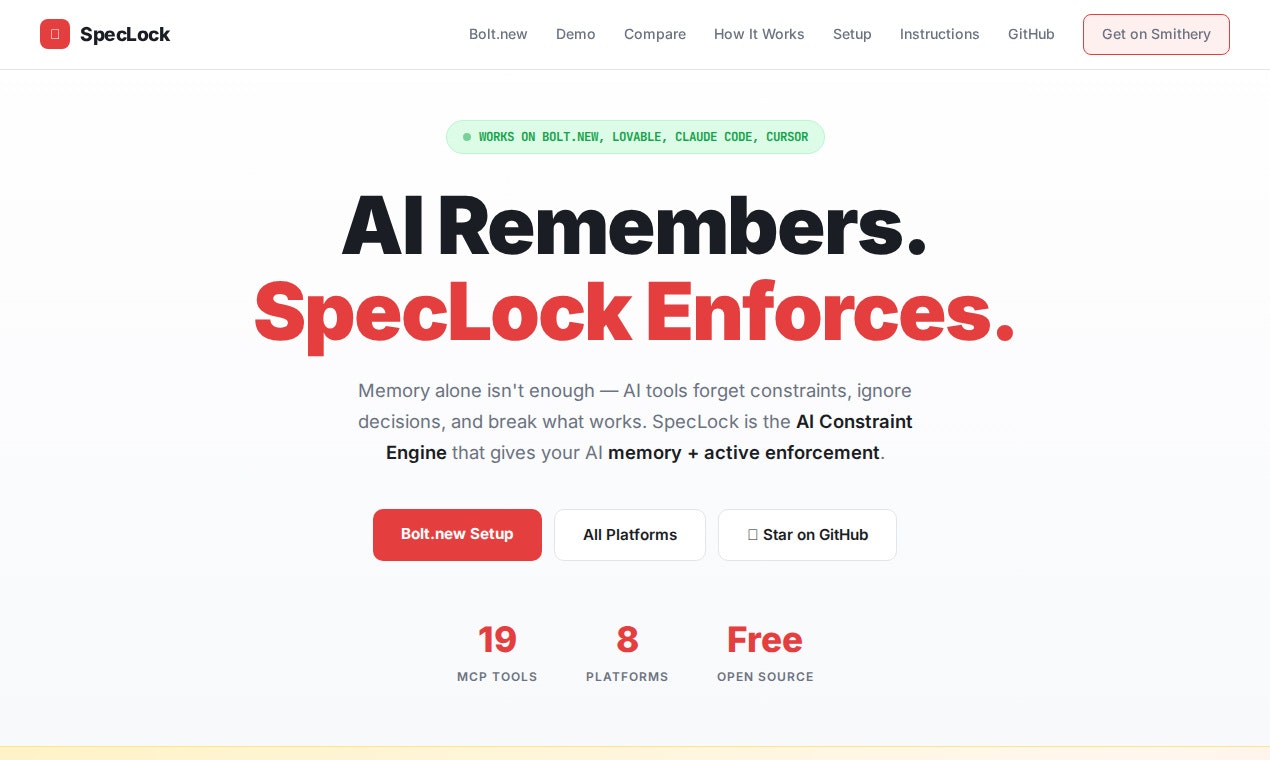
24 alternatives to SpecLock
AI Constraint Engine — Stop LLMs from breaking your code
Below are 24 products that do a similar job, ranked by how close each is in meaning and then by launch-day votes. Prices are shown for the 1 we have checked on their own sites, 1 of them free or with a free tier.
- 1
 Kastrafree tier, from $19.99/mo▲332
Hi HN, Fernando and I built Kastra. Kastra intercepts AI agent tool calls and evaluates them against deterministic policies before they execute. We built this product to control pre- and post-inference workloads. This is aimed at developers using coding agents like Claude Code, Codex, Cursor, and OpenClaw. Kastra pushes an allow, hold, and deny decision before the action runs. You can build these policies in plain English from the web app. The interception engine evaluates the tools, targets, and parameters of every action at sub 1ms at a scale of billions of interceptions per day. We also…
Jul 2026 · kastra.ai · its alternatives →
- 2

- 3

- 4

The modern standard in AML compliance through AI agents
2023 · flagright.com · its alternatives →
- 5FL
Hi HN! We just launched Codacy Guardrails, an IDE extension with a CLI for code analysis and MCP server that enforces security & quality rules on AI-generated code in real-time. It hooks into AI coding assistants (like VS Code Agent Mode, Cursor, Windsurf), silently scanning and fixing AI-suggested code that has vulnerabilities or violates your coding standards, while the code it’s being generated. We built this because coding agents can be a double-edged sword. They do boost productivity, but can easily introduce insecure or non-compliant code. One recent research team at NYU found that 40%…
2025 · its alternatives →
- 6
 Lockor▲7
Prevents AI from modifying protected files in VS Code/Cursor
2025 · open-vsx.org · its alternatives →
- 7

Please forgive the sign up. It means we can give away and keep track of free inference usage/no API keys needed. Happy to send sign in credentials on request if you prefer.
2025 · enginelabs.ai · its alternatives →
- 8

Real time code analysis, as you write code, powered by AI
2025 · codesherlock.ai · its alternatives →
- 9

The AI firewall that understands compliance context
Dec 2025 · promptlock.io · its alternatives →
- 10

- 11

AGENTS.lock keeps AI agent skills, instructions, and MCP servers in sync across Claude, Codex, Gemini, and Copilot CLIs using a single TOML lockfile as the source of truth. Instead of manually copying skills and configs between tools, you declare everything once in AGENTS.lock and run `al sync`. GitHub: https://github.com/luml-ai/AGENTS.lock
Jan 2026 · github.com · its alternatives →
- 12

Every AI tool locks you in. ShardStitch sets you free.
Jul 2026 · shardstitch.com · its alternatives →
- 13

- 14

Beat creative block with one constraint and a timer
Jun 2026 · apps.apple.com · its alternatives →
- 15
 Raptor▲10
Hot patch, cache, protect your for LLM API. Built in Rust.
Nov 2025 · raptordata.dev · its alternatives →
- 16

- 17

As a Security Engineer with over 10+ years in industry, I kept running into the same problem with coding agents: Instructions are not guarantees. I put guidance in `CLAUDE.md`, `AGENTS.md`, memory files, MCP descriptions, and tool documentation. I explicitly told the agent things like: - Use the code graph for architecture questions instead of grepping the repository. - Do not use deprecated APIs or Unsafe code. - Prefer specific tools for specific tasks. The agent would still ignore those instructions surprisingly often. It would grep the entire repo, use deprecated APIs, or choose a slower…
Apr 2026 · sigmashake.com · its alternatives →
- 18

The CI gate that says no to unapproved AI code
Aug 2026 · linebreakapp.com · its alternatives →
- 19
 Zedblock▲14
Build ai agent in minutes and automate your business
2024 · zedblock.com · its alternatives →
- 20

I built SpecMind, an open source developer tool for spec driven vibe coding. It keeps architecture and implementation aligned from the first commit instead of letting them drift apart. With AI assistants writing more of our code, projects move faster but architectural consistency is often lost. Each developer or AI can introduce new patterns, and after a few sprints, the structure becomes fragmented. SpecMind helps prevent that by generating and maintaining living architecture specs directly from your code. It works in three steps: 1. analyze – scans your codebase and generates…
Nov 2025 · github.com · its alternatives →
- 21

I'm an "ideas person" who messes around with AI on a low budget. I got tired of watching my tokens vanish and context windows filling up while agents fumbled around trying to find the right thing. Agents don't flail like they used to with shell tools, but there are still weak/blind spots and back-and-forth episodes — especially when using tools in combination/sequence. So I built "tilth" today. Or rather, AI built it — every line is Opus 4.6. I spent a lot of my precious tokens getting it to "not shit" (at least several of the different vendors' AI overlords assure me it's not…
Feb 2026 · github.com · its alternatives →
- 22

Security for AI-generated code, while it’s being written
Mar 2026 · github.com · its alternatives →
- 23
 Custosa▲15
Permission and compliance layer for Enterprise AI
Mar 2026 · custosa.com · its alternatives →
- 24

The Problem "Vibing" with LLMs is often too shallow for complex logic, while writing full specifications is cognitively expensive and slow. We need a middle ground that mimics how human programmers gather context—scanning structure before diving into details. The Solution: Outline Driven Development (ODD) I've built a "batteries-included" kit for Gemini/Claude/Codex that uses AST analysis to understand code structure rather than just raw text. This relies on a hyper-optimized Rust toolchain (`ast-grep`, `ripgrep`, `jj`, etc.) to feed precise, structural context to the agent. 1. The…
Nov 2025 · github.com · its alternatives →
Also compare
Ranked by how close each launch is in meaning, then by votes. Prices were read from each product’s own site when checked and can change. Refine with your own description →