AI · alternatives · 2026
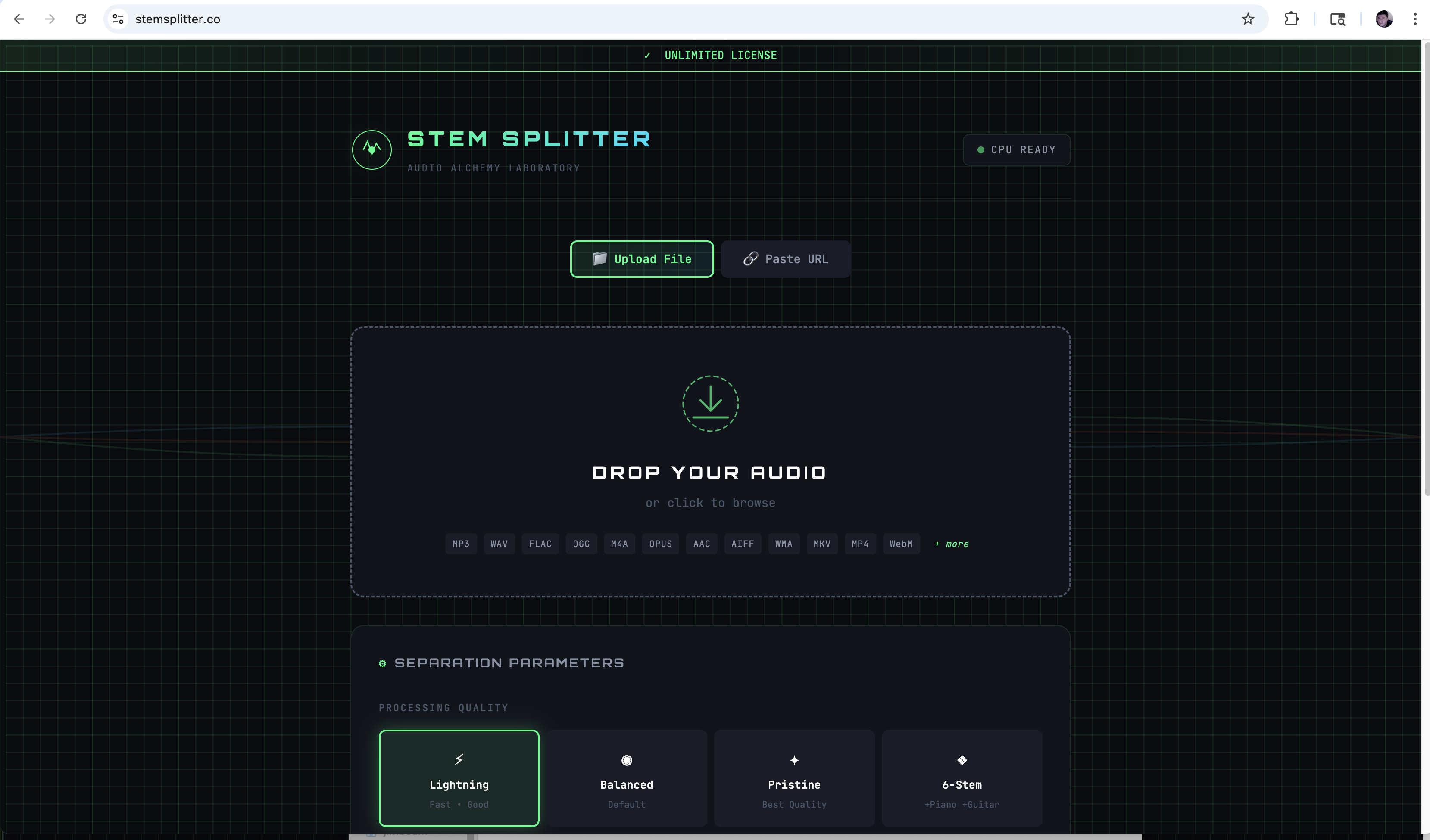
24 alternatives to STEMSPLITTER
Pro stem separation for $5 once, not $20/month
Below are 24 products that do a similar job, ranked by how close each is in meaning and then by launch-day votes.
- 1

Isolate vocals & instruments instantly
2025 · beatstorapon.com · its alternatives →
- 2
 Orchestria▲129
AI music engine with granular stem control
May 2026 · orchestria.tech · its alternatives →
- 3

6-stem AI vocal remover with credits that never expire
Apr 2026 · aistemsplitter.org · its alternatives →
- 4

- 5
 Stemix▲6
Split any song into vocals, drums, bass & more with AI
Dec 2025 · stemix.vercel.app · its alternatives →
- 6

- 7IF
Hi HN, Last time I showed free-music-demixer, which people seemed to enjoy. It was a static website with a Javascript + WASM module to perform music demixing (or music source separation) using an AI model UMX-L (Open-Unmix) running client-side in the browser. Since then, I have overhauled the project and made several improvements: - The demixing/separation quality is higher now, since I implemented the missing post-processing step - Memory usage is lower now by performing a custom segmented inference with a streaming LSTM, which should allow larger tracks (or, dare I say,…
2023 · freemusicdemixer.com · its alternatives →
- 8

- 9

Make custom backing tracks from any song
Jul 2026 · stemsplitterai.com · its alternatives →
- 10
- 11
 StemRoller▲80
Isolate individual vocal or instrument tracks from any song
2022 · stemroller.com · its alternatives →
- 12FA
Hi all, I've spent some time working on music demixing or music source separation algorithms, which take in a mixed song and output estimates of isolated components (e.g. vocals, drums, bass, other). I took a popular PyTorch model with good performance (Open-Unmix, UMX-L weights), reimplemented the inference steps in C++, and compiled it to WebAssembly for a free client-side music demixer.
2023 · sevag.xyz · its alternatives →
- 13

Hi HN! I reimplemented HTDemucs v4 (Meta's music source separation model) in Rust, using Burn. It splits any song into individual stems — drums, bass, vocals, guitar, piano — with no Python runtime or server involved. Try it now: https://nikhilunni.github.io/demucs-rs/ (needs a WebGPU-capable browser — Chrome/Edge work best) GitHub: https://github.com/nikhilunni/demucs-rs It runs three ways: - In the browser — the full ML inference pipeline compiles to WASM and runs on your GPU via WebGPU. No uploads, nothing leaves your machine. - Native CLI —…
Mar 2026 · github.com · its alternatives →
- 14
 StemGrab▲3
Split any song into vocals, drums & more — free
Aug 2026 · stemgrab.com · its alternatives →
- 15

- 16

- 17

- 18

In 2020, Magenta released DDSP [1], a machine learning algorithm / python library which made it possible to generate good sounding instrument synthesizers from about 6-10 minutes of data. While working with DDSP for a project, we realised how it was actually quite hard to find 6-10 minute of clean recordings of monophonic instruments. In this project, we have combined the DDSP architecture with a domain adaptation technique from speech synthesis [2]. This domain adaptation technique works by pre-training our model on many different recordings from the Solos dataset [3] first and then…
2022 · erlj.notion.site · its alternatives →
- 19

- 20

Split songs into 2/4/6 stems online with AI
Jul 2026 · aistemseparation.com · its alternatives →
- 21

Isolate vocals from any song for free
2020 · acapella-extractor.com · its alternatives →
- 22

An intuitive 64-step drum sequencer progressive web app built using React, Redux, and Tone.js
2021 · sequencer64.com · its alternatives →
- 23
 SongDonkey▲88
Artificial intelligence audio separation, free web app
2021 · songdonkey.ai · its alternatives →
- 24

Split any song into stems — offline, on-device, free
Jun 2026 · stemifylabs.com · its alternatives →

Also compare
Ranked by how close each launch is in meaning, then by votes. Prices were read from each product’s own site when checked and can change. Refine with your own description →