Life & fun · alternatives · 2026
24 alternatives to The Most Influential Works on TvTropes According to PageRank
An attempt at a blog by someone who thinks Haskell is cool.
This blog analyzes influential works on TV Tropes using PageRank algorithms to determine which entries have the most connections within the site. Created by someone interested in functional programming, it applies… Below are 24 products that do a similar job, ranked by how close each is in meaning and then by launch-day votes. The Most Influential Works on TvTropes According to PageRank launched in 2015; newer entries below may have overtaken it.
- 1

Hey HN! I love finding new books to read on here. I wanted to gather the most mentioned books and recreate the serendipity of physical browsing. I scraped 20k comments from HN threads related to reading, extracted the references and opinions using GPT-4o mini, and visualised their embeddings as a map. - OpenAI's embeddings were processed using UMAP and HDBSCAN. A direct 2D projection from the text embeddings didn't yield visually interesting results. Instead, HDBSCAN is first applied on a high-dimensional projection. Those clusters tend to correspond to different genres. The genre…
2024 · hnbooks.pieterma.es · its alternatives →
- 2

Visualizing influence relations of programming languages
2016 · exploring-data.com · its alternatives →
- 3

I think LLMs are overused to summarise and underused to help us read deeper. I built a system for Claude Code to browse 100 non-fiction books and find interesting connections between them. I started out with a pipeline in stages, chaining together LLM calls to build up a context of the library. I was mainly getting back the insight that I was baking into the prompts, and the results weren't particularly surprising. On a whim, I gave CC access to my debug CLI tools and found that it wiped the floor with that approach. It gave actually interesting results and required very little orchestration…
Jan 2026 · trails.pieterma.es · its alternatives →
- 4

Connect two articles on Wikipedia, but do it the long way. I've always been a fan of the theory of six degree of separation, but it's an overused concept when exploring the Wiki-graph. Instead of showing the shortest path, which in my opinion is "boring" and ends up connecting super-important central articles, I came up with my own method: WikiBinge selects the smaller, less represented articles on Wikipedia. In a WikiBinge path, the underdogs are the kings! How does it work? It's pretty straightforward! Compute PageRank on the Wiki-graph and assign as weight of each edge the PageRank value…
2023 · wikibinge.com · its alternatives →
- 5

Accessible end-to-end deep dive of crawling, embedding, projecting, and semantic searching all of Hacker News for my Hackerverse project.
2024 · blog.wilsonl.in · its alternatives →
- 6
 Linkeddit▲618
The tool actually hit Product Hunt #1 back in February. Since then I’ve added a bunch more on top of the original version. Now you just describe the intent or goal for the leads you want, and it searches based on keywords and a bunch of other signals to surface the best ones for you. I also added a Reddit-powered content writer. Basically, you pick a topic or category, and it pulls the top posts from Reddit, analyzes what made them go viral, and helps you write content using the same patterns. Reddit is super underrated for content. If something blows up there, it almost always spreads to…
2025 · linkeddit.com · its alternatives →
- 7TB
2016 · hackernewsbooks.com · its alternatives →
- 8

I built a system that monitors ~200,000 news RSS feeds in near real-time and clusters related articles to show how stories spread across the web. It uses Snowflake’s Arctic model for embeddings and HNSW for fast similarity search. Each “story cluster” shows who published first, how fast it propagated, and how the narrative evolved as more outlets picked it up. Would love feedback on the architecture, scaling approach, and any ways to make the clusters more accurate or useful. Live demo: https://yandori.io/news-flow/
Nov 2025 · yandori.io · its alternatives →
- 9

Hey there HN! We’re Antonio, Luca, and Yuhang, and we’re excited to introduce Fast GraphRAG, an open-source RAG approach that leverages knowledge graphs and the 25 years old PageRank for better information retrieval and reasoning. Building a good RAG pipeline these days takes a lot of manual optimizations. Most engineers intuitively start from naive RAG: throw everything in a vector database and hope that semantic search is powerful enough. This can work for use cases where accuracy isn’t too important and hallucinations are tolerable, but it doesn’t work for more difficult queries that…
2024 · github.com · its alternatives →
- 10

Over this Christmas break, while discussing the best episodes of Frasier with my mother (as we tend to do when I get to see her), I thought about coming up with something that's less arbitrary than 1-10 ratings. The result is TV Sort. It just uses a sorting algorithm, but... it's human powered. When the algorithm needs to compare two items, it asks you to compare them, and with that you end up with a full, thoroughly sorted episode list. It uses TMDB, IMDB, and Wikipedia to extract episode information for any show, to help jog your memory when making episode comparisons. It was a fun little…
2024 · tvsort.com · its alternatives →
- 11
A classic book for web analytics geeks
2015 · amazon.com · its alternatives →
- 12
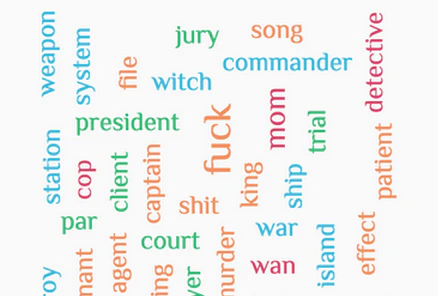
- 13IW
The book page links to a blog post that explains how I got about it (and has a link to sample content), but the TL&DR is that I could not find a lot of books that were on "our" history _and_ were larded with technical details. So I set about writing one, and some five years later I'm happy to share the result. I think it's one of the few "computer history" books that has tons of code, but correct me if I'm wrong (I wrote this both to tell a story and to learn :-)). My favorite languages are Smalltalk and Lisp, but as an Emacs user, I've been using the latter for much longer and for my…
Feb 2026 · berksoft.ca · its alternatives →
- 14KG
Hi HN! My latest side project is knowledge graph that maps the French culinary network using data extracted from restaurant reviews from LeFooding.com. The project uses LLMs to extract structured information from unstructured text. Some technical aspects you may be interested in: - Used structured generation to reliably parse unstructured text into a consistent schema - Tested multiple models (Mistral-7B-v0.3, Llama3.2-3B, gpt4o-mini) for information extraction - Created an interactive visualization using gephi-lite and Retina (WebGL) - Built (with Claude) a simple Flask web app to clean and…
2025 · theophilecantelob.re · its alternatives →
- 15

What can data tell us about how ideas flow through networks?
2016 · amazon.com · its alternatives →
- 16AT
Hi HN, I spent a few weeks looking at the top HN posts of all time. This included exploration, clustering, creating visualizations, and zooming in on what (to me personally) seems like some of the best discussions on here. Three things in this post: 1- The interesting groups of HN posts 2- The interactive visualizations that you can explore in your browser 3- The data from this exploration -- this includes CSV of the titles as well as the text embeddings of 3,000 Ask HN articles. Blog post about this whole process here: [1] ============ 1- The interesting groups of HN posts From the…
2022 · its alternatives →
- 17

- 18

- 19IV
2012 · exploringdata.github.com · its alternatives →
- 20IS
2023 · v01.io · its alternatives →
- 21
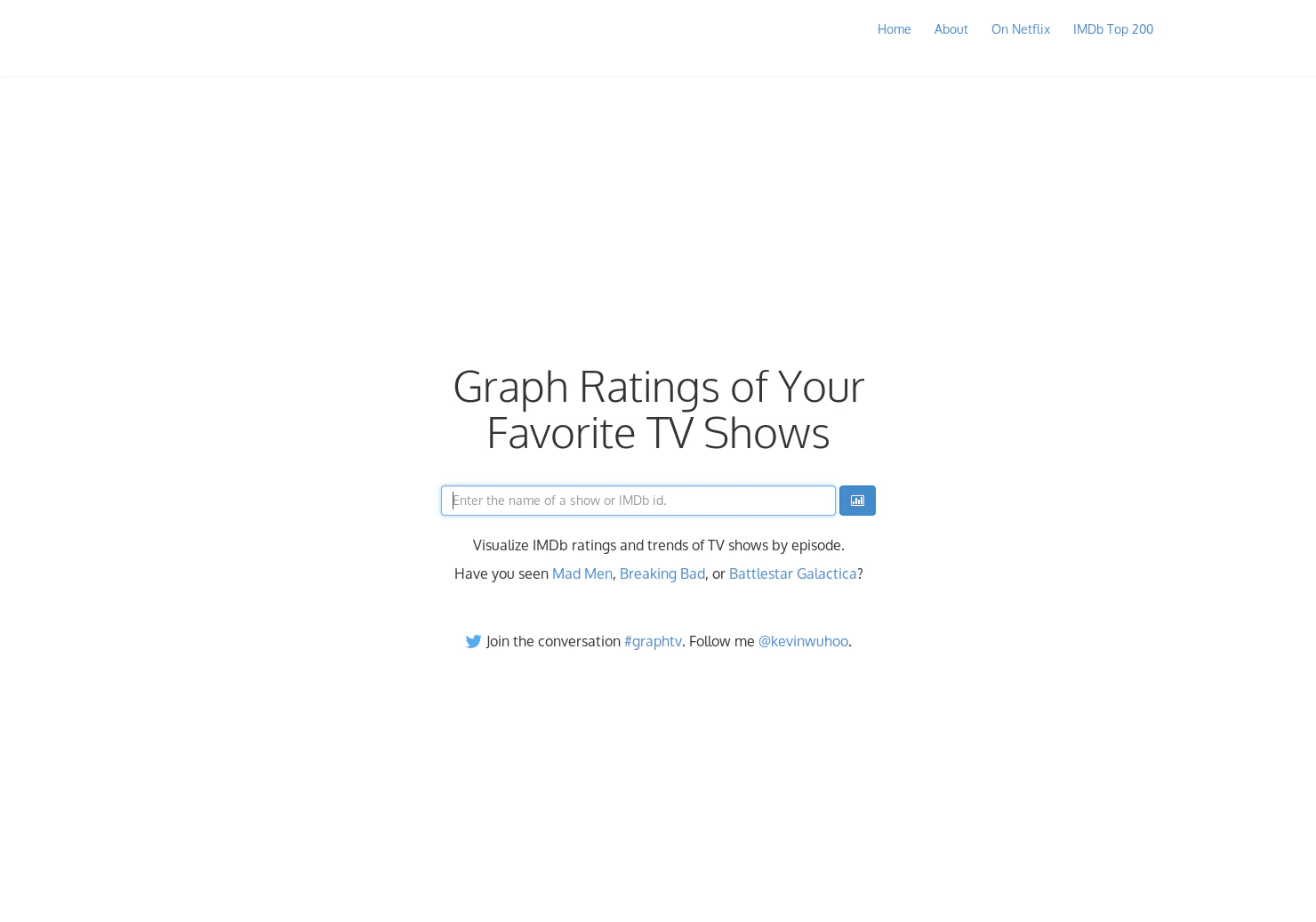 GraphTV▲73
Visualize IMDb ratings and trends of TV shows by episode.
2014 · graphtv.kevinformatics.com · its alternatives →
- 22
 Web Rewind▲98
An interactive journey through 30 years of the web
Mar 2026 · web-rewind.com · its alternatives →
- 23

We have a dataset of 3,095 standardized AI responses across 43 prompts. From each response, we extract a 32-dimension stylometric fingerprint (lexical richness, sentence structure, punctuation habits, formatting patterns, discourse markers). Some findings: - 9 clone clusters (>90% cosine similarity on z-normalized feature vectors) - Mistral Large 2 and Large 3 2512 score 84.8% on a composite metric combining 5 independent signals - Gemini 2.5 Flash Lite writes 78% like Claude 3 Opus. Costs 185x less - Meta has the strongest provider "house style" (37.5x distinctiveness ratio) - "Satirical…
Apr 2026 · rival.tips · its alternatives →
- 24

Hi HN, I recently noticed a recurring visual artifact in the "Most Replayed" heatmap on the YouTube player. The highest peaks were always surrounded by two dips. I got curious about why they were there, so I decided to reverse engineer the feature to find out. This post documents the deep dive. It starts with a system design recreation, reverse engineering the rendering code, and ends with the mathematics. This is also my first attempt at writing an interactive article. I would love to hear your thoughts on the investigation and the format.
Jan 2026 · priyavr.at · its alternatives →
Also compare
- I mapped HN's favorite books with GPT-4o alternatives
- Programming Languages Influence Network alternatives
- I used Claude Code to discover connections between 100 books alternatives
- WikiBinge – discover how all things are vaguely connected alternatives
- Exploring HN by mapping and analyzing 40M posts and comments for fun alternatives
- Linkeddit alternatives
Ranked by how close each launch is in meaning, then by votes. Prices were read from each product’s own site when checked and can change. Refine with your own description →