AI · alternatives · 2026

24 alternatives to Token Counter Pro
Know AI token costs before you spend
Below are 24 products that do a similar job, ranked by how close each is in meaning and then by launch-day votes.
- 1
 TokenCounter▲117
Count tokens and estimate costs for any AI model
2024 · tokencounter.co · its alternatives →
- 2

- 3

The LLM providers are constantly adding new models and updating their API prices. Anyone building AI applications knows that these prices are very important to their bottom line. The only place I am aware of is going to these provider's individual website pages to check the price per token. To solve this inconvenience I spent a few hours making pricepertoken.com which has the latest model's up-to-date prices all in one place. Thinking about adding image models too especially since you have multiple options (fal, replicate) to use the same model and the prices are not always the same.
2025 · pricepertoken.com · its alternatives →
- 4

- 5
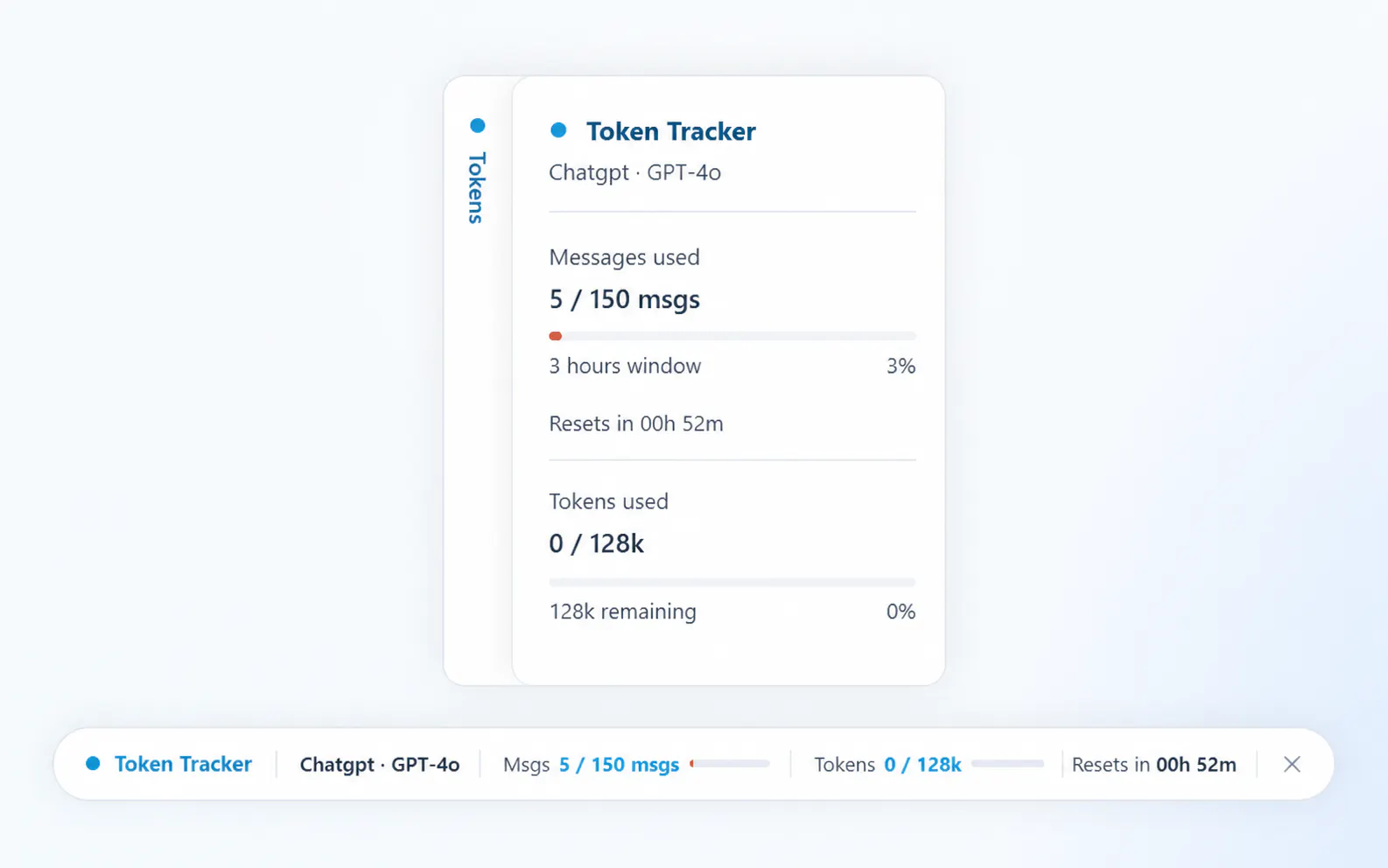
Track AI rate limits & token usage in real time — free
Jun 2026 · its alternatives →
- 6

- 7

See how much Claude you have left before you hit the wall
May 2026 · tokenmonitor.app · its alternatives →
- 8

Cut your AI costs by 63% — before you hit send
Jun 2026 · tokenmetr.com · its alternatives →
- 9

See exactly what your Claude and ChatGPT conversations cost
Jun 2026 · chromewebstore.google.com · its alternatives →
- 10

Know your AI costs before you hit send
Jun 2026 · calculadoratokens.com · its alternatives →
- 11

- 12

Live pricing for 309+ AI models (GPT, Claude, Gemini, Llama, DeepSeek) plus real-world cost calculators: chatbots, API budgets, and token math. Updated 2026-09-06.
Aug 2026 · costperprompt.com · its alternatives →
- 13

I use multiple AI tools for work and also my side projects, and the annoying part was to track my costs and token usage across tools. Everytime I had to visit each tool and its respective usage setting to check it and I was losing patience and also was getting hit by surprise limits Now I know that there are already free/open-source trackers for Cursor or Claude usage, and they are useful if that is all you need. My problem is broader as I wanted one small place to see tokens, spend, subscriptions and limits across the AI tools I actually use. I was really tired of switching tabs and…
Jul 2026 · lifehacksgermany.com · its alternatives →
- 14
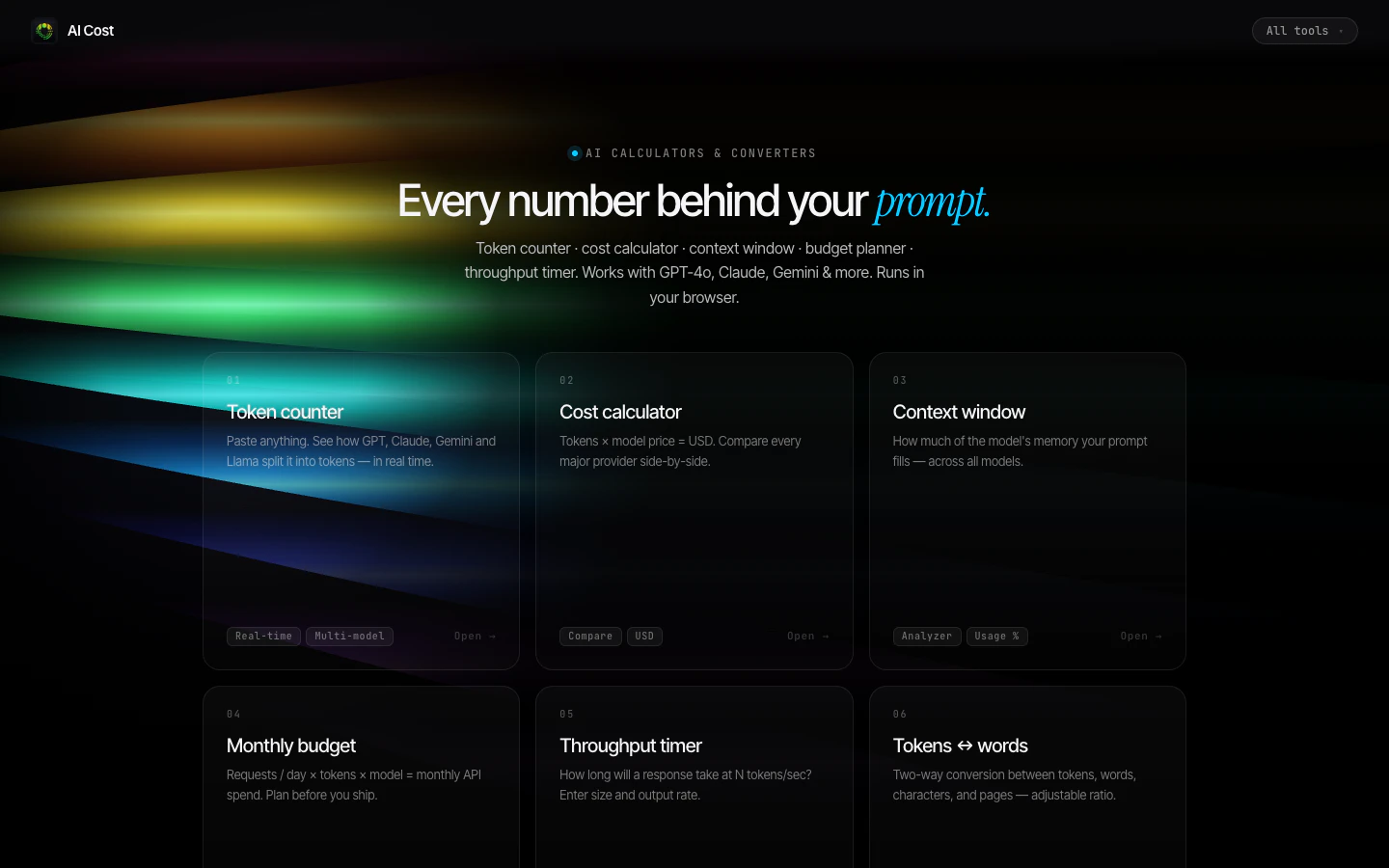
Every number behind your AI prompt. Free, no signup.
Apr 2026 · ai-token-counter-wheat.vercel.app · its alternatives →
- 15

I use Claude Code, Codex and Cursor (and sometimes Antigravity) basically every day, and could never tell how much I was actually consuming across all of them. So I built TokenMaxxer. A small CLI reads the files these tools already write locally and puts it all in one dashboard, broken out by tool, model, provider and day. It covers 18 tools now, and you get a profile page with your daily activity, cost estimates, and your top models and tools. There's also a global leaderboard if you want to compete against other TokenMaxxers! I'd love to see if anyone can beat the first place (currently…
Aug 2026 · tokenmaxxer.xyz · its alternatives →
- 16

Input token counts and costs for over 160 AI models.
2024 · zatomic.ai · its alternatives →
- 17

See what every AI feature costs you — in real time
Jun 2026 · tokenguards.com · its alternatives →
- 18

- 19

Track Claude costs, tokens, context & model switches
Jun 2026 · chromewebstore.google.com · its alternatives →
- 20
 TokenGod▲14
AI builders: show what you spent, built, and earned
Aug 2026 · tokengod.lol · its alternatives →
- 21

Hi HN! Token cost has started to become a high topic of concern to all of us. I tried a few (awesome) tools such as rtk, caveman, and the recent (hillarious but effective) ponytail. What they usually do, is in-line token reduction, e.g. try to compress requests / responses as much as possible. But then it hit me (and I’m sure others had similar ideas) - just like we have routers that pick the right model, why not have something that will also narrow down the amount of available tools, skills and mcps based on repo/context? People usually accumulate skills, agents, MCP servers,…
Jun 2026 · github.com · its alternatives →
- 22

toolify100.com is a collection of tools
2025 · freetokencounter.com · its alternatives →
- 23

I built this after hitting the same wall repeatedly — no good way to enforce token budgets in application code. Provider caps are account-level and tell you what happened, not what is happening. Two ways to add it: # Direct client wrapper client = tokencap.wrap(anthropic.Anthropic(), limit=50_000) # LangChain, CrewAI, AutoGen, etc. tokencap.patch(limit=50_000) Four actions at configurable thresholds: WARN, DEGRADE (transparent model swap), BLOCK, and WEBHOOK. SQLite out of the box, Redis for multi-agent setups. One design decision worth mentioning: tokencap tracks tokens, not dollars. Token…
Apr 2026 · github.com · its alternatives →
- 24

Hey HN - there are lots of tools to understand how many tokens you use and how much it costs, but we haven't found any that tell you where those tokens are going! Decant helps you understand what you are spending tokens on (context gathering, planning, code, chat, etc), so you can optimize it.
Aug 2026 · github.com · its alternatives →
Also compare
Ranked by how close each launch is in meaning, then by votes. Prices were read from each product’s own site when checked and can change. Refine with your own description →