
Aver – a language designed for AI to write and humans to review
I’ve been building Aver around a simple question: If AI is going to write more of the first draft, what should the source look like for the human reviewer? Aver is an experimental statically typed language and toolchain for AI-written, human-reviewed code. My bet is that source code should carry more than implementation. In most projects, implementation survives in the code, but intent lives in docs, decisions live in ADRs or tickets, and expected behavior lives in tests that may or may not stay close to what they describe. Aver tries to make those parts first-class: explicit method-level…
Aver – a language designed for AI to write and humans to review launched on March 11, 2026 with 7 votes, #1,458 of 23,380 launches that month and more than 75% of that year's launches.
What it does
Aver is a programming language for auditable AI-written code - jasisz/aver
In the maker’s words, at launch
I’ve been building Aver around a simple question: If AI is going to write more of the first draft, what should the source look like for the human reviewer? Aver is an experimental statically typed language and toolchain for AI-written, human-reviewed code. My bet is that source code should carry more than…
Does a similar job
all alternatives →
 Quibbler – A critic for your coding agent that learns what you wantOct 2025 · github.com · ▲114
Contribute to fulcrumresearch/quibbler development by creating an account on GitHub.
 We built an AI to review your pull requests2025 · infinitcode.ai · ▲53
Hey HN, We’re two developers (co-founders) with a team of 20 who got tired of spending hours reviewing PRs, so we built Infinitcode.ai, an AI-powered code reviewer that: - *Summarizes PRs in plain English*: No more deciphering 1,000-line diff jungles - *Catches more than bugs*: Security holes, performance pitfalls, code smells, even typos (yes, we’ll flag “vurnerabilities” and vulnerabilities) - *Zero onboarding*: Works instantly—no “let me learn your codebase for weeks” nonsense. Why we’re posting: We’re in alpha and need brutal honesty. Roast our tool, mock our UI, or tell us why AI will…
 agorNov 2025 · agor.live · ▲102
The command center for AI enablement. Empower your team with AI teammates — Claude Code, Codex, Gemini — on a shared canvas anchored on git branches, with real-time multiplayer and an MCP surface agents drive themselves.
 AI Detector by ContentDetector.AI2023 · moxby.com · ▲99
Free and accurate AI detector to check AI content
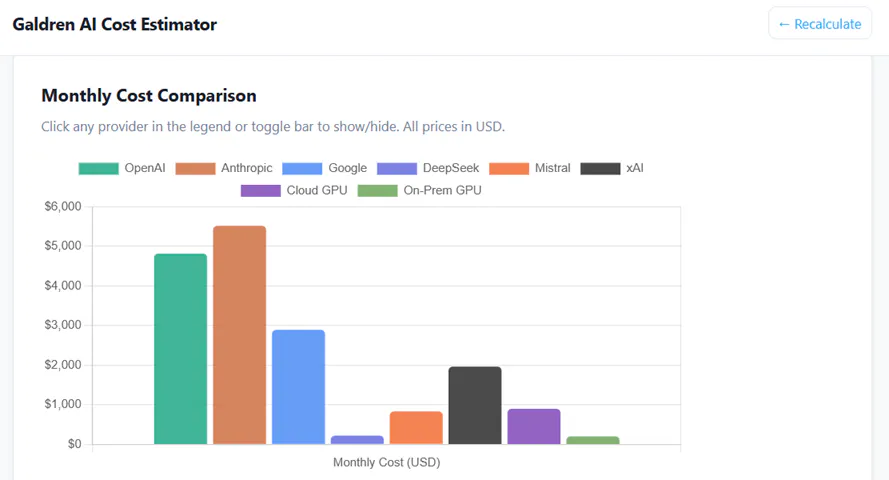 AI Cost EstimatorJul 2026 · galdren.com · ▲3
I'm running an experiment to discover ways to move AI agents from "instruction followers" to "process owners". Most agents fail when a task requires evolving intuition or persistent, multi-day workflows. The core of this experiment is a collaborative "do-and-learn" loop where the agent executes a proven, high-stakes lead generation methodology, and the human provides the "judgment" layer. This is an ambitious experiment exploring a few points: Judgment vs. Execution: Humans learn good judgment through direct experience, failures, and working through problems. If we offload the doing to an…
More ai this month
the category →


Paintings by AI models: programs run through a simulation of oil paint.
AI · 22d ago · stillwet.art

 FastRouter.ai▲364
Route requests to the right LLM for cost, latency & quality
AI · 23d ago · fastrouter.ai
Source: Show HN post ↗ · launch text quoted in part
Launched alongside, March 2026
the whole month →


Switch from ChatGPT to Claude with import memory feature
AI · Mar 2026 · claude.com
 Littlebird▲709
Littlebird remembers everything across your meetings, messages, docs, and apps, then takes action so you can recall any detail and never lose context.
AI · Mar 2026 · littlebird.ai

