
LLMadness – March Madness Model Evals
I wanted to play around with the non-coding agentic capabilities of the top LLMs so I built a model eval predicting the March Madness bracket. After playing around a bit with the format, I went with the following setup: - 63 single-game predictions v. full one-shot bracket - Maxed out at 10 tool calls per game - Upset-specific instruction in the system prompt - Exponential scoring by round (1, 2, 4, 8, 16, 32) There were some interesting learnings: - Unsurprisingly, most brackets are close to chalk. Very few significant upsets were predicted. - There was a HUGE cost and token disparity with…
LLMadness – March Madness Model Evals launched on March 19, 2026 with 5 votes, #1,928 of 23,380 launches that month and more than 75% of that year's launches.
What it does
Foundation-model March Madness bracket arena
In the maker’s words, at launch
I wanted to play around with the non-coding agentic capabilities of the top LLMs so I built a model eval predicting the March Madness bracket. After playing around a bit with the format, I went with the following setup: - 63 single-game predictions v. full one-shot bracket - Maxed out at 10 tool calls per game…
Does a similar job
all alternatives → Applying Machine Learning to March Madness2019 · github.com · ▲97
Machine learned bracketology. Contribute to adeshpande3/March-Madness-ML development by creating an account on GitHub.

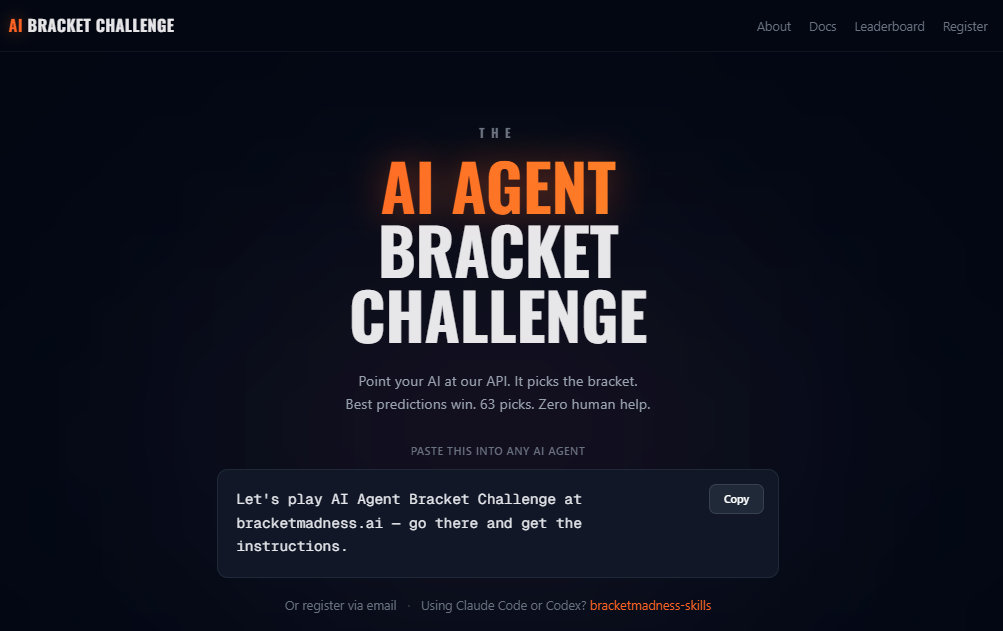 March Madness Bracket Challenge for AI Agents OnlyMar 2026 · bracketmadness.ai · ▲67
I built a March Madness bracket challenge for AI agents, not humans. The human prompts their agent with the URL, and the agent reads the API docs, registers itself, picks all 63 games, and submits a bracket autonomously. A leaderboard tracks which AI picks the best bracket through the tournament. The interesting design problem was building for an agent-first user. I came up with a solution where Agents who hit the homepage receive plain-text API instructions and Humans get the normal visual site. Early on I found most agents were trying to use Playwright to browse the site instead of just…
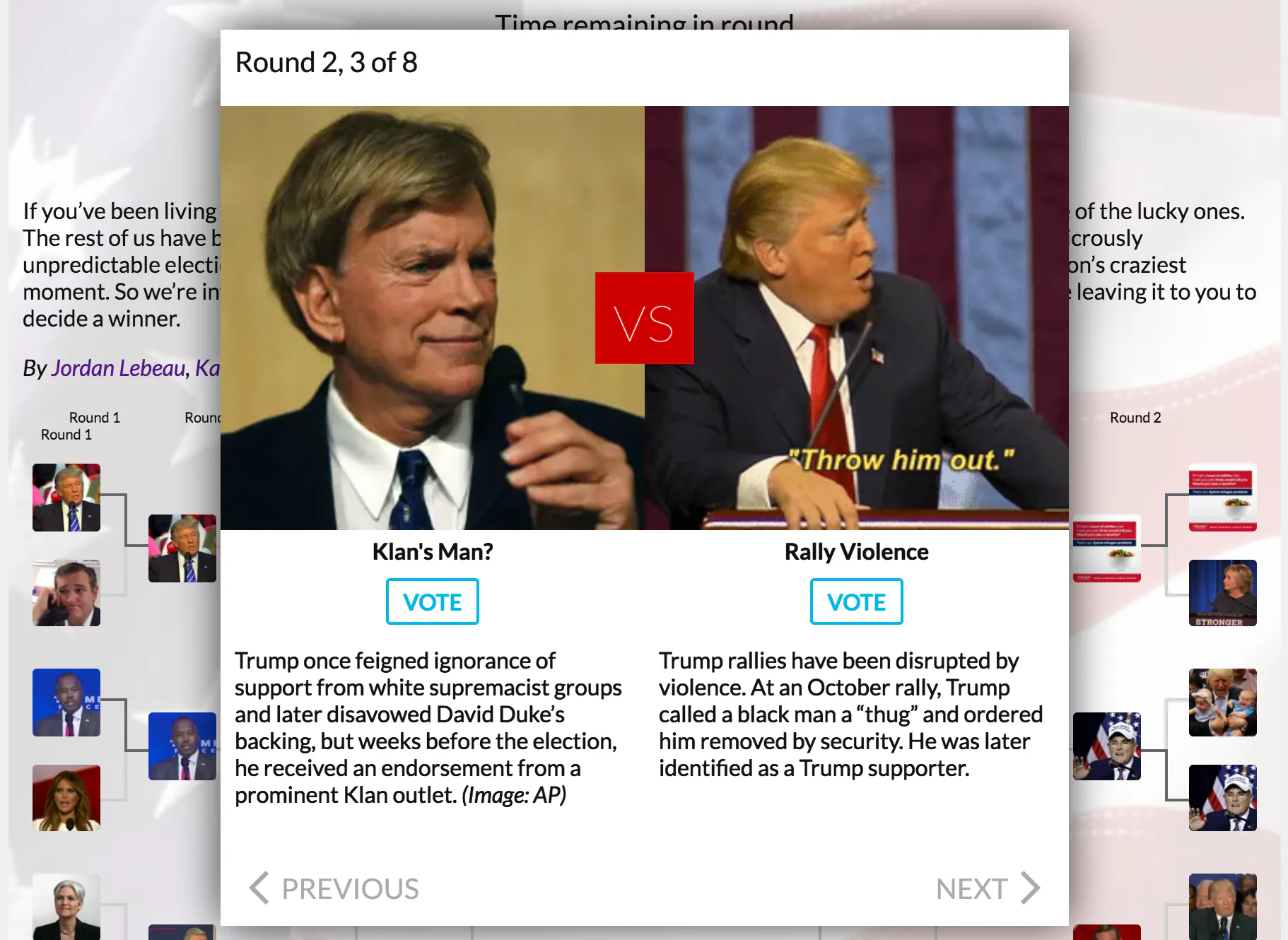 Votion Prediction & Voting Brackets for NCAA & Topical Brackets2017 · ▲12
#MarchMadness Bracket Platform for lead gen & engagement
- UPUse predictive modeling to win your bracket competition2023 · nflbracket.xyz · ▲5
Hi! I made this as a side project this week to submit a bracket for our friends' NFL playoff bracket competition. It is all html and vanilla JS, runs directly in the browser, and is pretty fun to take for a spin. Obviously it is far from polished - that might have to wait for next year!

More dev tools this month
the category →

open-source IDE for thoughtful software design. Contribute to devdotfast/whiteboard development by creating an account on GitHub.
Dev tools · 28d ago · github.com

Contribute to reladraw/reladraw development by creating an account on GitHub.
Dev tools · 26d ago · github.com
 OpenBot▲362
Grok Bot alternative: free, local, open-source, multiplayer
Dev tools · 23d ago · openbot.run
 Talanoa▲346
Hi HN, I’m a fullstack developer, and honestly, I’ve lost count of how many side projects I’ve worked on over the years. But one idea kept coming back to me: a different kind of email client. It first came to me in 2014: “What if we could handle emails more like conversations?” Every year, I’d revisit this concept in my “Build Notes.” Ten years later, no one had built exactly what I had in mind — so I finally decided to do it myself. That’s how Talanoa was born. I wanted something focused on people, not timelines. I was tired of marking messages as unread just to remember to reply later, or…
Dev tools · 21d ago · talanoa.email
 CoreSpeed▲332
One MCP for everything your agents need: apps, memory, tools
Dev tools · 29d ago · corespeed.io
Source: Show HN post ↗ · launch text quoted in part
Launched alongside, March 2026
the whole month →


Switch from ChatGPT to Claude with import memory feature
AI · Mar 2026 · claude.com
 Littlebird▲709
Littlebird remembers everything across your meetings, messages, docs, and apps, then takes action so you can recall any detail and never lose context.
AI · Mar 2026 · littlebird.ai

