Notion-style editing meets infra-debugging tools
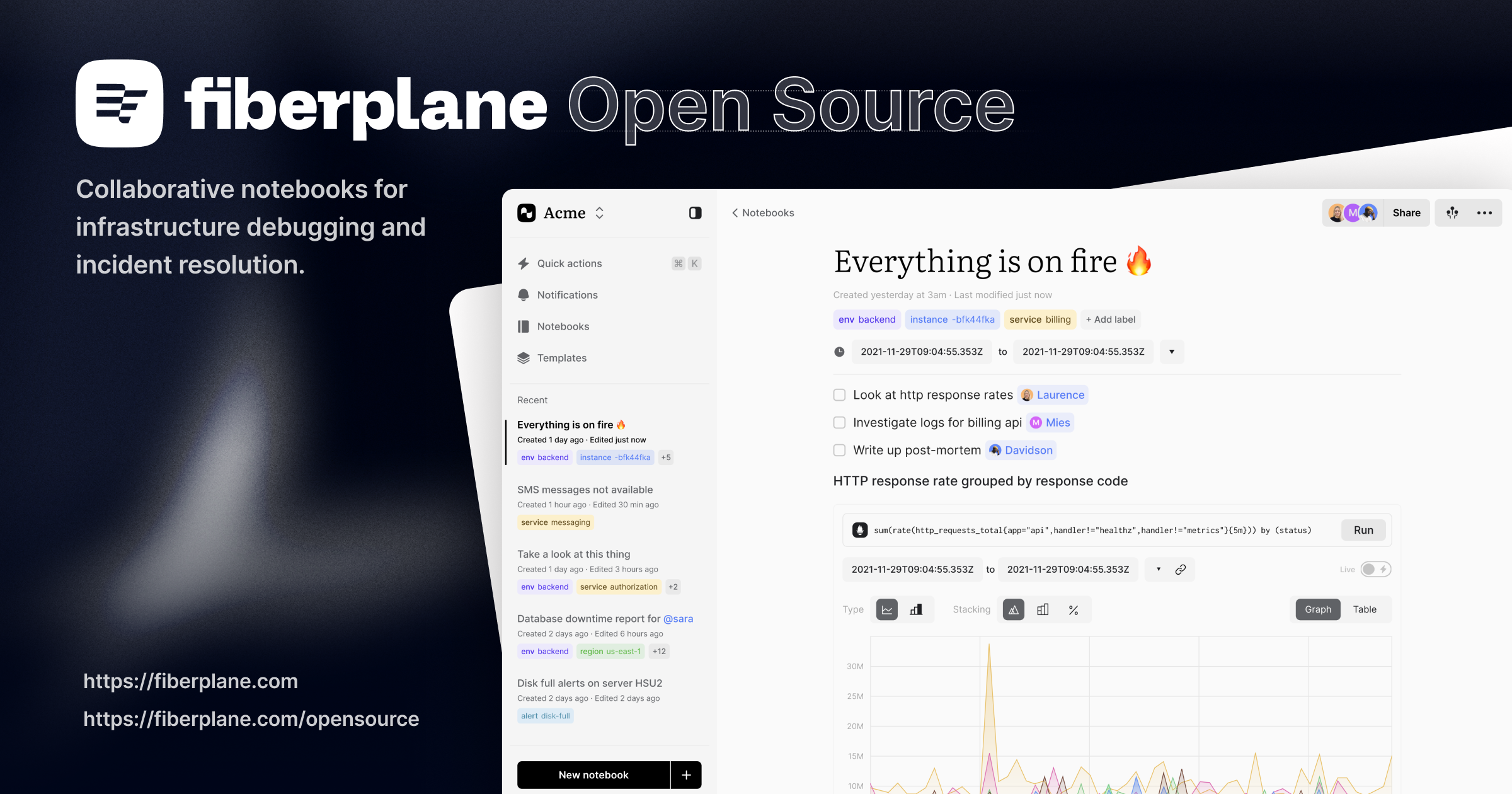
Hi HN, TL;DR: Collaborative notebooks for debugging your infrastructure I’m mies, founder, and CEO of Fiberplane, and I’m excited to show you what we’ve built; a real-time collaboration tool for SRE and DevOps engineers. As of today, Fiberplane is in public beta. Before Fiberplane, you’d need to cobble together information from teammates and alert tools like PagerDuty in Slack, switch to dashboard Nr. X to look at the data, screenshot it, switch back to Slack, paste, and then rinse and repeat, all while critical services were down. Then you’d do this dance all over again but now pasting…
Notion-style editing meets infra-debugging tools launched on November 15, 2022 with 17 votes, #1,161 of 3,471 launches that month and more than 75% of that year's launches. The site was still online in September 2026, 3 years on.
In plain words
Fiberplane is a collaborative notebook tool designed for SRE and DevOps engineers to debug infrastructure incidents in real time. It consolidates information from multiple sources and alert tools into a single workspace where teams can query data, communicate, assign tasks, and document investigations simultaneously. Rather than switching between dashboards, Slack, and documents during outages, engineers use Fiberplane to streamline incident response and post-mortem documentation in one place.
written from the facts on this page · September 2026
From the sources
Building the control plane for software work in the age of agents
Fiberplane is building the control plane for software work in the age of agents. Fiberplane is building the control plane for software work in the age of agents. Local-first, agent-native issue tracking built for Claude Code and sharp sessions. AI-powered code review that turns diffs into stories — right from your terminal or desktop. Binds specs to code. Lints for drift. Warns you before a stale doc makes it tofrom fiberplane.com
In the maker’s words, at launch
Hi HN, TL;DR: Collaborative notebooks for debugging your infrastructure I’m mies, founder, and CEO of Fiberplane, and I’m excited to show you what we’ve built; a real-time collaboration tool for SRE and DevOps engineers. As of today, Fiberplane is in public beta. Before Fiberplane, you’d need to cobble together…
Does a similar job
all alternatives →

- AWA web debugger an ex-Cloudflare team has been working on for 4 years2024 · ▲886
Hey HN, I wanted to show you a product a small team and I have been working on for 4 years. https://jam.dev It’s called Jam and it prevents product managers (like I used to be) from being able to create vague and un-reproducible bug tickets (like I used to create). It’s actually really hard as a non-engineer to file useful bug tickets for engineers. Like, sometimes I thought I included a screenshot, but the important information the engineer needed was what was actually right outside the boundary of the screenshot I took. Or I'd write that something "didn't work" but the engineer…

More work this month
the category →
Endless lofi beats composed live in your browser, over pixel-art nights in Paris, Tokyo, New York, Hong Kong, Sydney, San Francisco and more. Free, no sign-up.
Work · 24d ago · loficities.com
 Smooth Recorder▲257
Mac screen recordings that look edited when you hit stop
Work · 18d ago · smoothrecorder.com


Work · 12d ago · readrare.com
Source: Show HN post ↗ · launch text quoted in part
Launched alongside, November 2022
the whole month →


I made a thing! In 2014, I was holding a stack of iPhones and thought to myself: "Hey, if I had each phone display a playing card, I could click a button and they'd shuffle themselves" I pared that idea all the way down to this: trading cards made of e-ink displays. Right now, each card costs me about $20 each, but with only a bit more scale, I think I can get that down to $10. In doing this project, I learned how to design electronics and circuit boards. I learned Rust and wrote my first driver, I upped my CAD skills, 3D printed, and did my first resin casting. I generated the images on the…
Dev tools · 2022 · wyldcard.io