Robot MCP Server – Connect Any Language Model and ROS Robots Using MCP
We’ve open-sourced the Robot MCP Server, a tool that lets large language models (LLMs) talk directly to robots running ROS1 or ROS2. What it does - Connects any LLM to existing ROS robots via the Model Context Protocol (MCP) - Natural language → ROS topics, services, and actions (And the ability to read any of them back) - Works without changing robot source code Why it matters - Makes robots accessible from natural language interfaces - Opens the door to rapid prototyping of AI-robot applications - We are trying to create a common interface for safe AI ↔ robot communication This is too big…
Robot MCP Server – Connect Any Language Model and ROS Robots Using MCP launched on September 10, 2025 with 26 votes, #529 of 8,160 launches that month and more than 90% of that year's launches. The site was still online in September 2026, 1 year on.
In plain words
Robot MCP Server is an open-source tool that enables large language models to communicate directly with robots running ROS1 or ROS2. It translates natural language commands into ROS topics, services, and actions without requiring changes to existing robot code. Designed for researchers and developers, it provides a standardized interface for AI-robot interaction, making it easier to prototype applications and explore safe communication between language models and robotic systems.
written from the facts on this page · September 2026
From the sources
Connect AI models like Claude & GPT with robots using MCP and ROS. - robotmcp/ros-mcp-server
ROS-MCP-Server connects large language models (such as Claude, GPT, and Gemini) to robots, enabling bidirectional communication with no changes to existing robot source code. 🤖 Example - Controlling "Wilson" with natural language ( video ) From a single prompt — "Grab a Coke from the fridge & go to the living room." — Google Gemini uses the MCP server to navigate and manipulate autonomously. Built on ROS 2 with Nav2 (SLAM) for mapping and navigation, and MoveIt to command the manipulator. 🐕 Example - Controlling Unitree Go2 in NVIDIA Isaac Sim ( video ) The MCP server connects Claude to a simulated Unitree Go2 quadruped in NVIDIA Isaac Sim, interpreting natural language commands to…from github.com
In the maker’s words, at launch
We’ve open-sourced the Robot MCP Server, a tool that lets large language models (LLMs) talk directly to robots running ROS1 or ROS2. What it does - Connects any LLM to existing ROS robots via the Model Context Protocol (MCP) - Natural language → ROS topics, services, and actions (And the ability to read any of them…
Does a similar job
all alternatives → I Built a MCP Server for Robot Operating System2025 · github.com · ▲5
I've been experimenting with ROS (Robot Operating System) and the Model Context Protocol (MCP), and noticed a gap: while there were some MCP servers for ROS, most were limited. They either only supported topic communication or had hard-coded topic names, which severely limited their reusability. To address this, I built a general-purpose MCP server for ROS that allows interaction with ROS topics, services, and actions -making it more flexible and extensible than previous approaches. A key design decision was enabling communication between the MCP server and a local ROS machine by simply…
- OSOpen-Source MCP Server for Context and AI Tools2025 · ▲43
Large Language Models (LLMs) are powerful, but they’re limited by fixed context windows and outdated knowledge. What if your AI could access live search, structured data extraction, OCR, and more—all through a standardized interface? We built the JigsawStack MCP Server, an open-source implementation of the Model Context Protocol (MCP) that lets any AI model call external tools effortlessly. Here’s what it unlocks: - Web Search & Scraping: Fetch live information and extract structured data from web pages. - OCR & Structured Data Extraction: Process images, receipts, invoices, and handwritten…
 An MCP server that gives LLMs temporal awareness and time calculation2025 · github.com · ▲91
This is an open‑source Model Context Protocol (MCP) server that gives any LLM a sense of the passage of time. Most MCP demos wire LLMs to external data stores. That’s useful, but MCP is also a chance to give models perception — extra senses beyond the prompt text. Six functions (`current_datetime`, `time_difference`, `timestamp_context`, etc.) give Claude/GPT real temporal awareness: It can spot pauses, reason about rhythms, and even label a chat’s “three‑act structure”. Runs locally in <60 s (Python) or via a hosted demo. If time works, what else could we surface? - Location /…
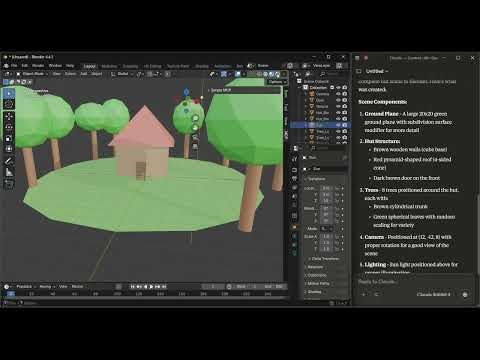 MCP server for Blender that builds 3D scenes via natural language2025 · blender-mcp-psi.vercel.app · ▲151
Hi HN! I built a custom MCP (Model Context Protocol) server that connects Blender to LLMs like ChatGPT, Claude, and any other llm supporting tool calling and mcps, enabling the AI to understand and control 3D scenes using natural language. You can describe an entire environment like: > “Create a small village with 5 huts arranged around a central bonfire, add a river flowing on the left, place a wooden bridge across it, and scatter trees randomly.” And the system parses that, reasons about the scene, and builds it inside Blender — no manual modeling or scripting needed. What it can do: -…
 MCP-Kafka – Natural Language Interface for Kafka Commands2025 · github.com · ▲19
I built a Model Context Protocol server that allows users to interact with Kafka using natural language instead of complex CLIs. It uses LLMs to interpret commands in plain English and executes the corresponding Kafka operations. This makes Kafka more accessible to non-experts while maintaining its powerful functionality.
 Cloud-Ready Postgres MCP Server2025 · github.com · ▲167
Hey HN, I built pg-mcp, a Model Context Protocol (MCP) server for PostgreSQL that provides structured schema inspection and query execution for LLMs and agents. It's multi-tenant and runs over HTTP/SSE (not stdio) Features - Supports multiple database connections from multiple agents - Schema Introspection: Returns table structures, types, indexes and constraints; enriched with descriptions from pg_catalog. (for well documented databases) - Read-Only Queries: Controlled execution of queries via MCP. - EXPLAIN Tool: Helps smart agents optimize queries before execution. - Extension…
More ai this month
the category →


Paintings by AI models: programs run through a simulation of oil paint.
AI · 21d ago · stillwet.art
 PixVerse R2▲381
A real-time world model you can explore and change
AI · 30d ago · world.pixverse.video

Source: Show HN post ↗ · launch text quoted in part
Launched alongside, September 2025
the whole month →

The site hit #1 on HN about a year ago. Got enough traffic that I turned it into a proper API. What's there: - REST API — 35k products, manually filterable by category, free key, 60 req/min - CLI — npx anycrap random -c food - faker.js plugin — bundled, no API call, works offline - HuggingFace dataset — full 35k rows for ML/training https://anycrap.shop/developers
AI · 2025 · anycrap.shop

I made a built-from scratch Wayland Compositor to display any GUI app* in the terminal! I think there is a lot of unexplored potential in custom Wayland compositors, a lot of really cool things you can embed existing applications into! So, I started with embedding apps into the terminal because that is the easiest input/output (output is just utf-8 and I use the great `chafa` library for that, and I just read from stdin for the input). If you have any other ideas for cool Wayland compositors, let me know. I purposedly wrote 80% the app in Typescript to appeal to the most developers and…
Dev tools · 2025 · github.com
- IR
Years ago I stumbled across a basic version of this concept and it stuck with me. I knew if I was ever going to take on such a project, it would need to be flawless, but without coding experience it was just another idea that would never happen. By the end of 2024, as AI coding tools exploded everywhere, I finally had a way to make it real. I started from zero knowledge and spent months collaborating with AI agents as a learning experience. Every pixel and every function went through me. The AI translated what I asked for into code, but every decision was human. I didn't use existing OS…
AI · 2025 · mitchivin.com