Six years of running a period tracker app with no subscription, no ads
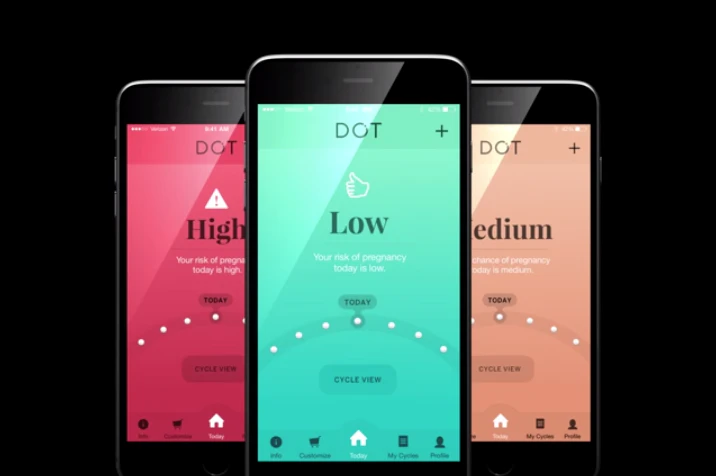
I've been running Simpluna, a period-tracking app, for six years. It's a company based in Tokyo, Japan, but development and operations are basically a one-person effort. The app is built with React Native (Expo). The defining trait of the app is that it's simple, with no unnecessary features. Recording periods, calculating predictions, and sending notifications — that's the core of it. This space is dominated by big players (Flo, Clue, and in Japan, Luna Luna). Building something similar would have been hopeless, so I made the things those apps don't have my selling point. Optional features…
What it does
In the maker’s words, at launch
I've been running Simpluna, a period-tracking app, for six years. It's a company based in Tokyo, Japan, but development and operations are basically a one-person effort. The app is built with React Native (Expo). The defining trait of the app is that it's simple, with no unnecessary features. Recording periods, calculating predictions, and sending notifications — that's the core of it. This space is dominated by big players (Flo, Clue, and in Japan, Luna Luna). Building something similar would have been hopeless, so I made the things those apps don't have my selling point. Optional features beyond the basics are offered as one-time purchases. Most apps in this space use subscriptions, but I didn't want to. Subscriptions make revenue easier, but they're a mechanism that keeps manufacturing reasons not to cancel, and features keep piling up as a result. By staying away from subscriptions, I could keep the app simple — a tool that doesn't intrude on the user's life. With privacy in mind, data is stored locally on the device by default rather than in the cloud. So far, the app has found a solid footing in East Asia — Japan, Korea, Taiwan, and China. It has almost no name recognition in the West or elsewhere, but there is a small number of users in those regions who like it and keep using it. The reality, though: the app is profitable and covers its running costs, but it's not yet at a level that supports a living, so I have no choice but to keep it going alongside other work. I see this as one of the costs of not taking the subscription route. I have two questions. How do you see the difficulty of sustaining an app on one-time purchases alone? I'd love to hear from people who made the same choice, or who gave up and moved to subscriptions. The other: could an app like this be accepted in North America and Europe?
Does the same job
all alternatives →- IMI made a privacy friendly and simple app to track my menstruation2024 · play.google.com · ▲732
Hey HN, after the app I actually used to track my period wanted me to log in and save my data in the cloud, I decided to write my own. Most apps in this area are based on a subscription model and display far too much information anyway. For me, a simple calendar is enough where I can add a few notes if necessary. So that is the result of my work - a simple design and the data is only saved on the smartphone.
- IMI made an app that consolidated 18 apps (doc, sheet, form, site, chat…)2024 · nino.app · ▲810
Nino is a radical approach to solve the app chaos problem for today's knowledge worker. I believe there are still too many tools; even using them becomes work in itself. I'm building all these apps from scratch in one place, using the same database and UI, with the flexibility to eventually support the majority of work from one "superapp." Currently there are 18 apps (called "modules") on Nino: - Database types: Sheet, Form, Calendar, Gallery, Board, Todo, List - Composition types: Doc, Slide, Drive, Notebook, Canvas, Grid, Blog, Site - Communication types: Channel, Chat, Meet I want to…



More growth this month
the category → Browzer▲427
Put your technical content on autopilot Discussion | Link
Growth · 14d ago · producthunt.com
 AstraPixels▲267
A pixel-art solar system at its real current positions.
Growth · 29d ago · astrapixels.com
Launched alongside, August 2026
the whole month →- TL
Life & fun · 10d ago · louisabraham.github.io


- SA
Hello HN! I found that picking out plausible but diverse skin tones for my digital art and game development projects was kind of difficult, and I got curious about if there was a way to define a color space that made it easy. I've built a color picker and procedural generation algorithm based on the space as well as a bunch of other fun js features and demos throughout the page that use the equations. If you find it interesting, I have lots of explanations of how I built it and what properties the space has. The methodology might be a bit shaky, but hopefully the result is as helpful for…
Life & fun · Aug 2026 · toneyalexander.github.io

I trained a 125M-parameter transformer to autocomplete piano performances in real time (~108 notes/sec on an iPhone 15). The idea is basically GitHub Copilot or Tabnine, except instead of prompting it with code, you prompt it by playing a few notes on a MIDI piano. The model then continues what you played, entirely on-device. The app is free if anyone wants to try it. Happy to answer questions about the model, training, Core ML, or the many things that didn't work.
AI · 17d ago · simedw.com