Life & fun · February 28, 2026

Tomoshibi – A writing app where your words fade by firelight
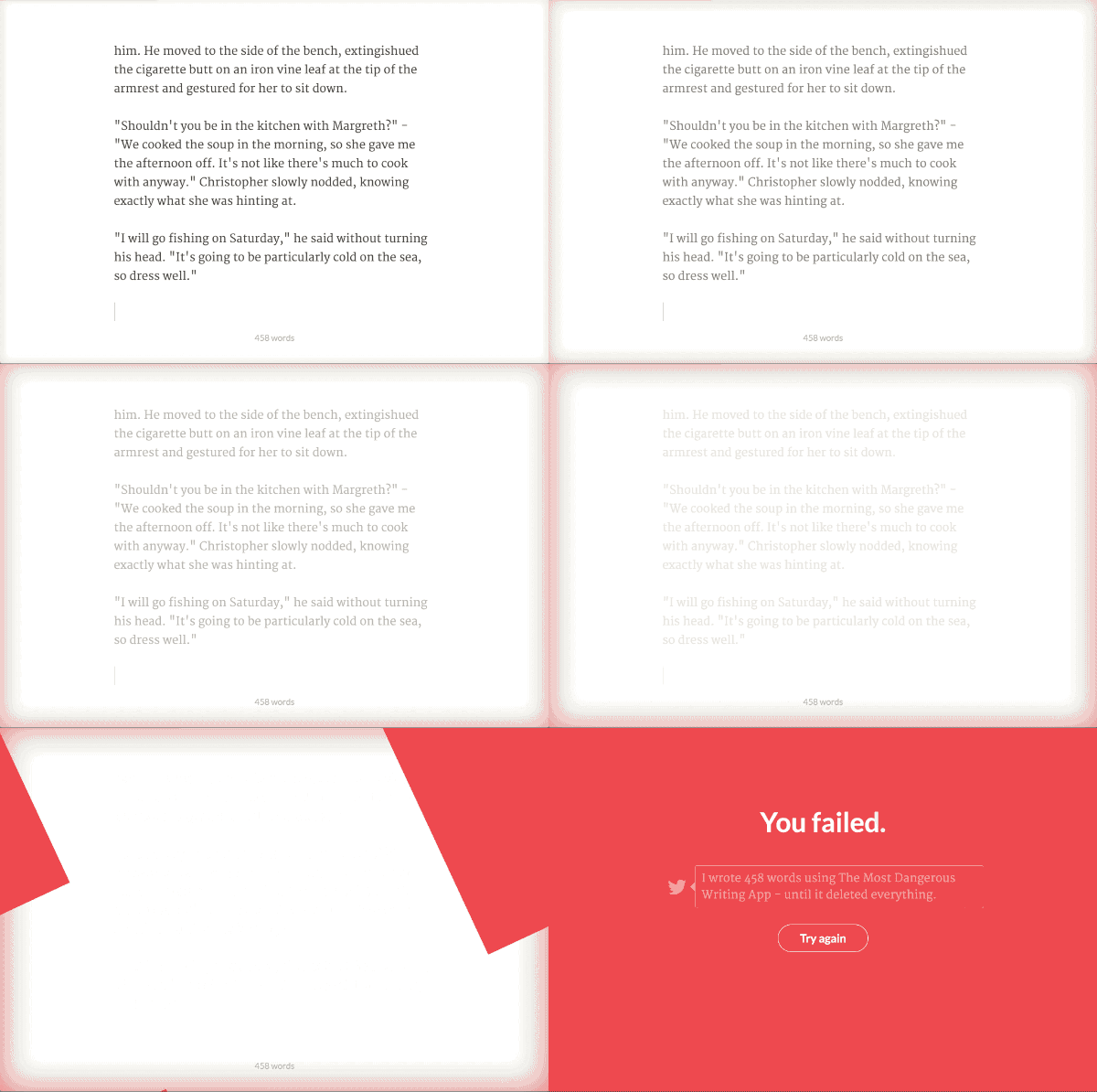
I spent ten years trying to write a novel. Every time I sat down, I'd write a sentence, decide it wasn't good enough, and rewrite it. The problem wasn't discipline — it was that I could always see what I'd written and go back to change it. I tried other approaches. Apps that delete your words when you stop typing — they fight fear with fear. That just made me panic. I wanted the opposite: not punishment, but permission. "Tomoshibi" is Japanese for a small light in the dark — just enough to see what's in front of you. You write on a dark screen. Older lines fade, but not when you hit return.…
Tomoshibi – A writing app where your words fade by firelight launched on February 28, 2026 with 25 votes, #700 of 16,627 launches that month and more than 90% of that year's launches.
In plain words
Tomoshibi is a writing app designed to help writers focus on forward momentum rather than constant revision. It displays text on a dark screen where older lines gradually fade as you write new ones, allowing editing only on the current and previous line. The app targets writers who struggle with perfectionism and endless rewriting, offering permission to write imperfectly rather than imposing punishment-based restrictions.
written from the facts on this page · September 2026
From the sources
書いた言葉が消えていく執筆アプリ。A writing app where your words fade. No account needed. Free on the web, Mac app available.
Open it and there's a dark screen, a small flame. It breathes when you type. No toolbar, no menu. Older lines fade — but not instantly. They wait until you move on. You can still fix a typo. You just can't spiral. Everything is saved. When you come back, your last sentence is waiting. No account. No subscription. Everything is free.from tomoshibi.in-hakumei.com
In the maker’s words, at launch
I spent ten years trying to write a novel. Every time I sat down, I'd write a sentence, decide it wasn't good enough, and rewrite it. The problem wasn't discipline — it was that I could always see what I'd written and go back to change it. I tried other approaches. Apps that delete your words when you stop typing —…
Does a similar job
all alternatives →- AFApp for learning how to write Japanese2012 · kanjibyhand.com. · ▲55
I'm a long time lurker that recently quit my job to work on my own projects, a lot due to the inspiration from Hacker News. Now I have published my first serious project, an app for learning how to write Japanese characters. It's the app I always wanted but couldn't find when I was studying. It tries to be simple to use, you just start the quiz and go with the flow. There's no need to plan and manage your studies, and it uses spaced repetition for better retention. There's a promo page with more details up at http://www.kanjibyhand.com. It's only for Android so far. The free version includes…


- IOIchinichi – One note per day, E2E encrypted, local-firstMar 2026 · ▲136
Look, every journaling app out there wants you to organize things into folders and tags and templates. I just wanted to write something down every day. So I built this. One note per day. That's the whole deal. - Can't edit yesterday. What's done is done. Keeps you from fussing over old entries instead of writing today's. - Year view with dots showing which days you actually wrote. It's a streak chart. Works better than it should. - No signup required. Opens right up, stores everything locally in your browser. Optional cloud sync if you want it - E2E encrypted with AES-GCM, zero-knowledge,…

More life & fun this month
the category →
A free city-building game in your browser. You are the mayor. You know what the city needs. Now get it past the zoning board, the neighbors, the appeals court and the next election.
Life & fun · 3d ago · permit.petercai.com
- IV
Life & fun · 16d ago · tanzaniaeducationproject.org

Turn a phone, tablet or TV into a sign. Type a message and it fills the screen: welcome signs, timers, Wi-Fi passwords and more. No app, no account, free.
Life & fun · 16d ago · bigwords.page

Play a free virtual guitar online with your keyboard or by touch. Slow songs down and see every chord, string and strum. Acoustic, classic, electric and bass.
Life & fun · 10d ago · guitoro.com

Carrier settings from iPhone, Pixel and Galaxy firmware, decoded and compared: APNs, VoLTE, 5G and Wi-Fi Calling per carrier, and what each build changed.
Life & fun · 14d ago · carrierexplode.com

Life & fun · 24d ago · space.bl2.net
Source: Show HN post ↗ · launch text quoted in part
Launched alongside, February 2026
the whole month →


 Lovon AI Therapy▲801
Feel closer and have more fun with your partner every day!
AI · Feb 2026 · lovon.app

Hello my name is Ben Ward for the past 3 years I have been remastering the financial game Wall Street Raider created by Michael Jenkins originally on DOS in 1986. It has been a rough journey but I finally see the light at the end of the tunnel. I just recently redid the website and thought maybe the full story of how this project came to be would interest you all. Thank you for reading.
Work · Feb 2026 · wallstreetraider.com