AI · alternatives · 2026

24 alternatives to Agent Engineering Toolkit
Proof-carrying workflows for coding agents
Below are 24 products that do a similar job, ranked by how close each is in meaning and then by launch-day votes. Prices are shown for the 1 we have checked on their own sites, 1 of them free or with a free tier.
- 1

- 2

Automated Penetration Testing for AI-Built Apps
2021 · replay.io · its alternatives →
- 3
 Replicas▲239
Hey HN! I'm Connor, creator of Replicas. I'm a heavy Codex/Claude Code user, and I wanted to hand off tasks to agents like I would to an engineer - kick something off before work, let it scaffold while I'm at lunch, even come back to a ready PR. The problem: existing alternatives use workspace VMs that are black boxes. I have no access to any of them - they can't run tests, read logs, or use tools like the Playwright MCP (which I use to verify agents actually fixed what they claim to fix). Replicas gives agents real cloud workspaces where they can: - Run your test suite and read the…
Jun 2026 · replicas.dev · its alternatives →
- 4
 Clears▲376
Move beyond AI coding to Agentic Software Delivery
Aug 2026 · clears.ai · its alternatives →
- 5

I use AI agents to build UI features daily. The thing that kept annoying me: the agent writes code but never sees what it actually looks like in the browser. It can’t tell if the layout is broken or if the console is throwing errors. So I built a CLI that lets the agent open a browser, interact with the page, record what happens, and collect any errors. Then it bundles everything — video, screenshots, logs — into a self-contained HTML file I can review in seconds. proofshot start --run "npm run dev" --port 3000 # agent navigates, clicks, takes screenshots proofshot stop It works with…
Mar 2026 · github.com · its alternatives →
- 6

- 7

Hi HN! We’re the team behind Fiddler, and we recently built an Agent Cache feature. It works by capturing an LLM request/response pair and, once caching is enabled, serving subsequent matching calls locally so duplicate requests never hit the provider. It’s meant to reduce three pains that show up together in agent development: token cost, feedback-loop latency, and output non-determinism. We’d love to hear your thoughts.
Aug 2026 · telerik.com · its alternatives →
- 8
 Agen▲138
AI changed the way we code, but we're still using the old processes, and we've become the bottleneck, the AI is waiting for us - to reply, to open our laptops, to review the code, and so on. We're building the future of AI software development. The agents are autonomous, they run in sandboxes, automatically fix the pipelines, and deliver you the final, working code. You can use live preview to see the changes they made. Working across multiple repositories, all within the same session. This is the future - you don't need an IDE, and you don't have to run anything locally.
Mar 2026 · agenhq.com · its alternatives →
- 9

hi guys. been working on something i think is fundamentally missing in today's workflow with ai agents. vcs. i find myself struggling with questions that agents can't answer like "why did you do it?", "when did u delete this folder? why?", etc. or trying to /rewind (after a /compact...) or basically `bisect` to find when and why something was done by the agent in the current / previous session. just like git did for code, i think we are the same core capabilities with ai agents so... i developed an open source solution for that (currently supporting claude code) would love to…
May 2026 · github.com · its alternatives →
- 10

Hey HN! We’ve been building an MCP server to help AI-assisted web app developers by using browser agents to test whether changes made by an AI inside an editor actually work. We've been testing it on scenarios like verifying new flows in a UI, or checking that sending a chat request triggers a response. The idea is to let your coding agent both code and evaluate if what it did was correct. Here’s a short demo with Cursor: https://www.youtube.com/watch?v=_AoQK-bwR0w When building apps, we found the hardest part of AI-assisted coding isn’t the coding—it’s tedious point-and-click…
2025 · github.com · its alternatives →
- 11

Instant recall for coding agents. Search the history already on your machine. Git blame, but for agent sessions.
Apr 2026 · ctx.rs · its alternatives →
- 12

Single-agent LLMs suck at long-running complex tasks. We’ve open-sourced a multi-agent orchestrator that we’ve been using to handle long-running LLM tasks. We found that single LLM agents tend to stall, loop, or generate non-compiling code, so we built a harness for agents to coordinate over shared context while work is in progress. How it works: 1. Orchestrator agent that manages task decomposition 2. Sub-agents for parallel work 3. Subscriptions to task state and progress 4. Real-time sharing of intermediate discoveries between agents We tested this on a Putnam-level math problem, but the…
Feb 2026 · github.com · its alternatives →
- 13

We now write most of our code with agents. For a while, PRs piled up, causing review fatigue, and we had this sinking feeling that standards were slipping. Consistency is tough at this volume. I’m sharing the solution we found, which has become our main product. Continue (https://docs.continue.dev) runs AI checks on every PR. Each check is a source-controlled markdown file in `.continue/checks/` that shows up as a GitHub status check. They run as full agents, not just reading the diff, but able to read/write files, run bash commands, and use a browser. If it finds…
Feb 2026 · docs.continue.dev · its alternatives →
- 14

Tool-agnostic TypeScript library for observing coding agent sessions. Built-in Cursor provider, extensible to Claude Code, Codex, and OpenCode. - vtemian/agentprobe
Mar 2026 · github.com · its alternatives →
- 15

Contribute to vrn21/bouvet.com development by creating an account on GitHub.
Jan 2026 · github.com · its alternatives →
- 16
 Aether▲26
Since coding agents like Claude Code and Codex came out, I've been pretty obsessed with them. It's hard not to when you're getting a 20x discount on inference. I've also been frustrated by them a lot. I hated walking around with my laptop lid open while connected to a hotspot on my phone, having to tediously accept commands so I don't lose my root directory, and running out of RAM when running multiple agents that were spinning up dev servers in different worktrees at once. A lot of people would say existing cloud agents are the solution to this, as none of the above problems apply to any…
Jul 2026 · runaether.dev · its alternatives →
- 17
Deterministic offline release evidence for AI agents
Jul 2026 · iisacc-justmoong.github.io · its alternatives →
- 18AO
I have spent a long time working in an XP/TDD style, so when AI coding tools became useful enough for real work, I adopted them quickly. The first bottleneck I hit was not code generation, it was verification: AI could write code and tests quickly, but I was still the person reviewing implementations, clicking through flows, checking logs, inspecting database state, and deciding whether the result was actually correct. That pushed me to move validation further left. Before implementation, AI had to produce test plans. After implementation, it had to execute those plans too: drive the…
Mar 2026 · its alternatives →
- 19

GitHub - https://github.com/vostride/agent-qa Live Demos - https://vostride.com/demo/agent-qa
May 2026 · vostride.com · its alternatives →
- 20

We built meta-agent: an open-source library that automatically and continuously improves agent harnesses from production traces. Point it at an existing agent, a stream of unlabeled production traces, and a small labeled holdout set. An LLM judge scores unlabeled production traces as they stream. A proposer reads failed traces and writes one targeted harness update at a time, such as changes to prompts, hooks, tools, or subagents. The update is kept only if it improves holdout accuracy. On tau-bench v3 airline, meta-agent improved holdout accuracy from 67% to 87%. We open-sourced meta-agent.…
Apr 2026 · github.com · its alternatives →
- 21

Hi HN, This is a project I've been working on since the beginning of 2025 full time, without funding. Coding agents have fundamentally changed the way we write software. When you let an agent write code, pull dependencies, and run scripts, you are delegating trust while still keeping the responsibility. You shouldn't have to choose between moving fast with agents and maintaining basic control over your host machine. Normally, we just inspect the final result, treating the app like a black box. Most security tools only sandbox the app runtime and ignore the build phase. CapaKit is my attempt…
Jun 2026 · capakit.com · its alternatives →
- 22

Evidence Layer for AI Agent Actions. Contribute to aerf-spec/agentmint-python development by creating an account on GitHub.
Apr 2026 · github.com · its alternatives →
- 23

I’ve been tinkering with what a “multi-agent IDE” should look like if your day-to-day workflow is mostly in terminal (Claude Code, OpenAI Codex, etc.). The more I played with it, the more it collapsed into three fundamentals: * A good TUI: Terminal is the center stage, with other stuff (CodeEdit, Diff, Review) baked on the side. I don’t like piping Agent’s output through some electron wrapper, here you get to run CC/Codex/Droid/Amp/etc directly. * Isolation: agents shouldn’t step on each other’s toes. The simplest primitive I’ve found is Git worktrees. It is not as…
Jan 2026 · agentastic.dev · its alternatives →
- 24
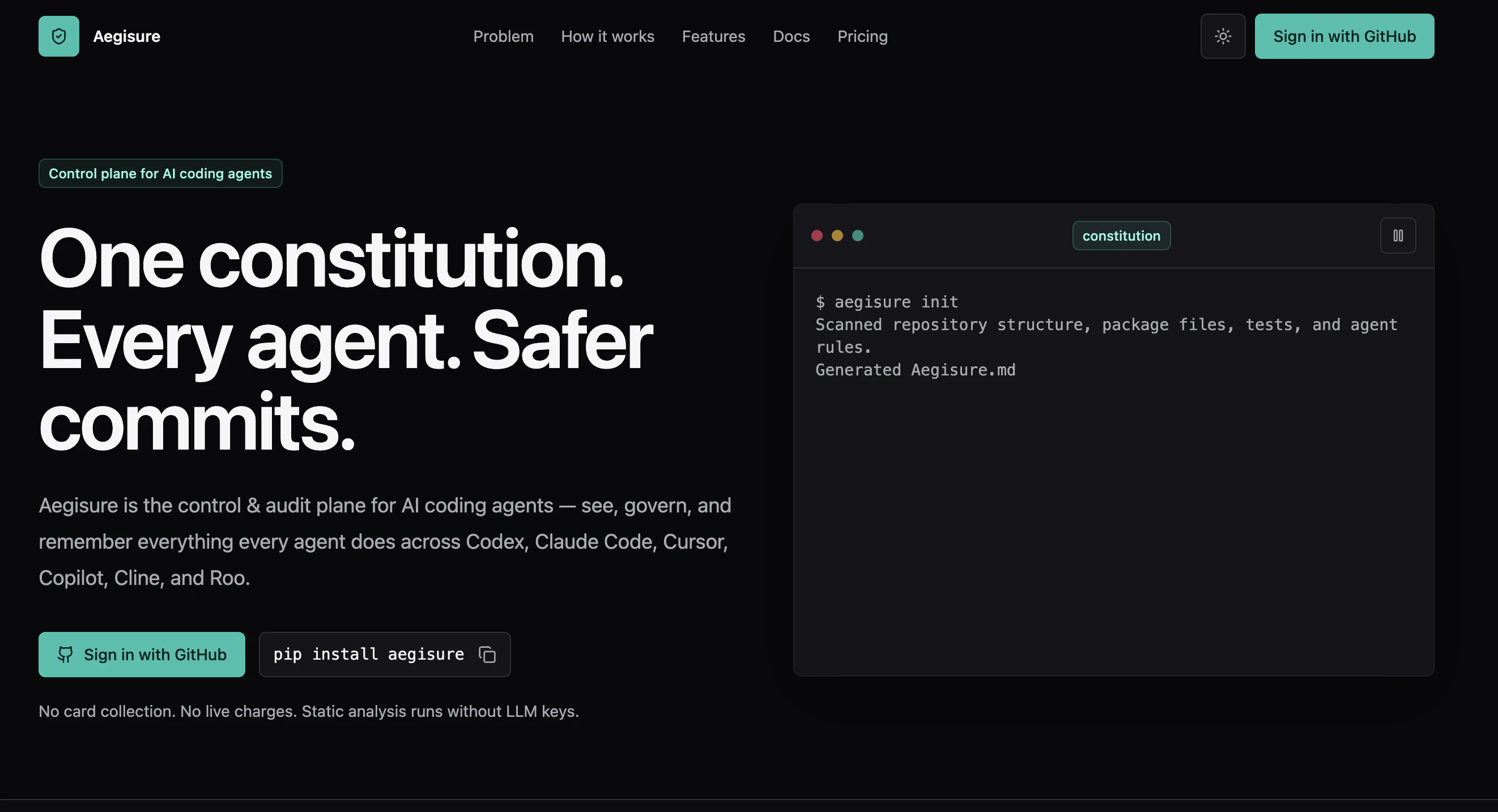 Aegisure▲5
Control & audit layer for your AI coding agents
Jun 2026 · aegisure.dev · its alternatives →
Also compare
Ranked by how close each launch is in meaning, then by votes. Prices were read from each product’s own site when checked and can change. Refine with your own description →